Saturated Steam powers modern industry in ways few other utilities can match. Among all steam types, it remains the most preferred heating medium — valued for its high latent heat content, predictable pressure-temperature relationship, and precise temperature control capability.
Yet even the best-designed steam systems face a fundamental challenge: steam demand is rarely constant. Production cycles, shift patterns, batch processes, and equipment start-ups all cause demand to fluctuate continuously. These variations in boiler load directly affect how Saturated Steam behaves — changing its pressure, temperature, dryness fraction, and moisture content in ways that can seriously impact boiler performance and process efficiency.
This article explains exactly how Saturated Steam responds to varying load conditions, the operational problems that result, and the proven engineering solutions that keep industrial steam systems running at their best.
What is Saturated Steam?
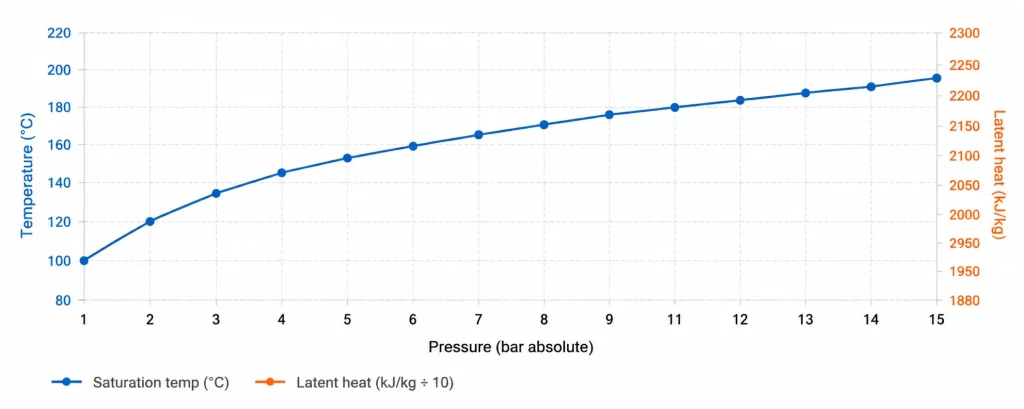
Saturated Steam is water vapour existing in thermodynamic equilibrium with liquid water at a specific pressure and temperature. Its defining characteristic is the direct relationship between pressure and temperature — raise the pressure, and the saturation temperature rises proportionally. At 5 bar absolute, Saturated Steam sits at approximately 151°C; at 10 bar absolute, it rises to around 180°C.
Within Saturated Steam, two important distinctions exist. Dry Saturated Steam is 100% vapour with no suspended water droplets, delivering maximum latent heat upon condensation. Wet steam contains suspended liquid droplets, described by a dryness fraction below 1.0 — a dryness fraction of 0.95 means 5% of the steam mass is liquid water. Unlike superheated steam, which is heated beyond its saturation temperature and used mainly in power turbines, Saturated Steam begins releasing its enormous latent heat immediately upon contact with a heat transfer surface, making it the ideal medium for industrial process heating.
Why Saturated Steam is Widely Used in Industry
Industries across the globe rely on Saturated Steam because it delivers heat at a constant, pressure-controlled temperature, releases very high latent heat upon condensation (approximately 2,000–2,250 kJ/kg depending on pressure), and creates excellent heat transfer coefficients at heat exchanger surfaces. Temperature control is elegantly simple: set the steam pressure, and the process temperature is automatically fixed.
This makes Saturated Steam indispensable in dairy pasteurisation, pharmaceutical sterilisation, textile dyeing, rice parboiling, food retort processing, rubber vulcanisation, chemical reactor heating, paper drying, and dozens of other industrial applications where consistent, controllable heat delivery is non-negotiable.
Understanding Boiler Load Conditions and Steam Demand
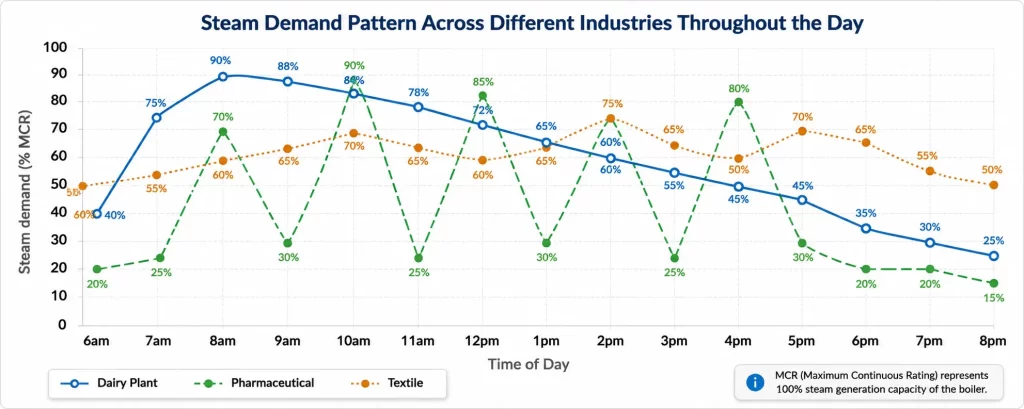
Boiler load is the rate at which Saturated Steam is being demanded, expressed as a percentage of the boiler’s maximum continuous rating (MCR). Industrial steam demand is rarely steady. Dairy plants peak during morning pasteurisation. Pharmaceutical autoclaves demand sharp steam bursts then sit idle. Textile mills shift between dye batches. Rice mills transition between parboiling stages. Each pattern creates distinct load conditions that stress the boiler and the steam distribution system differently.
Under low load, steam pressure is stable and dryness fraction is high, but boiler efficiency often falls due to proportionally larger heat losses and cycling. Under medium load — typically 50–80% MCR — most well-designed boilers operate at peak efficiency with consistent Saturated Steam quality. Under high load or sudden demand surges, pressure drops, the water-steam interface in the boiler drum becomes turbulent, and moisture carryover into the distribution system becomes a serious risk.
Sudden load changes are the hardest to manage. When a large autoclave valve opens instantly, or multiple steam consumers come online simultaneously, the boiler drum experiences an immediate pressure drop. This triggers the swell effect — bulk boiling throughout the drum water creates a false high level reading, potentially confusing feedwater controls precisely when accurate control matters most.
Thermodynamic Behaviour of Saturated Steam Under Load Variations
When steam demand increases and boiler pressure drops, the saturation temperature falls with it — Saturated Steam arriving at process equipment is cooler than required. The dryness fraction also drops: under high load or sudden surges, it can fall from an ideal 0.98+ down to 0.90 or lower, meaning 10% of the steam mass is liquid water. This wet steam delivers significantly less heat per kilogram, disrupts process temperatures, erodes valves and pipework, and overwhelms steam traps with excess condensate.
Moisture carryover — the entrainment of water droplets from the boiler drum into the steam main — is the primary Saturated Steam quality failure mode under high load. It occurs when steam velocity at the drum water surface becomes high enough to lift droplets into the outgoing steam flow. High TDS (Total Dissolved Solids) in boiler water worsens this by promoting foaming. The consequences cascade through the entire production system.
Common Industrial Problems from Poor Saturated Steam Quality
Wet steam and pressure instability create a chain of operational problems across industries. Water hammer — violent pressure shocks caused by liquid slugs decelerating in steam pipework — can fracture pipes and damage valve bodies. In food retort sterilisation, Saturated Steam pressure drops during the hold phase reduce sterilisation temperature below the validated F0 value, causing batch rejection. In pharmaceutical autoclaves, wet steam fails EN 285 dryness fraction requirements, triggering costly sterilisation cycle failures.
In dairy processing, fluctuating steam temperatures activate automatic milk divert valves, forcing reprocessing. In textile dyeing, wet steam causes uneven colour uptake and fabric damage. In rice parboiling, uneven heat penetration from inconsistent Saturated Steam increases grain breakage during milling, directly reducing yield and revenue. Across all industries, wet steam increases fuel consumption — even a 2% increase in moisture content can raise fuel use by 3–5% for the same process output.
Engineering Solutions to Maintain Stable Saturated Steam Quality
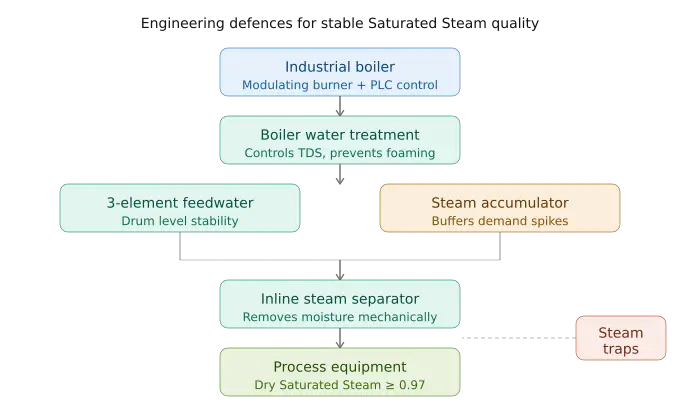
Modern industrial boilers incorporate multiple layers of engineering defence to protect Saturated Steam quality under varying loads.
Correct boiler sizing is the starting point. A detailed steam demand analysis covering peak loads, average loads, and rate-of-change is essential. Oversized boilers cycle inefficiently at low loads; undersized ones cannot meet peak demand without pressure drop and wet steam formation.
Steam accumulators store energy as hot pressurised water and release it as Saturated Steam during demand peaks, allowing smaller boilers to meet high cyclic demands reliably — particularly valuable in bakeries, breweries, and rubber plants.
Inline steam separators installed in the steam main remove residual moisture mechanically, increasing dryness fraction to above 0.997 even if the boiler produces slightly wet steam under peak load.
Boiler water treatment controls TDS through chemical dosing and blowdown, preventing foaming at the water surface — the leading cause of moisture carryover. Blowdown heat recovery minimises the energy penalty.
Three-element feedwater control, monitoring steam flow, drum level, and feedwater flow simultaneously, provides far more responsive drum level control than single-element systems, reducing level swings during load surges.
Fully modulating burners with PLC automation allow modern boilers to match heat input to Saturated Steam demand in real time, minimising pressure fluctuations across the entire load range.
Systematic steam trap maintenance using ultrasonic and infrared tools identifies failed traps before they cause live steam blowthrough or condensate flooding in process equipment.
Role of Boiler Design in Handling Variable Loads
Fire tube boilers provide natural thermal buffering through their large water volumes but respond slowly to sustained load increases. Water tube boilers offer faster response and higher output capacity with less inherent buffering. Coil type boilers respond fastest to load changes but depend entirely on their controls to match Saturated Steam generation to demand in real time. For highly variable industrial loads, the most effective approach is a modern water tube or hybrid boiler paired with a steam accumulator, fully modulating burner controls, and comprehensive steam system monitoring.
Conclusion
Saturated Steam will remain the dominant industrial heating medium for the foreseeable future. But maintaining its quality under the varying load conditions of real industrial operation demands a thorough understanding of its thermodynamic behaviour, a well-engineered steam system, and disciplined operational practices.
Wet steam, pressure instability, and moisture carryover are not inevitable — they are preventable through correct boiler sizing, steam accumulators, separators, rigorous water treatment, effective controls, and systematic maintenance. Selecting the right industrial boiler and maintaining it to the highest standard is the foundation on which consistent Saturated Steam quality, process efficiency, and industrial productivity are built.
Key Takeaways
- Saturated Steam temperature and quality are directly governed by pressure — any pressure change from load variation immediately affects process performance.
- High boiler loads and sudden demand surges are the primary causes of wet steam, moisture carryover, and dryness fraction degradation.
- Industries with cyclic or variable steam demands — dairy, pharma, food, textiles, rice mills, chemicals — are most at risk from Saturated Steam quality fluctuations.
- Steam accumulators, inline separators, correct boiler sizing, and rigorous water treatment are the most effective engineering defences against load-related steam quality problems.
- Modern modulating burners, three-element feedwater control, and PLC automation enable boilers to maintain consistent Saturated Steam quality across the full load range.
- Systematic steam trap maintenance and condensate recovery are essential for energy efficiency and long-term steam system reliability.
(FAQs) About Saturated Steam Under Varying Load Conditions
Saturated Steam is steam that exists in equilibrium with water at a specific pressure and temperature. Any change in pressure directly changes the steam temperature, making it ideal for industrial heating applications requiring precise temperature control.
Saturated Steam offers excellent heat transfer efficiency, high latent heat content, easy temperature control through pressure adjustment, and consistent heating performance. It is commonly used in food processing, pharmaceuticals, textiles, dairy, chemicals, paper, and rice mills.
Changes in steam demand can cause pressure fluctuations, lower dryness fraction, increased moisture content, and unstable steam temperatures. These changes can negatively impact process efficiency and product quality.
Boiler load refers to the amount of steam being generated relative to the boiler’s maximum rated capacity. It is usually expressed as a percentage of the boiler’s Maximum Continuous Rating (MCR).
A sudden increase in steam demand can cause a rapid pressure drop inside the boiler, leading to lower saturation temperatures, reduced steam quality, and an increased risk of moisture carryover.
Wet steam contains suspended water droplets mixed with steam. It delivers less usable heat, increases fuel consumption, damages valves and pipelines, causes water hammer, and reduces overall process efficiency.
For most industrial applications, a dryness fraction above 0.95 is considered acceptable, while critical processes such as pharmaceutical sterilization often require dryness fractions above 0.97.
Wet steam can cause inconsistent heating, product quality issues, equipment erosion, increased condensate formation, steam trap overload, and higher maintenance costs across industrial facilities.
Moisture carryover occurs when water droplets are carried from the boiler drum into the steam distribution system. It is commonly caused by high steam velocities, sudden load changes, and poor boiler water quality.
Industries such as dairy processing, pharmaceuticals, food manufacturing, textile dyeing, rice milling, paper production, and chemical processing are highly sensitive to Saturated Steam quality variations.
Latent heat is the hidden energy stored in steam that is released when steam condenses, making steam one of the most efficient heat transfer media used in industries such as food processing, pharmaceuticals, textiles, chemicals, and rice mills.
Q=mL
Where:
- Q = Heat energy absorbed or released (kJ)
- m = Mass of the substance (kg)
- L = Specific latent heat (kJ/kg)
Superheated steam is steam that has been heated beyond its saturation temperature at a given pressure. Unlike saturated steam, superheated steam contains additional heat energy and does not contain moisture.
For example, at 10 bar pressure, saturated steam has a temperature of approximately 180°C. If this steam is further heated to 250°C while maintaining the same pressure, it becomes superheated steam.