Every boiler operator knows the sinking feeling of a sluggish startup — steam pressure refusing to climb, uneven heating across distribution lines, and that nagging uncertainty about what is happening inside the system. More often than not, the culprit is something invisible: trapped air.
Air is the silent enemy of a steam boiler. It gets locked inside headers, pipelines, and heat exchangers during every shutdown, and unless it is properly removed before steam generation begins, it causes a cascade of problems — from poor heat transfer and pressure fluctuations to accelerated corrosion. The tool designed specifically to solve this problem is the air vent valve.
If you manage an industrial steam system and you are not paying close attention to these devices, you are almost certainly losing efficiency and shortening equipment life. This article explains everything you need to know.
What Is an Air Vent Valve?
An air vent valve — also called a thermostatic air vent or automatic air eliminator — is a device installed in steam systems to automatically release trapped air and other non-condensable gases from pipelines, heat exchangers, steam headers, and process equipment.
Unlike a manual bleed valve that requires an operator to open and close it, a thermostatic air vent valve works automatically. It opens when it senses air or cold gases and closes when steam arrives, making it an essential component of any well-designed steam distribution system.
Typical installation points include:
- The top of steam headers and main distribution lines
- Heat exchangers and shell-and-tube units
- Steam coils and radiators
- High points in steam pipework where air tends to collect
- Jacketed vessels and process equipment
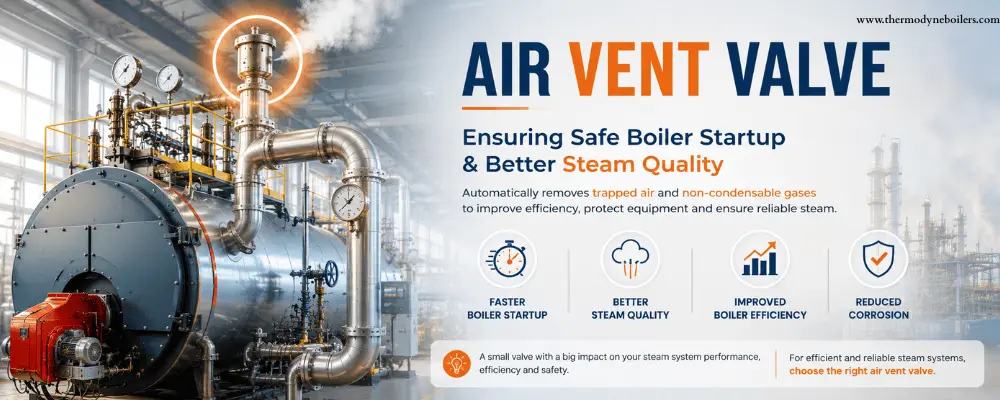
A Steam boiler air vent valve is specifically fitted at the steam outlet or top of the boiler shell to purge air during the initial startup phase.
Why Air Removal Is Critical in Steam Boilers
It may seem harmless, but trapped air inside an industrial steam boiler or distribution system creates serious operational and safety challenges.
Air Pockets Disrupt Steam Flow
Air does not mix with steam — it sits as a pocket and blocks steam flow. In a distribution system, air pockets create dead zones where no heating occurs. Production lines that depend on consistent process temperatures suffer as a result.
Reduced Heat Transfer Efficiency
Air is a poor thermal conductor. When air is trapped against a heat exchange surface, it acts as an insulating layer. Even a thin film of non-condensable gases can drop heat transfer rates by 20–30% in some industrial applications. You burn more fuel and get less heat.
Corrosion and Oxygen Attack
Air carries oxygen. Inside a hot, wet steam environment, oxygen reacts aggressively with carbon steel pipework and boiler internals. This accelerates pitting corrosion and can cause premature tube failures. Regular air removal is, therefore, also a boiler maintenance priority.
Uneven Steam Distribution
When air occupies parts of a steam distribution system, it prevents steam from reaching all areas uniformly. In a factory with multiple process points drawing from one steam header, some users will receive adequate steam while others starve — causing inconsistent output quality.
Energy Losses and Pressure Build-Up
Trapped air forces the boiler to work harder to maintain pressure. The steam system efficiency drops, fuel consumption rises, and pressure build-up can become erratic. Over time, this stresses safety valves and control systems unnecessarily.
How an Air Vent Valve Works
The operating principle of a thermostatic air vent valve is elegantly simple. It relies on the temperature difference between air/non-condensable gases and steam.
Step-by-step working:
- During boiler startup, the system is filled with cold air. The valve is in the open position because its thermostatic element — typically a bimetallic strip or liquid-filled bellows — is contracted in the cold state.
- As the boiler fires and temperature rises, air is pushed toward the high points of the system. The open valve allows this air to escape freely into the atmosphere or, in closed systems, into a condensate return line.
- As steam reaches the valve, the rising temperature causes the thermostatic element to expand. This expansion closes the valve seat, preventing live steam from escaping.
- During operation, if non-condensable gases accumulate again — which can happen over time as dissolved gases come out of solution — the valve opens briefly to vent them and then closes again.
- On shutdown, as the system cools, the valve reopens to admit air, which is necessary to prevent a vacuum from forming and to prepare the system for the next startup.
This automatic open-close cycle happens without any manual intervention, which is what makes the air vent valve indispensable in modern industrial steam systems.
Benefits of Installing an Air Vent Valve
A properly selected and installed steam air vent valve delivers measurable improvements across the board.
Faster, Safer Boiler Startup
Without effective air venting, startup can drag on as the boiler struggles to displace air and build pressure. With these valves in place, air is expelled rapidly, and the system reaches operating pressure faster. This saves time and reduces the risk of thermal shock from uneven heating.
Better Steam Quality
Dry, saturated steam is what most industrial processes need. Air contamination reduces steam quality and introduces non-condensable gases that lower the effective steam temperature at any given pressure. Removing air improves steam quality and delivers more consistent process results.
Improved Boiler Efficiency
With air removed, heat transfer surfaces work at their design efficiency. The boiler does not need to compensate for insulating air layers, which means less fuel is consumed per unit of heat delivered.
Reduced Corrosion
Less oxygen in the system means significantly slower corrosion. Boiler tubes, headers, and pipework last longer. Maintenance intervals can be extended, and unplanned failures become less frequent.
Lower Fuel Consumption
Improved heat transfer and faster startup directly translate to lower fuel consumption. In a large industrial steam boiler running continuously, this saving can be substantial over a year of operation.
Longer Equipment Life
Reduced corrosion, lower thermal stress during startup, and more stable operating conditions all extend the service life of the boiler and the entire steam distribution system — including heat exchangers, control valves, and steam traps.
Stable Steam Pressure
A system free of trapped air maintains consistent pressure throughout. Control systems perform better, safety valves are not unnecessarily cycled, and process temperatures remain stable.
Air Vent Valve vs Steam Trap: Understanding the Difference
Many engineers — especially those newer to steam systems — confuse air vent valves with steam traps. They are related components but serve fundamentally different purposes.
| Feature | Air Vent Valve | Steam Trap |
|---|---|---|
Primary function |
Removes trapped air and non-condensable gases |
Removes condensate (water) from steam lines |
When it operates |
Mainly during startup; also during operation if gases accumulate |
Continuously during normal operation |
What it handles |
Air, CO₂, and other non-condensable gases |
Liquid condensate |
Operating trigger |
Temperature differential (air is cooler than steam) |
Temperature, pressure, or density differential |
Installation location |
High points in pipework, steam headers, heat exchangers |
Low points, steam traps on process equipment |
Common types |
Thermostatic (bimetallic or bellows) |
Float, thermodynamic, thermostatic, inverted bucket |
In practice, a well-designed steam system uses both. Steam traps handle the continuous job of draining condensate during operation, while air vent valves take care of gas removal during startup and whenever non-condensable gases accumulate. Relying on a steam trap alone to vent air is a common mistake — most traps are not designed for rapid air venting and will slow down startup considerably.
📚 Related Guide
Understanding Steam Traps is Just as Important as Air Vent Valves
While an air vent valve removes trapped air and non-condensable gases during boiler startup, a steam trap continuously removes condensate without allowing valuable steam to escape. Together, these two components play a critical role in improving steam quality, enhancing boiler efficiency, and ensuring reliable steam system performance.
📖 Read More: A Complete Guide to Steam Traps →Best Practices for Air Vent Valve Installation and Maintenance
Getting the most from your air vent valves requires attention at the installation stage and ongoing discipline in maintenance.
Installation
- Install at the highest points — air naturally rises, so valves placed at high points in headers and branch lines will capture it most effectively.
- Use the correct valve rating — select a valve rated for the maximum working pressure and temperature of your steam system. Undersized valves will not vent quickly enough.
- Ensure free drainage — the valve outlet should be piped to a safe discharge point. In closed systems, route the outlet to the condensate return.
- Avoid common mistakes — do not install them at low points, do not use them as substitutes for steam traps, and never block the outlet.
Inspection
- Check for steam leakage — a valve that continuously blows steam has failed in the open position. This wastes energy and indicates the thermostatic element has failed.
- Check for blocked vents — a valve that never opens during startup may be stuck closed. Air will remain trapped, and startup will be slow.
- Listen and observe — during boiler startup, listen for the hiss of air venting at each valve location. Silence when you expect venting often points to a failed or blocked valve.
Preventive Maintenance
- Inspect all units at every planned shutdown.
- Replace thermostatic elements on a scheduled basis based on the manufacturer’s recommendation, typically every two to three years under normal conditions.
- Keep spare valves in stock for critical locations — a failed air vent valve on a major steam header can affect production for an entire shift.
Common Mistakes to Avoid
- Installing valves in the wrong orientation
- Using general-purpose valves not rated for steam service
- Ignoring failed-open valves because “it still works”
- Skipping proper air venting devices entirely on new system installations to cut costs
Conclusion
The air vent valve is a small component with a large impact on boiler safety, steam quality, and system efficiency. It solves a problem that every steam system faces at startup — and it does so automatically, without operator intervention, every single time.
When these valves are properly installed, maintained, and replaced when needed, the results are clear: faster startups, dryer and higher-quality steam, lower fuel bills, reduced corrosion, and longer equipment life.
For plant managers and maintenance engineers responsible for industrial steam systems, making the air vent valve a regular part of the boiler maintenance schedule is one of the most cost-effective reliability decisions you can make.
Inspect your air vent valves at the next planned shutdown. If they have not been replaced in the last few years, replace them. Your steam system — and your fuel budget — will thank you.
🔗 Learn Another Important Boiler Spare
Steam Stop Valve – The Key to Safe Steam Isolation Without Energy Loss
An air vent valve removes trapped air during boiler startup, while a steam stop valve safely controls and isolates the steam supply without unnecessary steam loss. Understanding the function of both valves helps improve boiler safety, steam system reliability, and overall plant efficiency.
📖 Read More About Steam Stop Valve →Frequently Asked Questions (FAQs)
An air vent valve is an automatic device installed in steam systems to discharge trapped air and non-condensable gases from pipework, headers, and heat exchangers. It opens when it detects air or cool gases and closes automatically when steam arrives, ensuring the system operates free of air pockets.
It works on the principle of temperature differential. A thermostatic element inside the valve — typically a bimetallic strip or liquid-filled bellows — contracts in the presence of cool air, holding the valve open to allow venting. When steam reaches the valve and the temperature rises, the element expands and closes the valve seat, preventing steam loss.
Trapped air reduces heat transfer efficiency, causes uneven steam distribution, accelerates corrosion by introducing oxygen, and slows boiler startup. An air vent valve for boiler applications removes this air automatically, improving steam quality, boiler efficiency, and overall steam system safety.
A steam trap removes liquid condensate from a steam system during normal operation. An air vent valve removes gaseous air and non-condensable gases, primarily during startup and whenever gases accumulate. Both are necessary for a fully functional steam system — they perform complementary, not interchangeable, functions.
Air vent valves should be inspected at every planned maintenance shutdown — at a minimum, annually. Thermostatic elements should be replaced on a schedule recommended by the manufacturer, typically every two to three years. In systems with high cycle rates or aggressive water chemistry, more frequent inspection and replacement may be necessary.