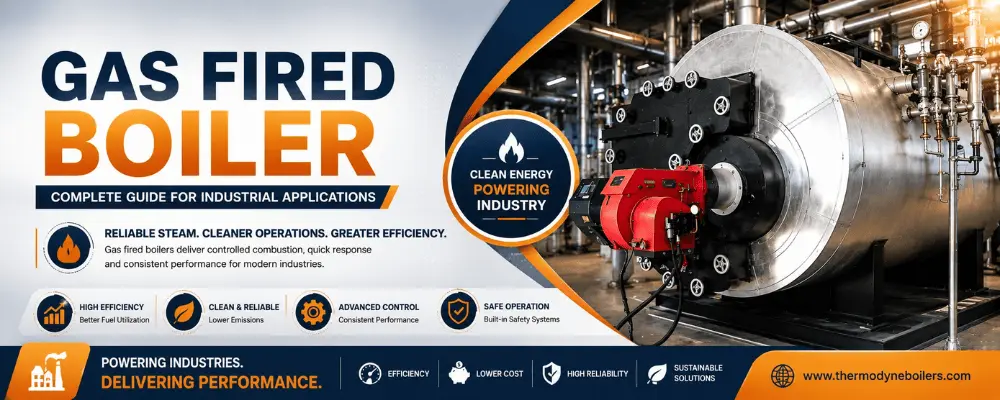
Manufacturing plants depend on a steady, well-controlled supply of steam to keep production lines running. Whether it’s cooking, sterilizing, drying, or process heating, an interruption in steam supply can stall an entire shift. This is why so many plant managers evaluating new steam-generation equipment look closely at the gas fired boiler — a system valued for its controllable combustion, quick load response, and comparatively simple operation. This guide covers how these systems work, what affects their performance, and how to choose one for an industrial application.
Explore our Oil & Gas Fired Boiler – Savemax for efficient, reliable and flexible industrial steam generation.
View Product →What Is a Gas Fired Boiler?
A gas fired boiler is a pressure vessel that burns natural gas or another gaseous fuel to generate heat, which is then transferred to water to produce steam or hot water for industrial use. The fuel is metered and mixed with combustion air at the burner, then ignited inside a combustion chamber.
The heat released travels through the boiler’s heat-transfer surfaces — tubes or shell passages — and raises the temperature of the surrounding water until it converts to steam at the operating pressure. This is the basic principle behind every gas steam boiler, regardless of size or manufacturer.
A natural gas boiler differs from a solid-fuel unit in a fundamental way: fuel delivery is continuous and controlled through a gas train rather than manually fed or stoked. There’s no ash to remove, no fuel stockpile to manage, and combustion parameters can be adjusted almost instantly. This makes an industrial gas boiler easier to automate and generally faster to bring online than a coal- or biomass-fired system.
Gas fired boilers are common wherever a plant needs steam that is both clean-burning and responsive to changing loads — food and beverage plants, pharmaceutical facilities, textile mills, and chemical processing units, among others.
How Does a Gas Fired Boiler Work?
The operating sequence follows a consistent path from fuel intake to steam delivery:
- Gas supply — Natural gas enters through a regulated gas train that controls pressure and flow to the burner.
- Burner operation — The burner ignites the incoming fuel, typically using an electronic ignition system.
- Air-fuel mixing — Combustion air blends with the gas in ratios set by the burner’s control logic.
- Combustion — The mixture burns inside the combustion chamber, releasing thermal energy.
- Heat transfer — Hot flue gases pass across heat-transfer surfaces, giving up energy to the water.
- Water heating — The water absorbs this heat and rises toward saturation temperature.
- Steam generation — Once saturation temperature is reached at the operating pressure, steam separates from the water.
- Flue gas discharge — Cooled combustion gases exit through the flue and chimney.
- Steam supply — Steam is routed through the distribution network to the process equipment that needs it.
The burner governs how much fuel and air enter the system, the combustion chamber contains the flame safely, the heat-transfer surfaces determine how efficiently energy moves into the water, and the control and safety systems keep the entire sequence within safe operating limits.
Main Components of a Gas Fired Boiler System
- Burner — Mixes gas and air in the correct proportion and ignites it. Burner turndown range and firing-rate control directly affect how well the boiler tracks fluctuating steam demand.
- Combustion chamber/furnace — The enclosed space where combustion occurs. Its geometry influences flame shape, stability, and how evenly heat is distributed to the surrounding surfaces.
- Boiler shell or heat-transfer surfaces — Tubes or shell sections through which flue gases pass, transferring heat into the water. The number of gas passes affects how much heat is recovered before exhaust leaves the boiler.
- Control system — Monitors steam pressure or water temperature and adjusts the burner’s firing rate accordingly. It also manages safety interlocks tied to water level, pressure, and flame status.
- Feedwater system — Supplies treated water to replace steam that leaves the system, typically through a feedwater pump and control valve.
- Steam and water circulation system — Manages the separation of steam from water in a steam boiler, or circulates heated water through the distribution loop in a hot water boiler.
- Safety valves and instrumentation — Set of safety valves, water level gauges, and pressure gauges that protect the system and give operators visibility into boiler condition.
- Flue gas exhaust system — Directs combustion byproducts out through the chimney, often after passing through heat-recovery equipment.
- Economizer, where applicable — Recovers residual heat from flue gases to preheat incoming feedwater, reducing the fuel needed to bring water to steam temperature.
Types of Gas Fired Boilers
Fire Tube Gas Fired Boiler
In this design, hot combustion gases pass through tubes submerged in water. Fire tube boilers are widely used in small to mid-capacity industrial applications because of their compact construction and relatively simple maintenance. A firetube boiler is a type of packaged gas fired boiler that arrives factory-assembled with the burner, controls, and major components pre-installed as a single unit. This reduces on-site installation work and shortens commissioning time compared with field-erected systems.
Water Tube Gas Fired Boiler
Here, water flows inside the tubes while hot gases surround them. Water tube designs generally suit higher-pressure and higher-capacity requirements, where fire tube construction becomes less practical.
Key Benefits of Gas Fired Boilers
- Cleaner combustion compared with many solid fuels, since there’s no ash or particulate residue to manage
- Precise burner control over the air-fuel mixture
- Good operational efficiency when properly tuned and maintained
- Faster response to changing steam demand
- Straightforward integration with automated control systems
- No fuel stockpiling or ash disposal requirements
- Consistent steam output under stable operating conditions
- Lower routine cleaning requirements than solid-fuel systems
These advantages make an industrial gas fired boiler a practical fit for operations that need dependable, well-controlled steam without the fuel-handling burden of solid-fuel alternatives.
Gas Fired Boiler Efficiency
Several variables influence gas fired boiler efficiency:
- Burner performance and calibration
- Air-fuel ratio control
- Excess air levels
- Flue gas exit temperature
- Effectiveness of the heat-transfer surfaces
- Feedwater temperature entering the boiler
- Blowdown frequency
- Condition of insulation on the shell and piping
- How closely the boiler operates to its rated load
- Water quality and scale buildup
- Consistency of preventive maintenance
Improving efficiency typically starts with combustion tuning — keeping excess air at an appropriate level for the burner and load. Recovering heat through an economizer, minimizing blowdown losses, and maintaining insulation also contribute. It’s worth separating boiler efficiency, which describes how well the unit converts fuel energy into usable steam, from overall fuel savings, which depend on plant load patterns, operating hours, and how consistently the boiler runs near its optimal load point.
Industrial Applications of Gas Fired Boilers
- Food processing — steam for cooking, blanching, and equipment cleaning
- Dairy — pasteurization and evaporation processes
- Textile — dyeing, drying, and fabric finishing
- Pharmaceutical — sterilization and controlled process heating
- Chemical — process heating and reaction temperature control
- Paper — drying sections in the paper-making process
- Rice mills — parboiling operations
- Breweries — mashing and wort boiling
- Distilleries — heating and distillation processes
- Packaging — steam for sterilization and equipment sanitation
- General manufacturing — space heating and various process-heating needs
Steam requirements vary widely across these sectors, but the underlying need is the same: a dependable industrial steam boiler that can hold pressure and respond to load changes without compromising product quality.
How to Choose the Right Gas Fired Boiler for Your Industry
- Required steam capacity — matched to peak, not just average, demand
- Operating pressure — determined by downstream process requirements
- Steam demand pattern — steady load versus frequent fluctuations
- Fuel availability and gas pressure — confirm adequate supply at the site
- Boiler efficiency — evaluated against realistic operating conditions
- Burner configuration — turndown range suited to load variability
- Automation requirements — level of monitoring and control needed
- Installation space — footprint, clearances, and stack routing
- Water quality — feedwater treatment needs based on local water conditions
- Safety requirements — interlocks, relief devices, and code compliance
- Maintenance requirements — accessibility for inspection and servicing
- Availability of technical support — from the chosen gas fired boiler manufacturer
- Lifecycle operating cost — not just upfront price, but long-term running cost
Working through this list before finalizing a specification helps avoid undersizing or oversizing the unit, both of which affect efficiency and reliability.
Gas Fired Boiler Maintenance
- Regular burner inspection and combustion tuning
- Gas train inspection for leaks and correct regulation
- Cleaning heat-transfer surfaces to prevent fouling
- Monitoring flue gas temperature and composition
- Inspecting safety devices, relief valves, and interlocks
- Maintaining proper water treatment to control scale and corrosion
- Checking instrumentation calibration
- Routine leak inspection across gas and steam lines
- Following a structured preventive maintenance schedule
Consistent maintenance keeps combustion parameters within their intended range, which supports both efficiency and safe operation over the boiler’s service life.
Conclusion
Choosing the right Gas Fired Boiler comes down to matching steam demand, operating pressure, and fuel availability with the right combination of efficiency, safety, automation, and lifecycle cost. None of these factors work in isolation — a boiler sized correctly but poorly maintained, or an efficient unit without adequate safety controls, will still fall short of what a plant needs.
Beyond the equipment specification itself, the manufacturer’s engineering expertise, ability to customize the system for your process, and reliability of after-sales support all play a meaningful role in how well the boiler performs over years of operation. Evaluating these factors alongside the technical specification gives industrial buyers a more complete basis for their decision.
FAQs – Gas Fired Boiler
A gas fired boiler is an industrial steam or hot water generation system that uses natural gas or other gaseous fuels as the primary fuel. It burns gas in a controlled combustion chamber and transfers the generated heat to water to produce steam or hot water.
A gas fired boiler works by supplying regulated gas and combustion air to a burner. The fuel is ignited, and the resulting heat is transferred through heat-transfer surfaces to water. The heated water produces steam, which is then supplied to industrial processes.
Key benefits include cleaner combustion, precise fuel control, fast response to changing steam demand, easy automation, consistent steam generation, reduced ash handling, and lower routine cleaning requirements compared with many solid-fuel boilers.
Gas fired boilers are widely used in food processing, dairy, pharmaceutical, textile, chemical, paper, rice milling, breweries, distilleries, packaging, and general manufacturing industries where reliable and controllable steam is required.
In a fire tube boiler, hot combustion gases flow through tubes surrounded by water. In a water tube boiler, water flows inside the tubes while hot gases pass around them. Fire tube boilers are commonly used for small to medium capacities, while water tube boilers are generally suitable for higher capacities and pressures.
Gas fired boiler efficiency depends on factors such as burner performance, air-fuel ratio, excess air, feedwater temperature, heat-transfer condition, flue gas temperature, operating load, water quality, and maintenance. Proper combustion tuning and heat recovery can significantly improve performance.
Efficiency can be improved through regular burner tuning, proper air-fuel ratio control, economizer installation, maintaining clean heat-transfer surfaces, reducing unnecessary blowdown, improving feedwater temperature, maintaining insulation, and operating the boiler close to its optimum load.
Selection should consider required steam capacity, operating pressure, steam demand pattern, gas availability and pressure, desired efficiency, burner turndown range, automation requirements, available installation space, water quality, safety requirements, maintenance needs, and lifecycle operating costs.
Regular maintenance includes burner inspection and tuning, gas train leak checks, heat-transfer surface cleaning, flue gas monitoring, safety valve and interlock inspection, water treatment, instrumentation calibration, steam and gas-line leak inspection, and preventive maintenance.
An industrial gas fired boiler is a practical choice when a plant requires reliable, responsive, and easily controlled steam generation. It offers automated combustion control, consistent output, quick load response, and reduced fuel-handling requirements, making it suitable for many modern industrial processes.