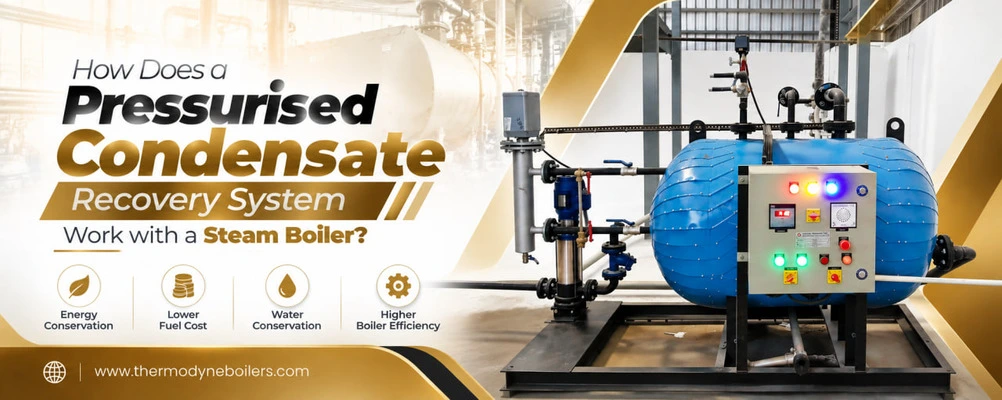
Hot condensate is far too valuable to waste. It is treated water that has already absorbed a significant amount of thermal energy from the steam boiler. If this condensate is discharged to drain, the plant loses not only heat but also the money spent on water, chemical treatment and fuel.
A Pressurised Condensate Recovery System captures this hot condensate in a closed circuit and returns it to the boiler feedwater system. By retaining the heat already present in the condensate, the system can reduce the energy required to produce steam and improve overall steam system efficiency.
This article explains how a pressurised condensate recovery system works with an industrial steam boiler and why it can be an important part of an efficient steam system.
What is a Pressurised Condensate Recovery System?
A pressurised condensate recovery system is a closed-loop arrangement designed to collect condensate from steam-consuming equipment and return it to the boiler house while maintaining pressure above atmospheric conditions. It is also commonly referred to as a pressurised condensate return system.
The primary purpose is not to generate additional steam. Instead, the system recovers the hot, treated water and the sensible heat contained in it so that both can be reused during steam generation.
The basic terms are:
- Condensate: Water produced when steam transfers its heat to a process and changes back into liquid.
- Atmospheric condensate recovery: Condensate is discharged into a vented receiver, where pressure falls to atmospheric pressure. This limits the condensate temperature and allows flash steam to escape unless separately recovered.
- Pressurised condensate recovery: Condensate is collected in a closed system above atmospheric pressure, allowing it to remain at a temperature above 100°C where operating conditions permit.
How Does a Pressurised Condensate Recovery System Work?
The working principle is relatively simple: steam delivers heat to the process, becomes condensate, and that hot condensate is returned to the boiler instead of being discarded.
The boiler first produces steam at the required operating pressure. The steam travels through the distribution network to process equipment such as heat exchangers, dryers, jacketed vessels, autoclaves and other steam-consuming applications.
As the steam transfers its latent heat to the process, it condenses into hot water. Steam traps remove this condensate from the equipment while preventing live steam from escaping.
The condensate then enters the return piping and is directed towards a condensate collection or pressurised receiver. Depending on the system design, a pressure-powered pump or electric condensate pump transfers the recovered water back towards the boiler house.
Because the return system is maintained above atmospheric pressure, the condensate can retain a higher temperature than condensate discharged into an open or vented tank. This means a greater portion of its sensible heat can be preserved.
When condensate pressure is reduced, some of the liquid may re-evaporate into flash steam. A properly designed system can separate this flash steam in a flash vessel and direct it towards a suitable low-pressure application, such as a deaerator or other low-pressure heating duty.
The remaining hot condensate can then be returned to the deaerator or boiler feedwater tank, where it combines with the required make-up water. The warm feedwater requires less additional heat before entering the boiler.
The cycle then repeats as the boiler converts the feedwater back into steam.
A Simple Example
Consider saturated condensate associated with steam at approximately 10 bar(g). Its temperature is around 184°C, meaning it contains substantial sensible heat.
If this condensate is suddenly reduced to atmospheric pressure, part of the water can flash into steam. This flash steam may then be lost through an atmospheric vent if there is no recovery arrangement.
A pressurised condensate recovery system helps retain the condensate’s thermal energy within the closed system and gives the plant an opportunity to recover flash steam where a suitable low-pressure use is available.
The exact amount of flash steam and recoverable energy depends on the pressure and temperature conditions of the condensate, so actual savings should always be calculated using the plant’s operating data.
It is also important to distinguish between the two recovery functions:
- Condensate recovery returns the liquid water and its sensible heat to the boiler feedwater system.
- Flash steam recovery captures the vapour produced when hot condensate undergoes a pressure reduction.
Both can work together to improve overall steam system performance.
Why Return Condensate to the Steam Boiler?
Condensate has already been treated and heated. Throwing it away means the plant has to replace both the water and much of the energy it contains.
Returning condensate to the boiler feedwater system can provide several benefits:
- Lower feedwater heating requirement
- Reduced fuel consumption
- Lower fresh water consumption
- Reduced chemical treatment requirement
- Lower heat loss from the steam system
- Better utilisation of treated boiler water
- Reduced thermal load on the boiler feedwater system
The actual savings depend on several factors, including condensate return percentage, steam pressure, condensate temperature, make-up water temperature and the overall plant layout.
For this reason, every condensate recovery system should be evaluated using actual operating conditions rather than relying on a fixed percentage of expected savings.
Pressurised vs Atmospheric Condensate Recovery
Both systems can be useful, but they operate differently and are suitable for different plant conditions.
| Parameter | Atmospheric Recovery | Pressurised Recovery |
|---|---|---|
Condensate pressure |
Atmospheric |
Above atmospheric |
System type |
Vented/open receiver |
Closed return circuit |
Condensate temperature |
Generally limited to around 100°C |
Can remain above 100°C depending on pressure |
Flash steam |
May be vented unless separately recovered |
Can be controlled and recovered |
Feedwater temperature |
Generally lower |
Potentially higher |
Heat recovery potential |
Moderate |
Higher in suitable applications |
Typical application |
Smaller or low-pressure systems |
Higher-pressure and larger process systems |
A pressurised condensate recovery system is not automatically the best solution for every plant. The correct approach depends on steam pressure, condensate volume, return distance, process requirements, equipment arrangement and condensate quality.
Another important engineering consideration is the effect of higher condensate temperature on pump suction conditions. Higher-temperature water has a higher vapour pressure, so the available NPSH must be checked carefully to avoid cavitation and ensure reliable pump operation.
How Does a Pressurised Condensate Recovery System Improve Boiler Efficiency?
A steam boiler must supply energy to raise feedwater to the required temperature and eventually convert it into steam.
If relatively cold make-up water enters the system, the boiler needs to supply more energy. When hot condensate is returned, the feedwater enters the system with a substantial amount of useful thermal energy already available.
As a result, the boiler has less additional heat to supply for the same steam output.
This is one of the main ways a pressurised condensate recovery system contributes to improved boiler-house efficiency.
It is important to understand that condensate recovery does not directly improve the combustion efficiency of the burner or furnace. Instead, it reduces the amount of energy that the boiler needs to add to the feedwater.
Can a Pressurised Condensate Recovery System Be Used with Any Steam Boiler?
In principle, a pressurised condensate recovery system can be integrated with many types of industrial steam boilers because it operates primarily on the condensate and feedwater side of the steam system.
It can be used with both fire-tube boiler and water-tube boilers, subject to proper engineering and compatibility with the existing boiler-house arrangement.
The fundamental benefit remains the same: returning hotter condensate reduces the amount of external energy required to heat the feedwater.
Before installation, engineers should evaluate:
- Boiler operating pressure and steam demand
- Condensate quantity and temperature
- Condensate return distance
- Condensate piping arrangement
- Deaerator or feedwater tank capacity
- Feed pump suction conditions and NPSH
- Condensate contamination risk
- Requirement for make-up water
- Flash steam recovery opportunities
Condensate quality is particularly important in processes where the condensate could become contaminated. Contaminated condensate should not be returned directly to the boiler without appropriate treatment or monitoring.
Key Benefits of a Pressurised Condensate Recovery System
A properly designed system can provide multiple operational and economic advantages:
1. Energy Conservation
Hot condensate carries useful sensible heat. Returning it reduces the energy required to heat the feedwater.
2. Fuel Savings
Because the boiler receives warmer feedwater, less fuel may be required to produce the same quantity of steam.
3. Water Conservation
Returning condensate reduces the volume of fresh make-up water required by the boiler system.
4. Lower Chemical Consumption
Condensate has already undergone water treatment. Recovering it can reduce the amount of additional chemical treatment required for replacement water.
5. Reduced Heat Loss
A closed return arrangement can minimise the heat losses associated with hot condensate being discharged or exposed to the atmosphere.
6. Improved Steam System Efficiency
Recovering both condensate and, where practical, flash steam allows the plant to make better use of energy that has already been supplied to the steam system.
Conclusion
A Pressurised Condensate Recovery System converts hot condensate from a potential waste stream into a valuable source of recovered water and thermal energy. By returning hot condensate to the boiler feedwater system, an industrial plant can reduce the amount of additional energy, water and treatment chemicals required for steam generation.
The effectiveness of a pressurised condensate recovery system depends on proper engineering, including pressure selection, condensate quantity, piping design, pump conditions, flash steam management and condensate quality.
When correctly designed and matched to the plant’s steam demand, a pressurised condensate return system can contribute significantly to efficient and reliable steam operation.
Thermodyne Engineering Systems provides industrial steam solutions, energy-efficient steam systems and customised engineering solutions for steam and condensate management.
Talk to our energy experts to evaluate the right steam and condensate recovery solution for your industrial application.