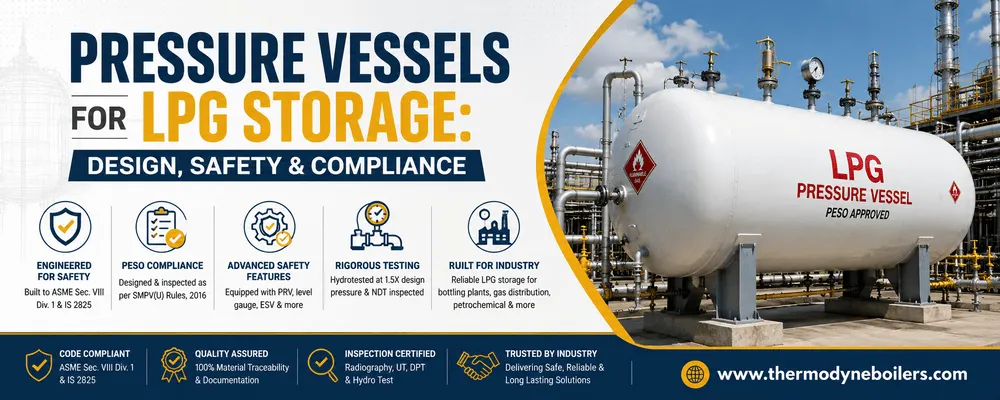
Liquefied Petroleum Gas is stored as a compressed liquid, typically at pressures between 7 and 17.5 kg/cm², depending on ambient temperature and propane-butane ratio. At these pressures, even a minor design or fabrication flaw can turn into a serious hazard. This is why Pressure Vessels for LPG service are engineered to recognized codes, not built on approximation. For LPG bottling plants, gas distributors, and petrochemical units, understanding the technical basis of vessel design, testing, and compliance is essential before procurement.
What are Pressure Vessels for LPG Storage?
Pressure Vessels are closed containers designed to hold fluids at a pressure substantially different from atmospheric pressure, as defined under codes like ASME Section VIII Division 1 and IS 2825. For LPG, the vessel holds the gas in its liquid phase, since one volume of liquid LPG expands to roughly 250 volumes of vapor at atmospheric conditions.
The design basis starts with vapor pressure data. Commercial LPG (a propane-butane mix) exerts a vapor pressure of around 4.5 kg/cm² at 15°C, rising to nearly 17 kg/cm² at 55°C. Indian design codes typically use a reference design pressure of 17.5 kg/cm² (250 psi) to cover this full temperature range with margin.
The shell is designed to take care of internal pressure through a combination of wall thickness, material yield strength, and joint efficiency. Any LPG pressure vessel design is governed by strict engineering codes for safe operations.
Recommended Reading
What is a Pressure Vessel? Types, Working Principle, Applications & Benefits
Learn about pressure vessels, their types, working principles, industrial applications, and key benefits in this detailed guide.
Read More About This Blog →Design Considerations for LPG Pressure Vessels
Every LPG tank is engineered around a defined set of technical parameters, not just general dimensions.
Material Selection: Shell and head plates are typically fabricated from carbon steel grades such as SA 516 Grade 60 or Grade 70, chosen for their tensile strength and weldability at low-to-moderate temperatures. Stainless steel (SA 240 grades) is reserved for vessels handling corrosive LPG blends or where product purity matters.
Design Pressure: Set above the maximum working pressure with a margin, commonly 17.5 kg/cm² for standard LPG vessels, calculated per Indian ambient temperature conditions.
Design Temperature: Ranges from a minimum metal temperature (often -20°C for brittle fracture consideration) to a maximum service temperature based on regional climate data.
Shell Thickness: Calculated using the standard thin-wall pressure vessel formula, t = PR / (SE − 0.6P).
Corrosion Allowance: Added to calculated thickness, depending on expected service life (usually 15–20 years) and environmental exposure.
Welding Standards: Shell and head welds follow ASME Section IX qualified procedures, with butt welds and full penetration joints mandatory on pressure-retaining seams.
Safety Factors: Code generally applies a safety factor of 2.5–4 on ultimate tensile strength when deriving allowable stress values, ensuring the vessel operates well within elastic limits.
Horizontal vs Vertical Tanks: Horizontal LPG tanks (bullet tanks) dominate above 5,000-liter capacities due to easier fabrication and inspection access, while vertical mounded or skid tanks suit constrained plot sizes and smaller volumes.
Essential Safety Features of Pressure Vessels
Safety hardware converts a code-compliant shell into an operationally safe unit.
- Pressure Relief Valve (PRV): Spring-loaded valve set to open at or near design pressure (commonly 17.5 kg/cm² for standard LPG vessels), sized per API 520/526 sizing methodology to discharge excess vapor before shell stress becomes critical.
- Safety Valves: A secondary independent relief path, ensuring protection continues even if the primary PRV underperforms or is under maintenance.
- Level Gauge: Rotary or magnetic float-type gauges limit filling to 85–90% of water capacity, leaving vapor space for thermal expansion of the liquid.
- Pressure Gauge: Bourdon-tube gauges provide continuous internal pressure readings for operator monitoring and trend logging.
- Emergency Shut-Off Valve (ESV): Actuated pneumatically or thermally, this valve isolates inlet/outlet lines within seconds during a detected leak or fire.
- Vent System: Directs relieved vapor to a safe height and location, away from ignition sources and personnel movement areas.
- Earthing: Resistance typically maintained below 5–7 ohms to dissipate static charge generated during liquid transfer.
- Fire Safety Requirements: Includes fireproof insulation on supports, water spray/deluge systems, and adequate separation distances as per Oil Industry Safety Directorate (OISD) norms.
- Corrosion Protection: Achieved through epoxy or polyurethane coatings, and cathodic protection for underground or mounded installations.
PESO Compliance for LPG Storage Tanks
The Petroleum and Explosives Safety Organisation (PESO), under the Ministry of Commerce and Industry, regulates LPG pressure vessels in India through the Static and Mobile Pressure Vessels (Unfired) Rules, commonly referenced as SMPV(U) Rules, 2016.
Regulatory requirements mandate design approval from PESO before fabrication begins, along with third-party inspection during manufacturing. Design drawings, stress calculations, and material test certificates (MTCs) must be submitted for review.
Hydrostatic Testing: Every vessel is tested at 1.5 times the design pressure (approximately 26.25 kg/cm² for a 17.5 kg/cm² rated vessel), held for a minimum specified duration, typically 30 minutes, to verify there is no permanent deformation or leakage.
NDT Testing: Radiographic Testing (RT) checks weld seam integrity internally, Ultrasonic Testing (UT) detects subsurface flaws, and Dye Penetrant Testing (DPT) or Magnetic Particle Testing (MPT) inspect surface-breaking defects on nozzles and welds.
Documentation: A complete data package, including the design calculation sheet, radiography reports, hydro-test certificate, and material traceability records, accompanies each vessel for PESO’s final review.
Safety Certification: Once inspection and testing are cleared, PESO issues an approval certificate authorizing the vessel for commercial installation and use, valid until the next periodic inspection cycle.
Applications of Pressure Vessels
Industrial pressure vessels extend well beyond LPG bottling. Common sectors include:
- LPG Bottling Plants
- Petrochemical Plants
- Oil & Gas Industry
- Chemical Plants
- Pharmaceutical Industry
- Food Processing Units
- Manufacturing Plants
- Energy Sector Installations
Across these industries, vessel specifications shift with fluid properties, but the underlying code compliance, hydrostatic testing, and NDT requirements remain consistent.
Why Choose Thermodyne Engineering Systems?
Thermodyne Engineering Systems designs and fabricates PESO approved pressure vessels in accordance with ASME Section VIII Division 1 and IS 2825 design codes. Every unit undergoes hydrostatic testing at 1.5 times design pressure, along with radiographic and ultrasonic weld inspection, before dispatch.
Custom capacities and orientations (horizontal or vertical) accommodate specific plot and process requirements, while documented material traceability supports long-term maintenance and statutory audits.
Conclusion
Safe LPG storage is a function of precise engineering. For facilities handling pressurized LPG, rigorous safety measures in construction should be kept priority to determine long-term operational safety. Pressure Vessels must be designed at the correct material, wall thickness, tested at 1.5 times design pressure, and certified under PESO’s SMPV(U) Rules to deliver measurable, code-backed safety and reliability. If your plant requires custom-engineered, PESO approved Pressure Vessels built to verified design codes, connect with Thermodyne Engineering Systems to discuss your project specifications.