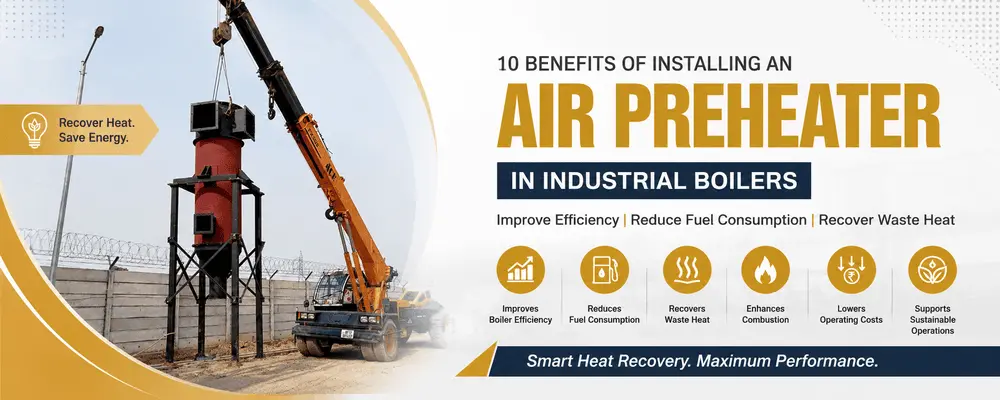
Industrial boilers are among the largest energy consumers in manufacturing plants. While most industries focus on selecting the right boiler or fuel, they often overlook one of the most effective energy-saving solutions—the air preheater. By recovering waste heat from hot flue gases and using it to preheat combustion air, an air preheater significantly improves boiler efficiency while reducing fuel costs.
Whether you operate a food processing unit, textile mill, dairy plant, chemical factory, or paper industry, installing an air preheater is a smart investment that enhances productivity and supports sustainable operations. A well-designed boiler air preheater not only improves combustion but also minimizes heat losses and extends the life of the boiler system.
What is an Air Preheater?
An air preheater is a waste heat recovery device installed in the flue gas path of an industrial boiler. Instead of allowing hot exhaust gases to escape through the chimney, the air preheater transfers this heat to the incoming combustion air before it enters the furnace.
Preheated air improves combustion efficiency, allowing the boiler to generate more steam with less fuel. This makes the industrial air preheater one of the most valuable energy-saving accessories for modern steam boiler systems.
🚀 Learn More About Air Preheaters
Air Preheaters (APH) play a crucial role in improving boiler efficiency by recovering waste heat from flue gases and preheating combustion air. Learn about their working principle, functions, advantages, and different types in our detailed guide.
Read: What is Air Preheaters in Boiler (APH): Working, Function & Types →1. Improves Boiler Efficiency
The primary advantage of an air preheater is its ability to improve overall boiler efficiency. By utilizing waste heat that would otherwise be lost through the stack, the boiler requires less fuel to achieve the desired steam output. Higher thermal efficiency translates directly into improved plant performance.
2. Reduces Fuel Consumption
Fuel costs account for a major portion of industrial operating expenses. A properly engineered boiler air preheater reduces fuel consumption by supplying preheated combustion air, enabling faster and more complete combustion. Over time, these fuel savings provide an excellent return on investment.
3. Maximizes Waste Heat Recovery
Every industrial boiler releases a significant amount of heat through flue gases. An air preheater captures this otherwise wasted thermal energy and converts it into useful heat for the combustion process. This improves energy utilization without increasing fuel input.
4. Enhances Combustion Efficiency
Efficient combustion is essential for stable steam generation. An industrial air preheater increases the temperature of incoming combustion air, producing a hotter and more stable flame inside the furnace. Better combustion improves heat transfer and reduces unburned fuel losses.
5. Lowers Stack Heat Losses
High stack temperatures indicate that valuable energy is leaving the boiler unused. Installing an air preheater lowers stack heat losses by extracting heat from exhaust gases before they are discharged, increasing the overall thermal performance of the boiler.
6. Reduces Operating Costs
Lower fuel consumption, improved combustion, and higher boiler efficiency collectively reduce operating expenses. An air preheater helps industries decrease energy costs without making major modifications to existing boiler systems, making it a cost-effective upgrade.
7. Supports Lower Emissions
Improved combustion results in more complete fuel burning, reducing smoke and harmful emissions. A high-performance air preheater supports cleaner boiler operation and helps industries move toward environmentally responsible and energy-efficient manufacturing practices.
8. Improves Steam Generation
A boiler air preheater enables the boiler to transfer heat more effectively, resulting in consistent steam pressure and reliable steam generation. This is especially important for industries where uninterrupted steam supply is critical to production.
9. Extends Boiler Life
Reduced thermal stress and improved combustion conditions help protect critical boiler components from excessive wear. Installing an industrial air preheater contributes to better equipment reliability, lower maintenance requirements, and a longer operational life for the entire boiler system.
10. Delivers Excellent Return on Investment
Among all boiler efficiency upgrades, an air preheater offers one of the fastest payback periods. The combination of fuel savings, lower maintenance costs, improved efficiency, and increased productivity makes it a highly profitable investment for industries of every size.
Why Choose Thermodyne Engineering Systems?
Thermodyne Engineering Systems manufactures high-performance air preheater solutions designed for demanding industrial applications. Our APH systems are engineered with optimized heat transfer surfaces, corrosion-resistant construction, and low pressure drop designs to maximize waste heat recovery while ensuring long-term reliability.
Whether your plant operates steam boilers, biomass boilers, coal-fired boilers, oil-fired boilers, or gas-fired boilers, our customized industrial air preheater solutions improve boiler efficiency, reduce fuel consumption, and enhance overall plant performance.
Conclusion
Installing an air preheater is one of the most effective ways to improve industrial boiler performance while reducing energy costs. From better combustion and lower fuel consumption to enhanced steam generation and reduced emissions, the benefits of an air preheater extend across every aspect of boiler operation. Investing in a high-quality APH from Thermodyne Engineering Systems helps industries maximize efficiency, recover valuable waste heat, and achieve long-term operational savings while supporting sustainable manufacturing practices.
🚀 Learn More About Air Preheaters
Air Preheaters (APH) play a crucial role in improving boiler efficiency by recovering waste heat from flue gases and preheating combustion air. Learn about their working principle, functions, advantages, and different types in our detailed guide.
Read: What is Air Preheaters in Boiler (APH): Working, Function & Types →FAQs related to Air Preheater
An air preheater (APH) is a heat recovery device that captures heat from hot flue gases and transfers it to the incoming combustion air. This improves combustion efficiency, reduces fuel consumption, and increases overall boiler efficiency.
Installing an air preheater offers several benefits, including improved boiler efficiency, lower fuel consumption, enhanced combustion, reduced stack heat losses, lower operating costs, and better waste heat recovery.
An air preheater preheats the combustion air using waste heat from flue gases. Since the incoming air is already warm, the boiler requires less fuel to generate the same amount of steam, resulting in higher thermal efficiency.
Yes. A properly designed boiler air preheater can significantly reduce fuel consumption by improving combustion efficiency and recovering heat that would otherwise be lost through the chimney.
Air preheaters are widely used in industries such as food processing, pharmaceuticals, textiles, chemicals, paper, sugar, rice mills, dairy, distilleries, and power plants where steam generation is essential.
Yes. Industrial air preheaters are ideal for biomass-fired, coal-fired, bagasse-fired, rice husk-fired, oil-fired, and gas-fired boilers, helping improve efficiency across various fuel types.
An economizer recovers waste heat to preheat boiler feedwater, while an air preheater uses waste heat to preheat combustion air before it enters the furnace. Both improve boiler efficiency but serve different functions.
Yes. By improving fuel combustion, an air preheater reduces unburned fuel, lowers fuel consumption, and helps decrease particulate matter and greenhouse gas emissions, supporting cleaner boiler operation.
Important factors include boiler capacity, fuel type, flue gas temperature, combustion air requirements, pressure drop, heat recovery efficiency, material of construction, and maintenance requirements.
Thermodyne Engineering Systems designs and manufactures high-efficiency Air Preheaters (APHs) with optimized heat transfer surfaces, robust construction, and low-pressure-drop designs. Our customized solutions help industries maximize waste heat recovery, reduce fuel costs, improve boiler efficiency, and ensure long-term reliable performance.