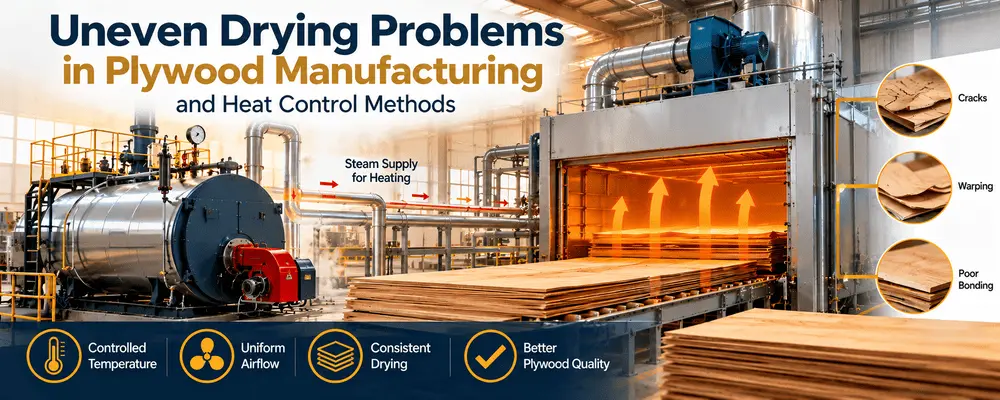
Drying is a critical stage in plywood manufacturing that directly affects product quality, dimensional stability, and bonding performance. Before veneer sheets are bonded together, they must be dried to an appropriate moisture content. However, Uneven Drying in Plywood Manufacturing is a common challenge caused by temperature fluctuations, inconsistent airflow, and inadequate moisture control.
When veneer sheets do not dry uniformly, manufacturers may experience surface cracks, warping, shrinkage, and adhesive bonding defects. These problems can increase material wastage, reduce production efficiency, and raise manufacturing costs. Implementing effective heat control methods and reliable industrial heating systems is essential for maintaining consistent drying conditions.
What Causes Uneven Drying in Plywood Manufacturing?
Several technical and operational factors can contribute to Uneven Drying in Plywood Manufacturing. Identifying these causes is the first step toward improving drying efficiency and maintaining consistent veneer quality.
1. Uneven Temperature Distribution
Temperature variations within a drying chamber can cause veneer sheets to dry at different rates. Areas exposed to excessive heat may lose moisture too quickly, while cooler zones may retain excess moisture.
Properly designed heating arrangements, strategically positioned temperature sensors, and effective heat distribution systems help maintain consistent temperatures throughout the drying chamber.
2. Inconsistent Airflow
Hot air circulation plays an essential role in veneer drying. Blocked air passages, poorly maintained fans, and unbalanced airflow can prevent heat from reaching all areas of the drying chamber uniformly.
Optimizing airflow distribution and maintaining ventilation equipment can improve heat transfer and reduce moisture variations between veneer sheets.
3. Variations in Veneer Thickness
Veneer thickness, wood species, and initial moisture content influence drying requirements. Thicker veneer sheets generally require different drying conditions than thinner sheets.
Using identical temperature settings and drying times for materials with different characteristics can result in inconsistent moisture removal. Manufacturers should establish appropriate drying schedules based on the properties of the wood being processed.
4. Incorrect Drying Temperature
Excessively high temperatures can dry the veneer surface rapidly while moisture remains inside the material. This may increase the risk of surface checking, cracking, and excessive shrinkage.
Conversely, insufficient temperatures can extend drying time, reduce production capacity, and increase energy consumption. Maintaining suitable operating temperatures is therefore essential for consistent drying performance.
5. Inadequate Moisture Monitoring
Without regular moisture measurements, under-dried or over-dried veneer sheets may proceed to the next manufacturing stage.
Moisture meters and suitable monitoring systems help operators evaluate drying performance and adjust operating conditions when necessary. Effective moisture management is an important part of controlling Uneven Drying in Plywood Manufacturing.
How Uneven Drying Affects Plywood Quality
Drying inconsistencies can affect veneer quality, adhesive bonding, and the performance of the finished plywood product.
- Poor adhesive bonding: Excessive moisture can interfere with adhesive performance and pressing conditions, depending on the adhesive system and manufacturing process.
- Warping and shrinkage: Uneven moisture loss can cause dimensional changes and distortions in veneer sheets.
- Surface cracks: Rapid or uncontrolled drying can increase the likelihood of veneer checking and cracking.
- Higher material wastage: Defective sheets may require reprocessing or rejection, increasing production costs.
- Inconsistent product quality: Moisture variations can affect the dimensional stability and performance of finished plywood.
Addressing the underlying causes of Uneven Drying in Plywood Manufacturing helps manufacturers reduce defects and maintain more consistent production quality.
Effective Heat Control Methods for Plywood Drying
Effective thermal management is essential for achieving uniform moisture removal, improving drying efficiency, and maintaining consistent product quality.
1. Maintain Uniform Temperature Distribution
Maintaining a uniform temperature throughout the drying chamber helps ensure that veneer sheets receive consistent heat exposure.
Temperature sensors installed at different locations can identify hot spots and cold zones. Operators can use this information to adjust heating parameters and improve overall temperature distribution.
Properly designed heat exchangers and balanced heating arrangements can also help minimize temperature variations.
2. Use Automated Temperature Control Systems
Automated temperature control systems use sensors and controllers to regulate heating output according to process requirements.
PID controllers and automated control valves can help minimize temperature fluctuations when properly configured. Automation also reduces the need for frequent manual adjustments and supports consistent drying conditions.
These systems can be particularly useful in large-scale plywood manufacturing facilities where stable temperatures are essential for maintaining production quality.
3. Optimize Hot Air Circulation
Uniform hot air circulation is essential for transferring heat efficiently to veneer sheets. Manufacturers should evaluate fan capacity, duct design, airflow distribution, and air passage conditions.
Regular inspections can identify blocked ducts, damaged fans, and other restrictions that affect circulation.
Improving airflow helps distribute heat more evenly throughout the drying chamber and reduces the risk of Uneven Drying in Plywood Manufacturing.
4. Monitor Veneer Moisture Content
Moisture meters and suitable inline monitoring systems help manufacturers measure and track veneer moisture levels during production.
Target moisture content should be established according to wood species, veneer thickness, adhesive specifications, and subsequent processing requirements.
Regular moisture measurements allow operators to identify under-drying or over-drying and make timely adjustments to drying conditions.
5. Optimize Drying Temperature and Residence Time
Different veneer types require different drying conditions. Temperature and residence time should be adjusted according to initial moisture content, material thickness, wood characteristics, and dryer design.
Production trials and historical process data can help manufacturers develop appropriate drying schedules. This approach can reduce drying defects, improve process consistency, and support better productivity.
Optimizing these parameters is an important strategy for minimizing Uneven Drying in Plywood Manufacturing.
6. Implement Heat Recovery Systems
Industrial veneer dryers can lose significant thermal energy through exhaust air. Suitable heat recovery systems can capture some of this energy and reuse it to preheat incoming air.
This approach can reduce fuel consumption and improve overall thermal efficiency, depending on the dryer configuration and operating conditions.
By recovering otherwise wasted heat, manufacturers can improve energy utilization without compromising the required drying conditions.
Role of Industrial Heating Systems in Plywood Manufacturing
Industrial heating systems provide the thermal energy required for veneer drying. Reliable heat generation, consistent heat transfer, and accurate temperature regulation are important for maintaining efficient drying operations.
Depending on process requirements, manufacturers may consider steam-based heating arrangements, thermal oil heaters, hot water systems, or direct-fired hot air systems.
Each option has different operating characteristics. The appropriate solution depends on the required operating temperature, dryer design, fuel availability, energy efficiency targets, and process control requirements.
A properly selected industrial heating system can support stable operating temperatures and help reduce process variations associated with Uneven Drying in Plywood Manufacturing.
Manufacturers should evaluate heating capacity, temperature control accuracy, maintenance requirements, energy consumption, and safety provisions before selecting a heating solution.
Best Practices to Prevent Uneven Drying
Plywood manufacturers can improve drying consistency by adopting the following practices:
- Regularly monitor temperature distribution throughout the drying chamber.
- Perform preventive maintenance on fans, ducts, and heat exchangers.
- Adjust drying schedules according to veneer thickness and initial moisture content.
- Calibrate temperature sensors and moisture measurement instruments.
- Maintain consistent veneer loading patterns.
- Record energy consumption, moisture levels, and drying-related defects.
- Review production data to identify recurring drying problems.
- Optimize drying parameters through controlled trials and performance analysis.
These practices help reduce the risks of Uneven Drying in Plywood Manufacturing while supporting consistent product quality and efficient resource utilization.
Conclusion
Uneven Drying in Plywood Manufacturing is a significant challenge because it can affect veneer quality, adhesive bonding, production efficiency, and energy consumption. Temperature variations, inconsistent airflow, unsuitable drying schedules, and inadequate moisture monitoring are among the major contributing factors.
Maintaining uniform heat distribution, implementing automated temperature control, optimizing airflow, and monitoring moisture content can improve drying performance. Efficient industrial heating systems and suitable heat recovery solutions can further support reliable operations and better thermal efficiency.
Ultimately, effective heat control methods help plywood manufacturers reduce material wastage, improve drying consistency, optimize energy usage, and produce high-quality finished products.