In industrial plants, steam is the lifeblood of production. It powers turbines, heats processes, drives machinery, and keeps operations running around the clock. But steam is also one of the most energy-intensive utilities a plant operates. Even a minor uncontrolled release or pressure deviation can translate into significant fuel consumption and rising operating costs.
Consider this: a single undetected steam leak of just 3 mm diameter at 7 bar pressure can waste over 33 kg of steam per hour. Multiply that across a large facility with dozens of pipeline connections, and the financial impact becomes staggering. This is precisely why controlling steam at every critical point in a distribution system is non-negotiable for plant managers and energy managers alike.
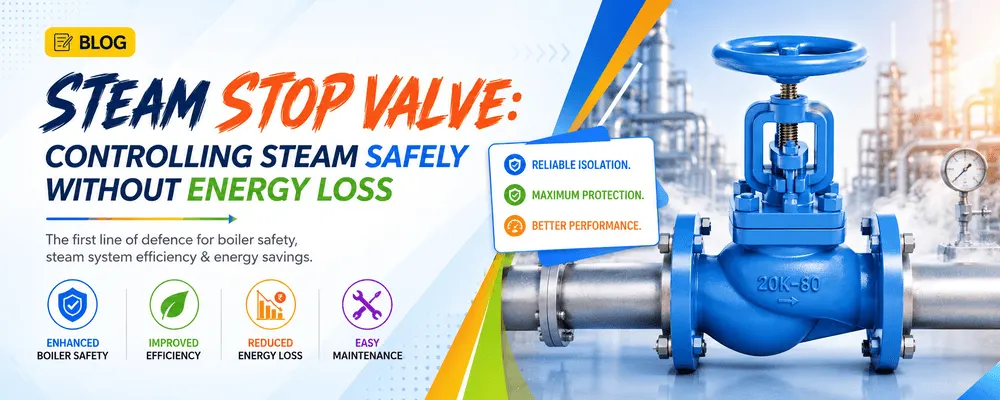
At the heart of that control sits the steam stop valve — a purpose-built industrial component that enables operators to isolate, regulate, and safely manage steam flow across boiler systems and distribution networks. It is the first and most critical line of defence against uncontrolled steam loss, pressure surges, and emergency situations in any steam boiler installation.
This blog examines how a steam stop valve functions, why it matters for boiler safety and steam system efficiency, how to maintain it properly, and what to look for when selecting one for your industrial application.
What Is a Steam Stop Valve?
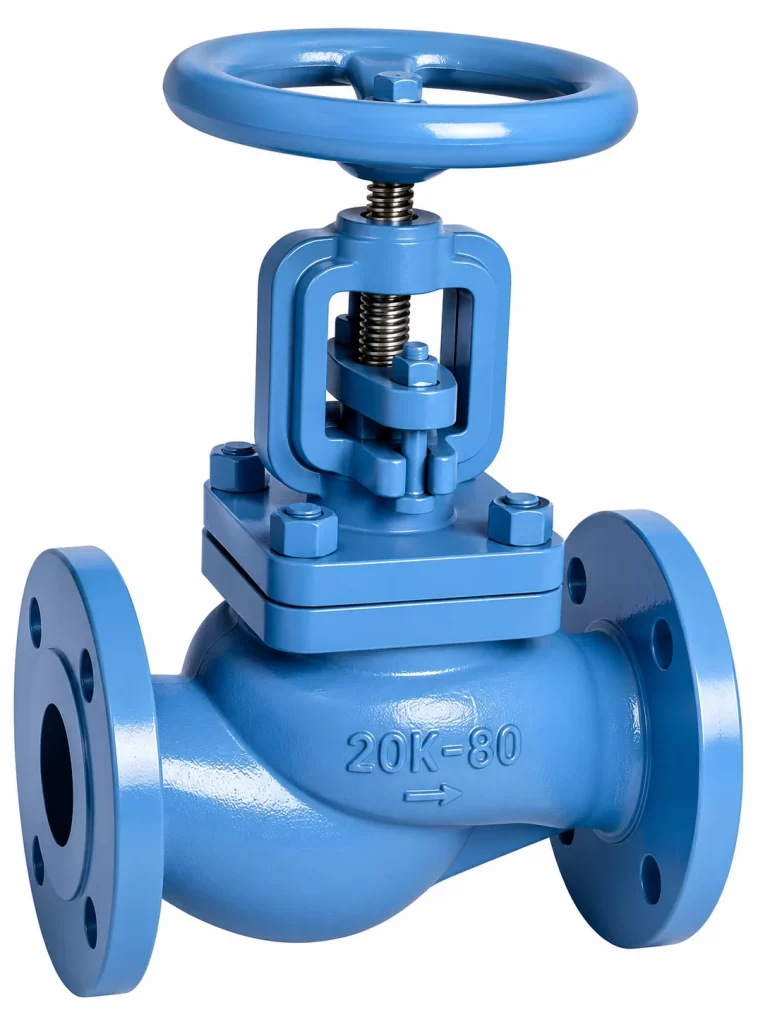
A steam stop valve is a manually or automatically operated isolation valve installed in a steam pipeline to start, stop, or regulate steam flow between the boiler and the distribution system. Its primary function is to provide a tight shutoff — blocking steam completely when the system is idle, under maintenance, or in an emergency.
In most industrial steam borile installations, the steam stop valve is fitted directly on the boiler steam outlet or at the entry point of the main steam header. From that position, it acts as the gatekeeper between the pressurised boiler vessel and the downstream steam distribution system.
Unlike control valves that modulate flow continuously, a steam stop valve is designed primarily for on/off isolation. It must provide a bubble-tight seal at rated pressure and temperature, withstand repeated cycling, and remain operable even after extended periods of being in one position.
Common types used in industrial steam boiler systems include globe stop valves, gate valves, and parallel slide valves — each suited to different pressure ratings, pipe sizes, and operational frequencies.
How Does a Steam Stop Valve Work?
The operating principle of a steam stop valve is straightforward but demands precision engineering to perform reliably under extreme conditions.
In a globe-type steam stop valve — one of the most widely used designs in industrial applications — steam enters through the inlet port and flows through a seat orifice. A disc or plug, connected to a stem and handwheel (or actuator), moves perpendicular to the steam flow path. When the operator closes the valve, the disc presses firmly against the seat, creating a metal-to-metal or soft-seated seal that stops all steam flow.
When opened, the disc lifts away from the seat and steam flows freely through the valve body toward the steam distribution system or process equipment downstream.
In automated systems, pneumatic or electric actuators replace the handwheel, allowing remote operation from a control room. This is particularly important for large industrial steam boilers where manual access may be difficult or dangerous during an emergency.
A critical feature of high-quality steam stop valves is the back-seating design, which allows the gland packing to be replaced or adjusted while the valve is in the fully open position without requiring a system shutdown. This reduces planned downtime and keeps the steam boiler operational.
Why Is a Steam Stop Valve Important for Boiler Safety?
Boiler safety is not optional — it is a legal, operational, and moral obligation. The steam stop valve plays a central role in three critical safety functions.
Emergency Isolation
In the event of a pipeline rupture, pressure surge, or process emergency, operators must be able to cut off steam supply instantly. The steam stop valve provides that capability. Without a reliable isolation point at the boiler outlet, steam continues to flow into a damaged system, escalating the incident and putting personnel at risk.
Maintenance Isolation
In the event of a pipeline rupture, pressure surge, or process emergency, operators must be able to cut off steam supply instantly. The steam stop valve provides that capability. Without a reliable isolation point at the boiler outlet, steam continues to flow into a damaged system, escalating the incident and putting personnel at risk.
Equipment Protection
Water hammer, pressure surges, and thermal shock can cause catastrophic damage to downstream equipment. By providing controlled startup and shutdown of steam flow, the steam stop valve reduces the risk of these damaging events. It also protects the industrial steam boiler itself from backflow conditions during multi-boiler installations.
Regulatory bodies including IBR (Indian Boiler Regulations), ASME, and EN standards mandate the fitment of steam stop valves on all steam boilers above a specified capacity precisely because of their critical role in boiler safety.
How a Steam Stop Valve Helps Reduce Energy Losses
Beyond safety, the steam stop valve is one of the most impactful components influencing steam system efficiency and boiler efficiency. Here is how.
Preventing Steam Leakage
Internal leakage through a worn or damaged steam stop valve allows pressurised steam to bypass the isolation point continuously. This steam leakage is pure waste — it represents fuel burned in the boiler to generate steam that delivers no useful work. A properly maintained steam stop valve with a tight shutoff eliminates this parasitic loss entirely.
Maintaining Steam Pressure Control
When a steam stop valve fails to hold pressure — due to seat erosion or packing leaks — the upstream steam pressure drops unpredictably. This forces the industrial steam boiler to fire more frequently to compensate, increasing fuel consumption and reducing boiler efficiency. A correctly functioning steam stop valve maintains a stable pressure boundary, allowing the boiler and pressure controls to operate within their designed parameters.
Reducing Partial Load Losses
During plant shutdowns, shift changes, or low-demand periods, operators use steam stop valves to isolate unused sections of the steam distribution system. This prevents residual steam from condensing and flooding inactive pipelines, and it eliminates the energy needed to reheat and repressurise those sections at restart. Effective isolation through properly operating steam stop valves can reduce startup steam losses by up to 20% in large industrial facilities.
How Proper Maintenance Reduces Fuel Consumption and Improves Reliability
A steam stop valve that is regularly maintained does more than just open and close reliably. It actively contributes to reduced fuel consumption and improved steam system reliability across the entire plant.
When valve internals remain in good condition — with intact seating surfaces, fresh packing, and smooth stem operation — the valve maintains a positive shutoff. This eliminates the micro-leaks and bypass losses that cumulatively drive up boiler fuel bills. Studies in industrial steam plants have shown that addressing internal valve leakage across a distribution system can reduce total steam losses by 3–8%, directly lowering fuel consumption by an equivalent margin.
From a reliability standpoint, a well-maintained steam stop valve responds correctly in emergencies, operates without seizing during infrequent use, and does not fail in a partially open position — a scenario that undermines both steam pressure control and downstream process quality.
Planned maintenance programs that include regular inspection, leak testing, and packing replacement ensure the steam stop valve performs its function precisely when it matters most, reducing unplanned outages and keeping the steam boiler operating at peak efficiency.
Common Problems Associated with Steam Stop Valves
Even robust industrial valves fail when neglected. Understanding the failure modes of a steam stop valve helps maintenance engineers intervene before a minor issue becomes a major problem.
- Internal leakage: Erosion of the disc or seat face — often caused by repeated partial-open operation or steam velocity cutting — creates a leakage path that cannot be closed fully. This is the most common and most costly failure mode.
- Valve wear: Repeated cycling under high differential pressure accelerates wear on stem threads, packing, and seating surfaces, reducing the valve’s ability to achieve tight shutoff.
- Improper operation: Operators who throttle a steam stop valve (using it as a flow-regulating device) accelerate seat erosion dramatically. Stop valves are designed for full-open or full-closed operation only.
- Lack of maintenance: Valves left in one position for extended periods tend to seize due to corrosion, scale buildup, or gland packing consolidation, making them inoperable in an emergency.
- Gland packing failure: Deteriorated packing allows steam to escape along the valve stem — a visible steam leakage that wastes energy and creates a safety hazard for nearby personnel.
Steam Stop Valve Maintenance Best Practices
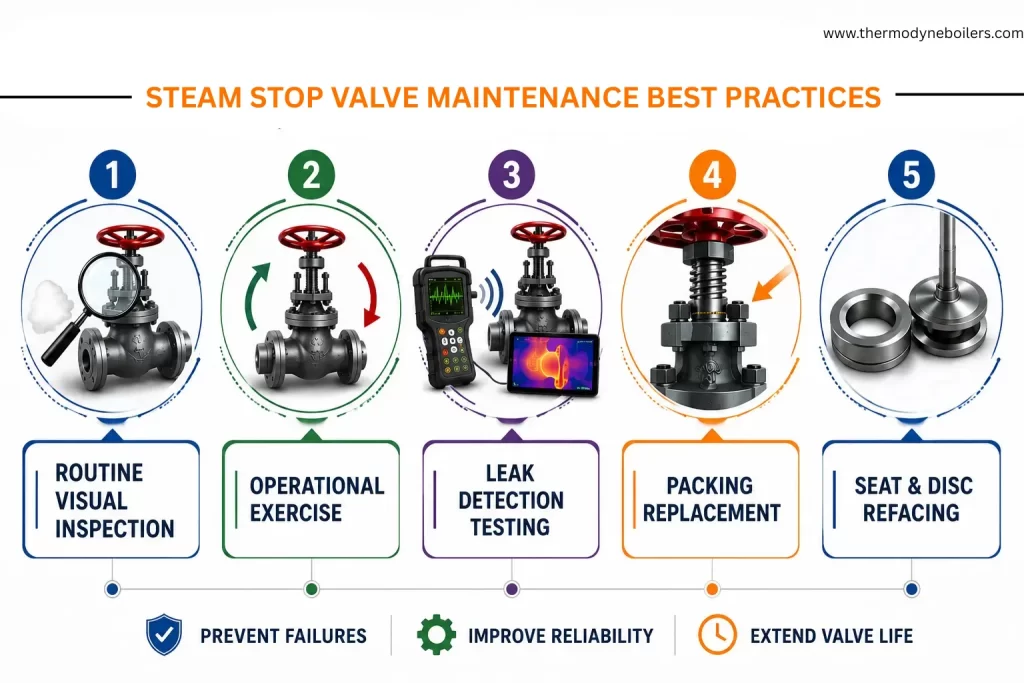
A structured maintenance programme keeps steam stop valves in peak condition and prevents the problems described above.
Routine Visual Inspection
During scheduled plant walkthroughs, engineers should inspect every steam stop valve for external steam leakage around the gland, signs of corrosion or insulation damage, and evidence of valve body erosion. Even minor external leaks indicate internal conditions that require attention.
Operational Exercise
Valves that remain in one position for extended periods must be exercised regularly — opened and closed through their full range of travel — to prevent seizure and confirm operability. A valve that cannot be operated in an emergency is as dangerous as no valve at all.
Leak Detection Testing
Using ultrasonic leak detectors or thermal imaging, maintenance teams can identify internal steam leakage through a closed steam stop valve without removing it from service. Any valve showing measurable internal leakage should be scheduled for repair or replacement.
Packing Replacement
Graphite or PTFE packing in the gland should be replaced at defined intervals or when leakage is first detected. In valves with a back-seating feature, packing can be replaced with the valve in service, minimising disruption to the steam boiler and distribution system.
Seat and Disc Refacing
During planned shutdowns, lapping the seat and disc faces restores the metal-to-metal seal and extends valve service life significantly. This is far more cost-effective than full valve replacement and restores tight shutoff performance.
Choosing the Right Steam Stop Valve for Industrial Applications
Selecting the correct steam stop valve for a specific application requires a systematic evaluation of operating conditions and system requirements.
- Steam pressure rating: The valve pressure class (PN rating or ANSI class) must equal or exceed the maximum allowable working pressure of the steam boiler. Undersized valves risk catastrophic failure.
- Operating temperature: High-pressure saturated or superheated steam imposes significant thermal stress on valve bodies and sealing materials. Valves must be rated for the maximum steam temperature in the system, with appropriate material selection.
- Valve material: Carbon steel (ASTM A216 WCB) suits most saturated steam applications up to approximately 400°C. Alloy steels or stainless steel are required for superheated steam, high-cycle applications, or corrosive steam conditions.
- Pipe size and flow velocity: Oversized valves operating partially open experience accelerated erosion. Correctly sized valves matched to design flow velocity maintain tight shutoff and long service life.
- Actuation method: Manual handwheels are adequate for infrequently operated isolation points. High-cycle or remotely operated applications require pneumatic or electric actuators with appropriate fail-safe positioning.
- Compliance and certification: For regulated industrial steam boiler installations, ensure the steam stop valve carries the required certifications — IBR approval, CE marking, or ASME stamp as applicable to your jurisdiction.
Conclusion
The steam stop valve is far more than a simple on/off device. It is a precision engineering component that underpins boiler safety, steam system efficiency, and plant reliability simultaneously.
For plant managers and energy managers, a well-selected and properly maintained steam stop valve delivers measurable reductions in steam leakage, fuel consumption, and unplanned downtime. For boiler operators and maintenance engineers, it provides the operational control necessary to isolate systems safely, carry out maintenance confidently, and respond decisively in emergencies.
Neglecting the steam stop valve — treating it as a passive fitting rather than a critical process component — is a common source of avoidable energy loss and operational risk in industrial plants. The economics are clear: the cost of a valve inspection programme is a fraction of the fuel wasted through internal steam leakage.
Invest in the right steam stop valve, install it correctly, maintain it rigorously, and it will deliver safe, efficient, and reliable steam control for the life of your plant.
Frequently Asked Questions (FAQ)
A steam stop valve is an isolation valve installed in a steam pipeline to start, stop, or regulate steam flow. It provides a positive shutoff between the steam boiler and the downstream steam distribution system, and is mandatory on most industrial steam boilers under applicable safety regulations.
A steam stop valve is typically installed at the steam outlet of the boiler, at the entry to the main steam header, and at key isolation points throughout the steam distribution system. Its location ensures that any section of the system can be safely isolated for maintenance or emergency shutdown.
By providing a tight shutoff, the steam stop valve eliminates internal steam leakage that would otherwise force the industrial steam boiler to fire continuously to maintain pressure. It also enables section isolation during low-demand periods, reducing heat losses and improving overall steam system efficiency.
At minimum, a visual inspection for external steam leakage should be conducted monthly. Operational exercise (full open and close cycling) should be performed quarterly. A detailed inspection including internal leak testing and packing condition assessment should be carried out annually or during each planned boiler shutdown.
Key indicators include visible steam leakage from the gland or body joints, inability to achieve a full shutoff (detectable by downstream pressure not dropping after closure), difficulty operating the handwheel or actuator, abnormal noise (hissing) when the valve is in the closed position, and discolouration or corrosion on the valve body.