Scale formation is one of the most persistent and costly threats to industrial boiler performance. A mere 3 mm of calcium or silica scale on heat transfer surfaces can reduce boiler efficiency by up to 25%, spike fuel consumption, and accelerate tube failures. For plant managers and maintenance engineers running continuous operations — whether in food processing, textiles, pharmaceuticals, or rice mills — unplanned boiler downtime is not an option. Timely boiler descaling is what stands between a high-performing asset and an unplanned shutdown.
Boiler descaling is the controlled removal of mineral deposits from internal boiler surfaces. Done correctly and on schedule, it restores heat transfer efficiency, extends equipment life, and delivers measurable fuel savings. But choosing the wrong method for your specific boiler type and scale composition can cause more harm than good.
This guide breaks down the two primary boiler descaling approaches — mechanical and chemical — so you can make an informed decision for your plant.
What Is Boiler Scaling and Why Does It Occur?
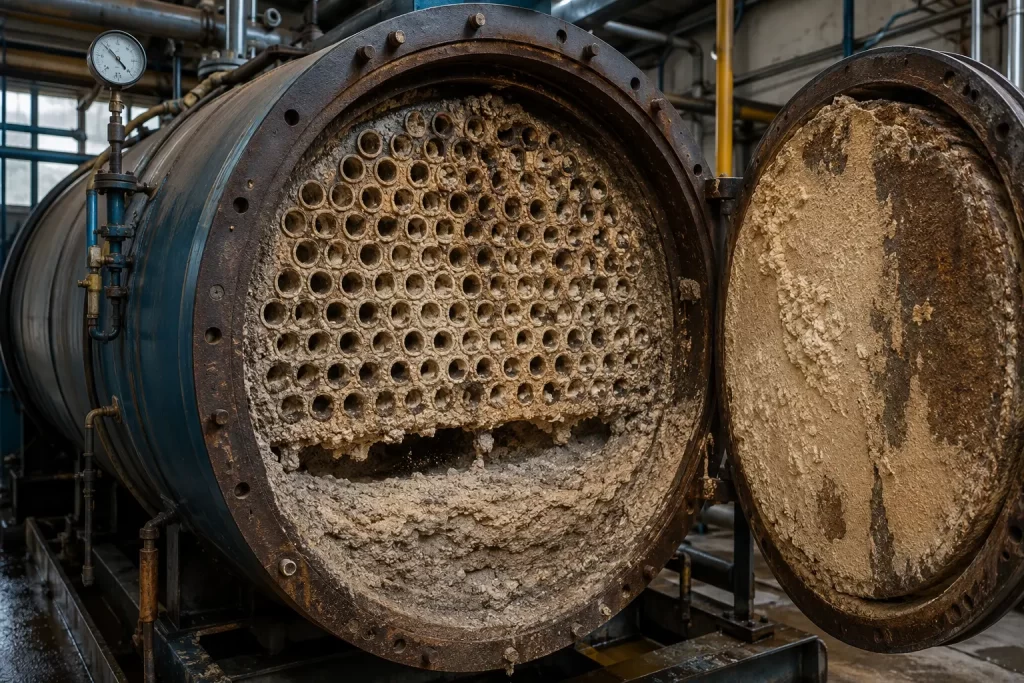
Scale is a hard, insulating mineral deposit that forms on the internal waterside surfaces of a boiler — primarily on heating tubes, drums, and the fireside. It is the direct result of dissolved minerals in feedwater, chiefly calcium carbonate, calcium sulfate, magnesium hydroxide, and silica, precipitating out of solution when water is heated repeatedly.
The root causes of scaling include:
- Poor boiler water treatment or inadequate blowdown frequency
- High hardness in makeup water
- Insufficient use of scale inhibitors
- Operating at high heat flux without softened water
Even with a reasonably good boiler water treatment programme, scaling builds over time. Left unaddressed, scale acts as a thermal insulator, forcing the boiler to consume more fuel to maintain steam output. The tube metal overheats, tensile strength degrades, and catastrophic tube failures become a real risk. This is precisely why periodic boiler descaling must be part of every plant’s preventive maintenance calendar.
Common Signs That Boiler Descaling Is Required
Maintenance engineers should watch for these indicators:
- Rising flue gas temperatures at the same load — a classic sign of reduced heat transfer
- Increased fuel consumption without a change in steam demand
- Abnormal hotspots or discolouration on boiler tubes during inspection
- Pressure drop across the system beyond normal thresholds
- White or grey deposits visible during internal inspection or when opening inspection covers
- Frequent tube failures or waterwall cracking
If your industrial steam boiler is showing two or more of these signs simultaneously, a scheduled boiler descaling intervention is overdue.
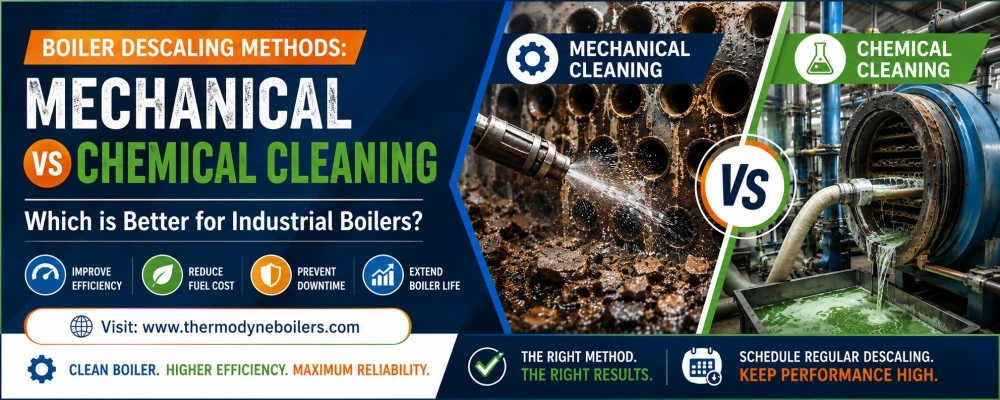
Mechanical Boiler Cleaning: Process, Advantages, and Limitations
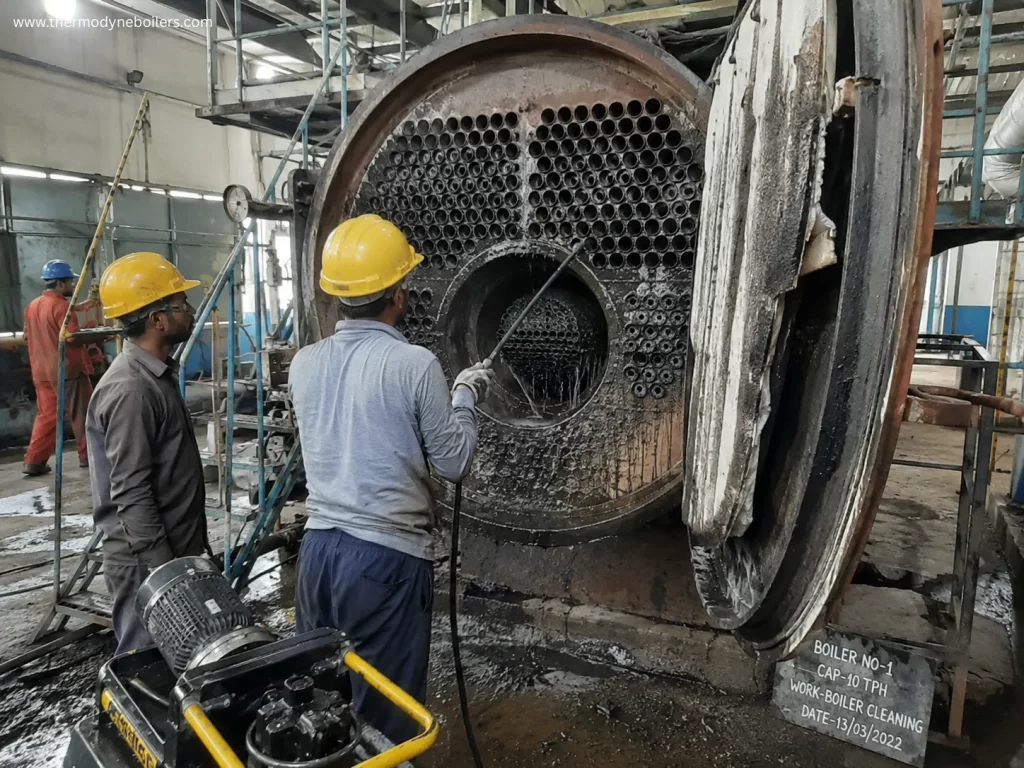
Process
Mechanical boiler cleaning involves physically removing scale using abrasive tools and equipment. Common techniques include:
- High-pressure water jetting (hydro-jetting): Water at 500–3000 bar is directed through nozzles to dislodge and flush out scale deposits. Widely used for fire tube boiler and water tube boilers.
- Rotary tube cleaners: Motorised brushes or cutters driven into individual tubes to scrape scale from the internal surface.
- Shot blasting / grit blasting: Abrasive media projected at surfaces for heavy-duty scale and corrosion product removal in large water tube boilers.
- Manual wire brushing: Used in accessible areas for light-scale deposits, particularly during routine steam boiler maintenance shutdowns.
Advantages
- No chemical hazards — safe for personnel when proper PPE is used
- Effective for thick, hard deposits such as silica-based scale that resists chemical attack
- Immediate visual confirmation of cleanliness post-cleaning
- No chemical waste disposal requirements
- Suitable for spot cleaning in localised areas without full system drainage
Limitations
- Labour-intensive and time-consuming, particularly in complex multi-pass fire tube boilers
- Risk of mechanical damage to tube surfaces if incorrect tooling or excessive pressure is applied
- Inaccessible bends, headers, and drum internals may remain partially scaled
- Requires complete boiler shutdown and adequate cooling time
- Not effective for very thin, widespread scale films distributed across large surface areas
Suitable Applications
Mechanical cleaning is the preferred boiler descaling choice for:
- Rice mills running paddy husk or biomass-fired boilers with thick calcium carbonate deposits
- Textile plants with older fire tube boilers where chemical circulation is not feasible
- Spot cleaning during annual IBR-mandated inspections
- Situations where chemical residue contamination is unacceptable, such as certain pharmaceutical process steam applications
Chemical Boiler Cleaning: Process, Advantages, and Limitations
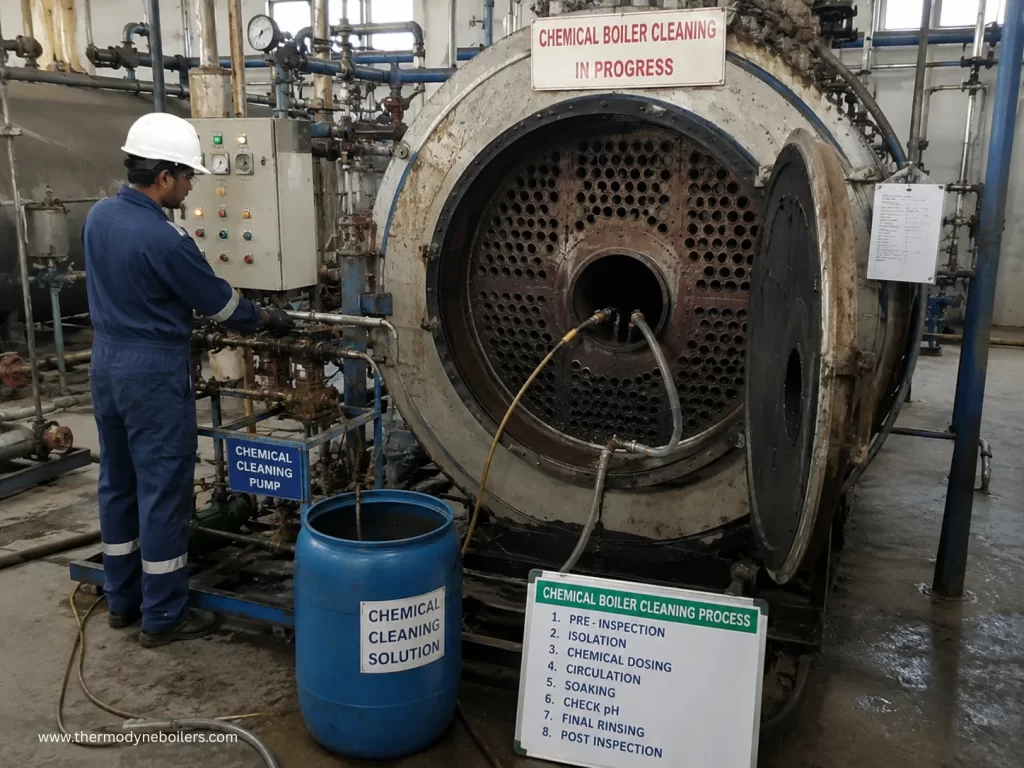
Process
Chemical boiler cleaning uses acid or alkaline solutions circulated through the boiler system to dissolve and flush scales chemically. The standard procedure involves:
- Pre-cleaning flush to remove loose sludge and debris
- Inhibited acid circulation — typically hydrochloric acid (HCl), citric acid, or EDTA-based solutions, dosed with corrosion inhibitors
- Neutralisation with alkaline solution (e.g., sodium carbonate) to arrest acid attack
- Passivation — an inhibitive rinse to protect freshly cleaned metal surfaces
- Final water flush and pH verification before recommissioning
For silica-dominant scale, hydrofluoric acid or specialised alkali-based formulations may be used under strictly controlled conditions.
Advantages
- Reaches all internal surfaces including bends, headers, and economisers that mechanical tools cannot access
- Faster cleaning of large industrial boiler systems with complex geometries
- Effective against thin, widespread scale films distributed uniformly across tube surfaces
- Can be integrated with boiler water treatment passivation in a single programme
- Reduces need for full disassembly, minimising maintenance downtime
Limitations
- Requires specialist chemical handling expertise and strict safety protocols
- Risk of over-etching or base metal attack if acid concentration, temperature, or contact time is poorly controlled
- Chemical waste must be neutralised and disposed of in compliance with CPCB effluent norms
- Not suitable for boilers with significant mechanical damage or thin-wall tubes
- Higher per-treatment cost when specialist contractors are engaged
Suitable Applications
Chemical cleaning is ideal for:
- Food processing plants where thorough sterilisation-grade cleanliness of steam circuits is required
- Chemical industry boilers with hard silica or mixed-scale deposits across complex tube bundles
- Pharmaceutical manufacturing (using non-toxic organic acid formulations) where contamination control of process steam is critical
- Water tube boilers with multiple drums and headers where mechanical access is limited
- Pre-commissioning cleaning of new industrial steam boilers
Chemical Boiler Cleaning: Process, Advantages, and Limitations
| Parameter | Mechanical Cleaning | Chemical Cleaning |
|---|---|---|
Scale Type |
Hard, thick, localised deposits |
Thin, widespread, complex geometry |
Access |
Limited to accessible tube interiors |
Reaches all wetted surfaces |
Cleaning Speed |
Slower (labour-intensive) |
Faster for large systems |
Risk to Metal |
Abrasion risk if misapplied |
Corrosion risk if poorly controlled |
Safety Hazards |
Physical / pressure injury |
Chemical burn / fume exposure |
Waste Disposal |
Minimal |
Requires neutralisation & CPCB compliance |
Downtime Required |
Full shutdown, longer |
Shorter with circulation method |
Cost |
Lower per-event |
Higher (chemicals + disposal) |
Effectiveness on Silica |
High (physical removal) |
Requires specialist formulations |
Post-cleaning Passivation |
Separate step required |
Integrated into process |
Suitability |
Fire tube, rice mill, textile boilers |
Water tube, pharma, food processing |
Factors to Consider When Selecting a Boiler Descaling Method
Choosing between mechanical and chemical boiler cleaning is not a binary decision. Evaluate these factors:
- Scale composition: Calcium carbonate responds well to both methods. Silica scale is better removed mechanically or with specialist chemical formulations. Mixed deposits may require a combined approach.
- Boiler design: Fire tube boilers with straight accessible tubes are well-suited to mechanical cleaning. Water tube boilers with complex headers and superheaters benefit more from chemical circulation.
- Degree of scaling: Thick, localised deposits favour mechanical removal. Thin, uniform scale films across large areas favour chemical methods.
- Production schedule: Chemical cleaning can often be completed faster on large systems, reducing downtime impact on production.
- Regulatory environment: IBR inspection requirements, CPCB effluent discharge norms, and food safety standards (FSSAI for process steam) all influence method selection.
- In-house expertise: Mechanical cleaning can be performed by trained in-house maintenance teams. Chemical cleaning typically requires engagement of specialist boiler cleaning contractors.
The Role of Boiler Water Treatment in Preventing Future Scale Formation
The most cost-effective approach to boiler descaling is prevention. A well-designed boiler water treatment programme dramatically reduces scale formation between cleaning cycles and extends the intervals between costly cleaning shutdowns.
Key elements of an effective treatment programme include:
- Water softening or demineralisation of makeup water to remove hardness ions at source
- Antiscalant and scale inhibitor dosing — phosphate, polymer, or chelant-based depending on water chemistry
- Controlled blowdown — both surface and bottom blowdown on a scheduled basis to purge concentrated dissolved solids
- Regular water quality monitoring — hardness, TDS, pH, alkalinity, and chloride checks at defined intervals
- Condensate return treatment to prevent reintroduction of contaminants
In rice mills where husk-fired boilers operate on raw borewell water, even a basic softener installation paired with a phosphate dosing programme can reduce descaling frequency from quarterly to annual. In pharmaceutical plants, full demineralisation of feedwater combined with online conductivity monitoring can essentially eliminate scale formation in process steam boilers.
Industry-Specific Examples
- Food Processing: A continuous cooker plant running a 5 TPH fire tube boiler on hard municipal water experienced a 20% increase in fuel consumption over 18 months. A scheduled boiler descaling programme — combining mechanical hydro-jetting followed by citric acid passivation — restored full heat transfer efficiency and eliminated two tube failures in the subsequent operating year.
- Pharmaceuticals: A formulation plant using jacketed vessel steam circuits commissioned a pre-startup chemical clean with EDTA-based solution on their new Thermodyne water tube boiler. This removed mill scale and construction debris, and the passivation layer significantly reduced early corrosion rates.
- Textiles: A dyeing mill in Surat running a 10 TPH fire tube boiler on coal had developed 6 mm of mixed calcium-silica scale. Rotary mechanical tube cleaning combined with targeted chemical treatment on headers recovered 18% heat transfer efficiency, reducing coal consumption by approximately 1.2 tonnes per day.
Practical Maintenance Recommendations
- Establish a water quality log — test hardness, pH, and TDS weekly and act on trends before they become scale problems.
- Schedule boiler descaling based on operating hours and water quality data, not just the calendar. High-hardness water may demand quarterly attention.
- Combine methods where appropriate — mechanical removal of heavy deposits followed by a light chemical passivation delivers the best results.
- Conduct tube thickness surveys using ultrasonic NDT before and after chemical cleaning to detect any metal loss.
- Maintain blowdown records — consistent bottom blowdown prevents sludge from hardening into difficult deposits.
- Train your boiler operators to identify early signs of scaling. Early intervention is always less costly than emergency cleaning.
Conclusion: Which Method Is Better?
There is no universal answer — the better method is the one that matches your boiler design, scale type, industry requirements, and operational constraints.
Choose mechanical boiler cleaning when you have thick, hard, localised deposits; accessible tube geometry; or when chemical use is restricted by safety or contamination concerns, as in many rice mill and textile applications.
Choose chemical boiler cleaning when scale is thin and widespread, the boiler has complex geometry, downtime must be minimised, or thorough passivation is required — as in food processing, pharmaceutical, and chemical industry boilers.
In many real-world scenarios, a combined approach — mechanical removal of heavy deposits followed by chemical passivation — delivers the highest boiler efficiency recovery. Regardless of the method chosen, a robust boiler water treatment programme remains the single most important investment a plant can make to reduce the frequency, cost, and risk of future boiler descaling interventions.
At Thermodyne Engineering Systems, our service engineers work with plant teams to assess scale composition, recommend the appropriate cleaning protocol, and design water treatment programmes that protect your investment and keep your industrial steam boiler operating at peak boiler performance — year after year.
Frequently Asked Questions (FAQ)
The frequency depends on water hardness, boiler operating hours, and the effectiveness of your water treatment programme. As a general guideline, boilers operating on untreated or lightly treated water may require descaling every 3–6 months. With proper demineralisation and antiscalant dosing, annual cleaning during scheduled shutdowns is typically sufficient for most industrial applications.
Full mechanical cleaning always requires a cold shutdown. Some online chemical treatment programmes — using scale-dispersant additives dosed into the feedwater — can soften and disperse light deposits during operation. However, for any significant scale accumulation, a planned shutdown for thorough boiler cleaning is necessary and strongly recommended for safety.
Standard inhibited hydrochloric acid is not suitable for stainless steel or copper alloys. Specialised formulations — citric acid, EDTA-based cleaners, or phosphoric acid — are used where mixed metallurgy is present. Always disclose the full tube and component material specification to your cleaning contractor before proceeding.
Studies and field data consistently show that 1 mm of calcium carbonate scale reduces heat transfer efficiency by approximately 7–10%. A 3 mm deposit can increase fuel consumption by 20–25%. For a 10 TPH boiler consuming 1,200 kg/hr of coal, this translates to a direct fuel cost increase of ₹3,000–4,000 per day, making timely boiler descaling a strong financial case beyond just equipment protection.
No treatment programme can guarantee zero scale formation indefinitely, but a well-managed programme with properly softened or demineralised water, correct inhibitor dosing, and disciplined blowdown can reduce scale formation to negligible levels over extended periods. In practice, this means moving from quarterly emergency descaling to planned annual inspections with minimal material removal — significantly reducing maintenance costs and unplanned downtime.