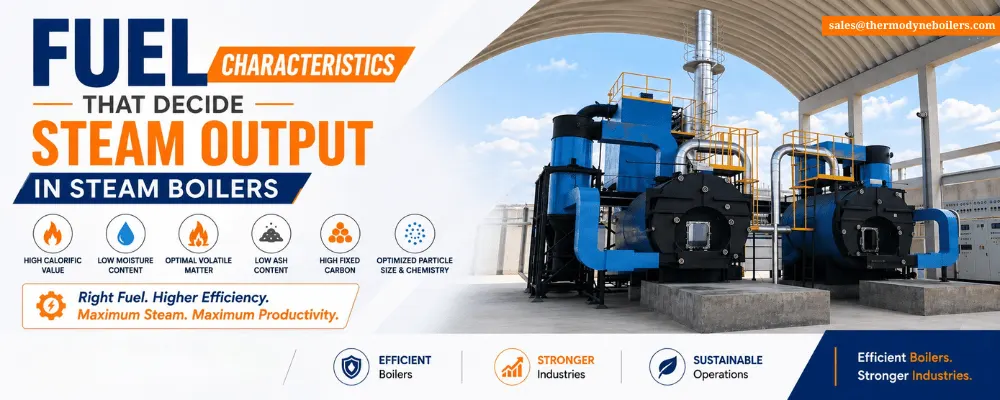
In industrial production, steam boilers form the backbone of operations, delivering high-pressure steam for heating, sterilization, drying, and turbine applications. While the design and capacity of a steam boiler play a vital role in performance, the characteristics of the fuel used are equally critical in determining steam output and operational efficiency.
Understanding how fuel properties affect combustion and heat transfer is essential for industries relying on industrial steam boilers to maintain consistent, high-quality steam and reduce operational costs.
1. Calorific Value – Energy Content Determines Steam Output
The calorific value of fuel represents the total energy released during combustion. Fuels with higher calorific values generate more heat per unit, leading to increased steam output from a steam boiler.
- High-Calorific Fuels: Oil, natural gas, and high-grade coal provide rapid energy release, ensuring faster and more stable steam generation.
- Low-Calorific Fuels: Biomass, agro-waste, and low-grade coal produce less heat per kilogram, requiring more fuel and longer combustion times, which can reduce industrial boiler efficiency.
Insight: Selecting fuels with consistent calorific values ensures predictable performance from industrial steam boilers and reduces operational variability.
2. Moisture Content – Impact on Boiler Efficiency
Fuel moisture acts as a heat sink. High moisture content reduces the effective heat available for steam generation, directly impacting steam output in industrial boilers.
- High Moisture Fuels: Wet biomass or agro-residues absorb heat to evaporate water, slowing down steam production and increasing fuel consumption.
- Low Moisture Fuels: Dried biomass, pellets, oil, and gas release maximum energy, enabling faster steam generation and improved steam boiler efficiency.
Recommendation: Using moisture-controlled fuels or pre-dried biomass can enhance industrial steam boiler performance.
3. Volatile Matter – Quick Ignition for Consistent Steam
Volatile matter is the portion of fuel that vaporizes and combusts easily. Fuels rich in volatile content ignite rapidly, providing immediate heat to steam boilers.
- High Volatile Fuels: Wood, certain agro-waste, and coal blends produce rapid steam output, ideal for processes requiring fast heat.
- Low Volatile Fuels: Hard coal or low-grade biomass requires controlled combustion to maintain stable industrial boiler performance.
4. Ash Content – Maintaining Heat Transfer Efficiency
Ash is the non-combustible residue left after fuel combustion. High ash content reduces the net heat available for steam generation and may cause scaling or fouling in industrial steam boilers.
- High Ash Fuels: Some coals and untreated agro-waste can reduce heat transfer efficiency and increase maintenance requirements.
- Low Ash Fuels: Oil, gas, and processed biomass ensure cleaner combustion and consistent steam output.
Operational Tip: Regular ash removal and proper fuel selection enhance the life and efficiency of industrial boilers.
5. Fixed Carbon – Sustaining Long-Term Heat
Fixed carbon represents the portion of fuel that burns slowly and provides sustained heat for steam boilers.
- High Fixed Carbon Fuels: Hard coal and biomass briquettes ensure steady steam generation over extended periods.
- Low Fixed Carbon Fuels: Fuels with less fixed carbon can lead to fluctuating steam output, affecting industrial processes.
6. Particle Size and Chemical Composition
Fuel particle size influences combustion efficiency. Uniform, small particles burn completely, while larger or irregular particles may cause incomplete combustion in steam boilers, reducing heat transfer. The chemical composition of fuel—including carbon, hydrogen, and sulfur—also affects flame temperature, emissions, and overall industrial boiler performance.
- Optimized Particle Size: Pulverized coal or processed biomass improves steam boiler efficiency.
- Chemical Considerations: Hydrogen-rich fuels enhance latent heat for steam generation, while high-sulfur fuels require careful corrosion management.
Conclusion
The steam output of a steam boiler depends significantly on fuel characteristics. By carefully evaluating calorific value, moisture content, volatile matter, ash content, fixed carbon, particle size, and chemical composition, industries can ensure reliable and efficient steam generation.
At Thermodyne Engineering Systems, our industrial steam boilers and industrial boilers are designed to efficiently handle a wide range of fuels, from biomass and agro-waste to coal, oil, and gas. Choosing the right fuel for your steam boiler ensures maximum energy utilization, consistent steam output, and sustainable industrial operations.
Investing in the right boiler combined with the right fuel strategy guarantees enhanced productivity, reduced operational costs, and long-term reliability for any industrial process.