Every year, manufacturing plants, EPC contractors, and utility engineers commission industrial water tank installations that underperform within the first five years — not because the tanks were poorly manufactured, but because the selection process was flawed from the outset. Choosing the right industrial water tank is a mission-critical engineering decision, yet it is consistently treated as a procurement afterthought. The consequences range from chronic pressure deficiencies and unexpected structural failures to accelerated corrosion, regulatory non-compliance, and six-figure lifecycle cost overruns.
This blog identifies the most technically significant mistakes industries make during the selection of an industrial water storage system — and explains how to avoid them with engineering precision.
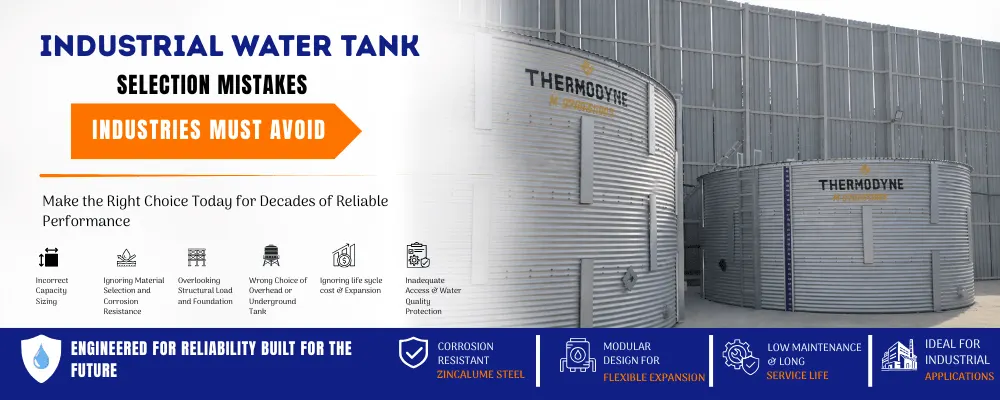
Mistake 1: Incorrect Capacity Sizing for the Industrial Water Tank
Oversizing wastes capital. Undersizing creates operational crises. Yet both are alarmingly common.
Most plant engineers rely on approximations — a rough daily consumption figure multiplied by a safety factor — rather than a structured hydraulic demand analysis. In process industries such as pharmaceuticals, food and beverage, and chemical manufacturing, water demand is not linear. It spikes during production cycles, equipment flushing operations, fire suppression demand intervals, and boiler feed requirements.
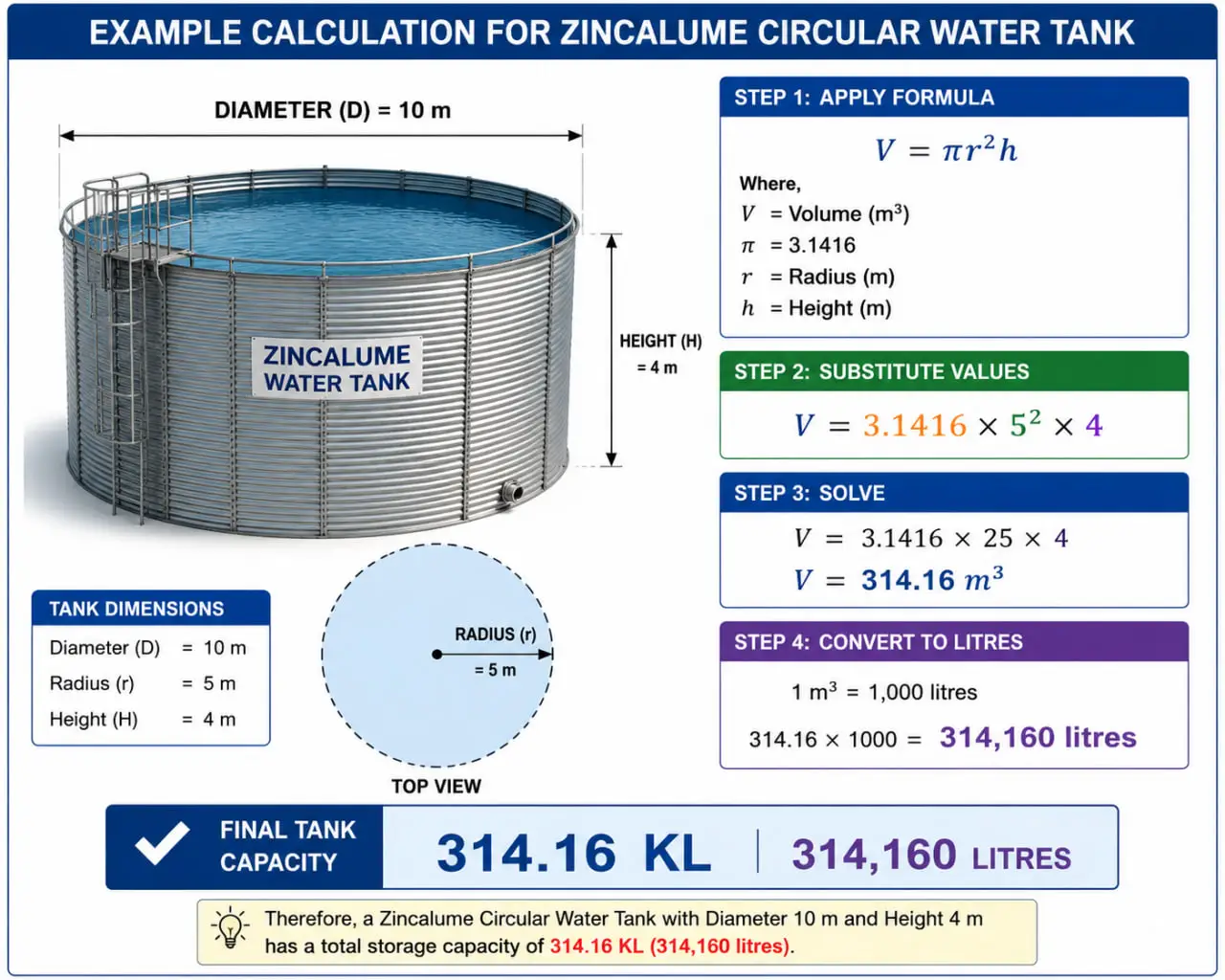
How to Calculate the Exact Capacity of an Industrial Water Tank
The correct approach uses a volumetric demand model, not a rule-of-thumb buffer.
Formula for Circular Water Tank Capacity
Formula:
V= πr2h
Why incorrect sizing creates operational problems:
- Undersized tanks create pressure drop during peak demand, stalling pneumatic systems, cooling towers, and process lines
- Oversized tanks increase static head beyond pipe pressure ratings, demanding additional pressure regulation hardware
- In cold-climate operations, oversized tanks with low turnover rates create stagnation zones, accelerating microbial growth and biofilm formation
Demand planning must account for future expansion, seasonal load variation, and emergency reserve requirements — not just current consumption averages.
Mistake 2: Ignoring Material Selection and Corrosion Resistance in Industrial Water Storage Tank Projects
Material selection is the most technically consequential decision in any industrial water tank project, and it is routinely under engineered. The default choice of mild steel — uncoated or with basic epoxy lining — results in accelerated internal corrosion when exposed to water with high TDS (Total Dissolved Solids), chloride content above 250 mg/L, or aggressive pH ranges outside 6.5–8.5.
For industrial facilities storing process water, raw water, or recycled effluent, the corrosion rate of unprotected carbon steel can exceed 0.5 mm/year. Over a 20-year lifecycle, this translates to structural wall thinning, contamination of stored water, and premature tank decommissioning.
The proven alternative is zincalume tanks, which use a steel substrate coated with a Zn-Al-Mg alloy. This metallurgical composition delivers self-healing barrier protection — when the surface is scratched or cut during installation, the zinc-aluminum matrix sacrificially oxidises to protect the exposed steel. Zincalume water storage tanks consistently demonstrate corrosion resistance 4–6 times superior to galvanised steel in independent accelerated salt-spray testing.
Industries operating in coastal zones, high-humidity environments, or areas with aggressive groundwater chemistry should mandate Zincalume-grade construction in their technical specifications. Failing to specify this at the procurement stage results in corrosion-related maintenance cycles beginning as early as Year 3–5, compared to Year 15+ for properly specified Zincalume tanks.
Mistake 3: Overlooking Structural Load and Foundation Engineering for the Industrial Water Tank
A 500 KL industrial water tank filled to capacity exerts approximately 500 metric tonnes of force on its foundation. This is not a civil engineering consideration that can be resolved post-installation. Yet many projects proceed with tank procurement before geotechnical soil bearing capacity reports are commissioned.
The critical structural parameters that must be verified before installation include:
- Soil bearing capacity (kN/m²): Must be evaluated at the planned foundation depth; soft or expansive soils require raft foundations or driven pile systems
- Seismic zone classification: In Seismic Zones III–V (as per IS 1893), tanks must comply with dynamic load analysis per IS 3370 for water retaining structures
- Wind load and overturning moment: Elevated overhead tanks are particularly vulnerable; slender aspect ratios (height-to-diameter > 1.5) demand detailed stability calculations
- Differential settlement tolerance: Modular bolted tanks offer a significant advantage here — they can be relevelled during maintenance cycles, unlike monolithic welded structures
Ignoring structural load analysis has caused several catastrophic tank collapses in industrial estates across South Asia — incidents that are preventable with standard pre-installation geotechnical investigation.
Mistake 4: Choosing Overhead vs. Underground Installations Without Hydraulic Mapping
The decision between overhead and underground industrial water tank is treated as a site preference issue when it is fundamentally a hydraulic systems engineering problem.
Overhead tanks generate gravity-driven head pressure of approximately 0.1 bar per metre of elevation. A 10-metre elevated tank delivers 1.0 bar at the base — adequate for most process applications. However, if distribution headers serve process equipment with minimum inlet pressure requirements above 2.5 bar, a gravity-only system is inadequate and must be supplemented by booster pump sets.
Underground tanks eliminate pressure variability but introduce their own engineering constraints: hydrostatic groundwater uplift forces during low-fill conditions can cause flotation of empty or near-empty tanks unless properly anchored; internal inspection and cleaning access becomes operationally complex; and pump suction head calculations must account for the total suction lift from below-grade storage.
Selecting the wrong configuration based purely on site aesthetics or contractor preference — without running a hydraulic gradient analysis across the full distribution network — creates pressure-related production losses that no amount of pump retrofitting can economically correct.
Mistake 5: Ignoring Life Cycle Cost Analysis and Expansion Planning
The industrial water tank with the lowest capital cost is almost never the one with the lowest 20-year total cost of ownership. Yet capital expenditure dominates procurement decisions in most industrial environments.
A lifecycle cost model for an industrial water tank must include:
- Annual maintenance cost: Internal inspection, cleaning, lining reapplication, fastener inspection
- Corrosion-driven replacement cycles: Mild steel tanks typically require full replacement at Year 10–12; Zincalume water storage tanks routinely exceed 20-year service life
- Downtime cost: Production interruption during tank maintenance — quantified at actual plant output values, not standard industry averages
- Expansion cost: Modular bolted panel tanks allow capacity addition in situ, eliminating the cost of new tank procurement when production scales
A 100 KL mild steel tank at ₹6.5 lakhs may appear more economical than a 100 KL Zincalume tank at ₹4.5 lakhs. However, when a corrosion-triggered replacement at Year 8 is factored in, along with two major relining operations, the mild steel option carries a 20-year TCO nearly 60% higher than the Zincalume alternative.
This is the analysis that separates technically informed procurement from price-driven purchasing.
Mistake 6: Inadequate Access Design for Maintenance and Water Quality Protection
Two commonly neglected design parameters are maintenance accessibility and water quality preservation.
An industrial water tank without properly located manhole access points, internal ladder systems, and roof vent configurations creates a maintenance liability. Internal inspection — required annually under most industrial hygiene protocols — becomes confined-space hazardous work when access is not engineered into the original tank design.
Water quality degradation through UV exposure, algae growth, and atmospheric contamination is equally preventable. Tanks storing potable or process-grade water must include:
- UV-resistant roofing or opaque panel construction to prevent photosynthetic algae growth
- Self-draining roof profiles to prevent stagnant surface water and mosquito breeding
- Screened overflow and vent fittings to prevent particulate ingress
- Smooth internal surface profiles that eliminate ledge accumulation and facilitate complete drainage during cleaning cycles
These are not optional upgrades. They are functional requirements that must appear in the technical specification at the tendering stage — not as site-level corrections after commissioning.
Conclusion: Technical Rigour in Industrial Water Tank Selection Is Non-Negotiable
The industrial water tank is the cornerstone of any plant’s utility infrastructure. Every mistake made during its selection — whether it involves miscalculated capacity, wrong material grade, inadequate structural analysis, or a mismatched installation type — multiplies in cost and complexity over the operational life of the facility. Industries that apply engineering rigour to tank selection, perform proper life cycle cost modelling, and specify proven materials like Zincalume from qualified industrial water tank manufacturers consistently outperform those that treat water storage as a commodity procurement.
The technical decisions made before a tank is ordered define the operational reliability of the water system for the next two decades. Make them with precision.
About Our Zincalume Tank Solutions
Our company Thermodyne Engineering Systems is an experienced industrial water tank manufacturer offering a comprehensive range of Zincalume water storage tanks engineered for demanding industrial environments. Built with corrosion-resistant Zincalume steel, modular panel design for flexible capacity scaling, and industrial-grade construction for long service life and minimal maintenance, our tanks are designed to deliver reliable, cost-effective water storage performance across manufacturing, infrastructure, and process industries. Contact our technical team for a capacity sizing consultation and lifecycle cost analysis tailored to your plant’s specific requirements.
FAQs: Industrial Water Tank Selection
Sizing based on average daily consumption instead of peak demand, fire reserves, and future expansion needs.
Use: V=πr2h
Where:
- V = Volume of tank (m³)
- π = 3.1416
- r = Radius of tank (m)
- h = Height of tank (m)
Overhead suits gravity-fed systems with adequate pressure. Underground suits high-demand facilities with booster pumps. Choose based on your required distribution pressure, not site preference.
Zincalume water storage tanks use a Zn-Al-Mg alloy coating that is self-healing and 4–6× more corrosion-resistant than standard galvanised steel — especially in coastal or high-TDS environments.
Yes. Soil bearing capacity, groundwater level, and seismic zone classification must be assessed before installing any tank above 50 KL.
60+ years with minimal maintenance, compared to 10–12 years for unlined mild steel tanks.
Internal cleaning every 6–12 months for process or potable water; annual inspection for all tank types.
Use opaque or UV-resistant panels, screened vents, self-draining roofs, and maintain adequate water turnover.
Certified material traceability, structural design documentation, Zincalume-grade construction, and post-installation warranty support.