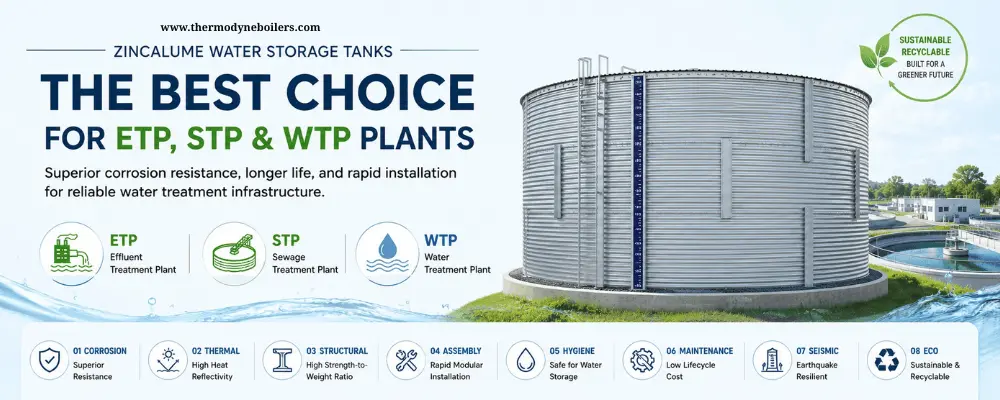
Water treatment facilities—whether using an (Effluent Treatment Plant) ETP tank or a (Sewage Treatment Plant) STP tank—require durable storage solutions to handle chemically aggressive fluids and varying operating conditions. A well-designed STP tank is essential for maintaining process stability, operational safety, and long-term efficiency in treatment plants.
Traditional materials like RCC and GI have limitations, including cracking, leakage, and corrosion in ETP tank and STP applications. In comparison, zincalume tanks offer superior strength, excellent corrosion resistance, and longer service life. Their modular design also ensures faster installation and reduced maintenance, making them a reliable and cost-effective solution for modern water treatment infrastructure.
Why ETP, STP & WTP Environments Demand Superior Materials
ETP — Effluent Treatment
Industrial effluents handled in an (Effluent Treatment Plant) ETP tank contain heavy metals, acids, alkalis, and dissolved salts. pH levels can fluctuate widely, creating a highly aggressive environment. Such conditions expose the ETP tank to continuous chemical attack, hydrogen sulphide vapours, and biological fouling, demanding materials with exceptional corrosion resistance.
STP — Sewage Treatment
A (Sewage Treatment Plant) STP tank deals with sewage containing ammonia, organic acids, and hydrogen sulphide gas—one of the most corrosive elements in wastewater systems. In addition, fluctuating water levels in an STP tank cause wet-dry cycles along the tank walls, accelerating corrosion, especially at the waterline.
WTP — Water Treatment
A WTP tank stores treated water containing residual chlorine, fluoride, or ozone, creating an oxidising environment. These conditions require storage systems that maintain hygiene while resisting long-term chemical degradation.
Across all three applications—ETP tank, STP tank, and WTP systems—the common challenge is sustained chemical exposure over long service periods. In such demanding conditions, zincalume tanks provide a durable, corrosion-resistant, and cost-effective solution, reducing the need for frequent replacement and minimizing operational disruptions.
Material Comparison Table
ETP, STP aur WTP applications ke liye teen main materials ka detailed comparison:
| Parameter | RCC Tank | GI Tank | Zincalume Tank |
|---|---|---|---|
Corrosion Resistance |
Moderate |
Low |
Excellent |
Service Life |
25–30 years |
7–10 years |
25–30+ years |
Installation Time |
60–90 days |
20–30 days |
12–15 days |
H₂S Gas Resistance |
Moderate |
Poor |
Good |
Seismic Resistance |
Low (Brittle) |
Moderate |
High (Ductile) |
Recyclability |
No |
Partial |
100% |
Tensile Strength |
~30 MPa |
~250 MPa |
~550 MPa |
Heat Reflectivity |
Low |
Low |
High (Al surface) |
Potable Water Use |
Conditional |
Limited |
Yes (with liner) |
Eight Technical Reasons Zincalume Excels in Treatment Plants
01 · Corrosion – Superior Resistance
In demanding environments such as an (Effluent Treatment Plant) ETP tank or (Sewage Treatment Plant) STP tank, corrosion is a major concern. The dual barrier–galvanic protection of zincalume tanks resists both acidic and alkaline conditions, extending service life by 3 to 4 times compared to conventional GI tanks.
02 · Thermal – High Heat Reflectivity
The aluminium-rich surface of zincalume tanks reflects solar radiation, reducing internal water temperature rise by up to 10–15°C. This is especially beneficial for biological processes inside an STP tank, where temperature stability directly affects microbial efficiency.
03 · Structural – High Strength-to-Weight Ratio
Zincalume panels retain high tensile strength (around 550 MPa), enabling lightweight yet robust designs for ETP tank and STP applications. This reduces foundation load while maintaining structural integrity.
04 · Assembly – Rapid Modular Installation
Prefabricated panels allow zincalume tanks to be assembled quickly on-site. A 500 KL STP tank or ETP tank can typically be installed within 12 to 15 days, minimizing plant downtime and reducing labour costs.
05 · Hygiene – Safe for Water Storage
When equipped with approved liners, zincalume tanks meet potable water standards, making them suitable even for WTP tank applications where hygiene and water quality are critical.
06 · Maintenance – Low Lifecycle Cost
Unlike conventional ETP tank or STP systems, zincalume tanks require minimal maintenance. Their self-healing coating reduces the need for frequent repairs, lowering operational expenditure over time.
07 · Seismic – Earthquake-Resilient Design
The ductile steel structure of zincalume tanks absorbs dynamic loads effectively, making them more reliable than rigid concrete structures for STP tank installations in seismic zones.
08 · Eco – Sustainable & Recyclable
Zincalume water storage tanks are 100% recyclable and often contain recycled steel, making them an environmentally responsible choice for ETP tank, STP tank, and WTP tank infrastructure projects.
Zincalume water storage tanks are 100% recyclable and often contain recycled steel, making them an environmentally responsible choice for ETP tank, STP tank, and WTP tank infrastructure projects.
Design and Specification Considerations
When specifying zincalume tanks for an (Effluent Treatment Plant) ETP tank, (Sewage Treatment Plant) STP tank, or WTP service, engineers must carefully evaluate key design parameters to ensure long-term performance and reliability. These include base steel grade and thickness (minimum 3.0 mm for tanks above 100 KL), coating mass (AZ150 or AZ200, with higher grades recommended for aggressive ETP tank environments), and liner type with appropriate certification based on chemical exposure.
Roof configuration—whether fixed or floating, vented or sealed—should be selected based on the volatility and nature of fluids stored in the STP tank or WTP system. Foundation design must comply with IS 3370 standards, using either a ring beam or full slab depending on load conditions and site requirements.
Additionally, all inlet, outlet, and overflow nozzles in zincalume tanks should be properly sealed using EPDM or Buna-N gaskets compatible with the service fluid. Fasteners must be stainless steel Grade 316 to prevent bimetallic corrosion, ensuring long-term durability of ETP tank and STP tank installations.
| Application | Main Challenge | Zincalume Solution |
|---|---|---|
ETP Tank |
Heavy metals, acids, alkalis, H₂S vapours, biological fouling |
Dual-barrier coating + AZ200 grade liner |
STP Tank |
Ammonia, organic acids, H₂S gas, wet-dry cycles at waterline |
Corrosion-resistant panels + thermal management |
WTP Tank |
Residual chlorine, fluoride, ozone — oxidising environment |
Approved liner + hygiene-certified design |
Conclusion: A Material Engineered for the Job
Zincalume tanks bring together advanced corrosion resistance, structural strength, and practical constructability—making them ideally suited for modern (Effluent Treatment Plant) ETP tank, (Sewage Treatment Plant) STP tank, and WTP applications. Designed to withstand aggressive environments, these tanks ensure long-term reliability across diverse treatment processes.
With a multi-decade service life, minimal maintenance requirements, and rapid installation, zincalume tanks offer a cost-effective solution for both ETP tank and STP tank systems. Their recyclability further supports sustainable infrastructure development.
As water treatment infrastructure continues to expand across industrial and municipal sectors, selecting the right STP tank or ETP tank material is not just a specification—it is a critical engineering decision that directly impacts performance, cost, and long-term operational success.
FAQs related to Zincalume Tanks-
A Zincalume tank is a modular steel storage tank coated with a zinc-aluminium alloy that provides superior corrosion resistance, high durability, and long service life. These tanks are widely used in ETP, STP, and WTP applications for industrial and municipal water storage.
Zincalume tanks are preferred for Effluent Treatment Plants because they can withstand aggressive chemicals, acids, alkalis, and dissolved salts commonly present in industrial wastewater. Their corrosion-resistant coating helps reduce maintenance and increases operational life.
Yes, Zincalume tanks are highly suitable for STP applications. They resist corrosion caused by hydrogen sulphide gas, ammonia, and organic waste, making them ideal for long-term sewage storage and treatment operations.
A properly designed and maintained Zincalume tank can deliver a service life of 25–40 years depending on environmental conditions, coating grade, and operating application.
Yes, when fitted with approved food-grade liners, Zincalume tanks are suitable for potable water and treated water storage applications in WTP systems.
Compared to RCC tanks, Zincalume tanks offer:
- Faster installation
- Better corrosion resistance
- Lower maintenance cost
- Improved seismic performance
- Lightweight modular construction
- Longer operational life
Yes, Zincalume tanks provide excellent corrosion resistance due to their zinc-aluminium protective coating system, which offers both barrier and galvanic protection against rust and chemical attack.
Because of their modular prefabricated design, Zincalume tanks can be installed much faster than conventional RCC tanks. Large-capacity tanks can often be assembled within a few weeks depending on project size.
Yes, Zincalume tanks are considered eco-friendly because they are 100% recyclable, require minimal maintenance, and often use recycled steel during manufacturing.
For aggressive wastewater environments such as ETP and STP applications, higher coating grades like AZ150 or AZ200 are generally recommended for improved durability and corrosion resistance.
Modular storage tanks are gaining popularity because they offer:
- Rapid installation
- Scalability
- Lower lifecycle cost
- Easy transportation
- Minimal civil work
- Better operational flexibility
These advantages make them highly efficient for modern water treatment infrastructure.