In industrial steam systems, maintaining a stable and reliable steam supply is essential for smooth production and energy efficiency. However, many industries operate with fluctuating steam demand, where sudden peaks can exceed the boiler’s capacity. This mismatch often leads to pressure drops, inefficient combustion, and production losses.
A steam accumulator solves this problem by acting as a thermal energy storage system. But to achieve maximum efficiency, it must be accurately sized based on process requirements.
In this detailed guide, we’ll explain how to size a steam accumulator for industrial boiler systems, including formulas, calculations, design considerations, and best practices.
What is a Steam Accumulator?
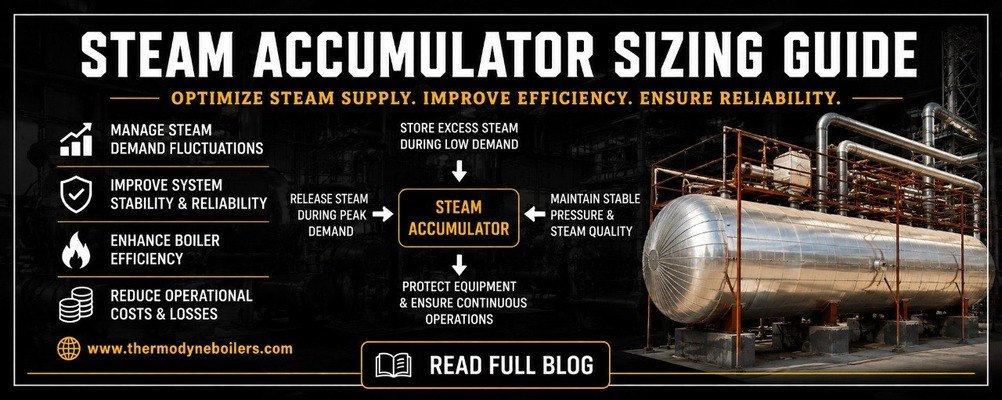
A steam accumulator is a high-pressure insulated vessel that stores excess thermal energy in the form of hot water and saturated steam. During low demand, excess steam is stored, and during peak demand, the stored energy is released as steam.
How It Works:
- During low demand → Steam is stored as hot water under pressure
- During peak demand → Pressure drops → Flash steam is generated
- Result → Instant steam supply without increasing boiler load
Why Steam Accumulator Sizing is Critical
Proper sizing of a steam accumulator plays a vital role in ensuring efficient and reliable operation of an industrial steam system.
An undersized accumulator cannot store enough energy to handle sudden spikes in steam demand, leading to pressure drops, unstable process conditions, and potential production downtime. This directly affects product quality and operational efficiency.
On the other hand, an oversized accumulator results in unnecessary capital expenditure and increased heat losses due to a larger surface area. It also requires more installation space and may lead to inefficient utilization of stored energy.
Accurate sizing ensures that the steam accumulator delivers the required steam during peak demand without overburdening the boiler. It helps maintain consistent pressure, improves fuel efficiency, and optimizes overall system performance.
The objective is to achieve the perfect balance between storage capacity and actual process demand for maximum efficiency and cost-effectiveness.
Key Parameters Required for Steam Accumulator Sizing
Before sizing a steam accumulator, it is important to collect accurate system data, as it directly affects performance and efficiency.
1. Steam Demand Pattern
This includes peak demand, average demand, frequency of demand spikes, and duration of peak load. It helps determine how much steam needs to be stored and supplied during fluctuations.
2. Boiler Capacity
The boiler’s maximum output, turndown ratio, and response time define how much load it can handle and how quickly it can react to demand changes.
3. Operating Pressure Range
4. Feedwater Temperature
5. Cycle Time
Step-by-Step Steam Accumulator Sizing Calculation
Step 1 — Find the "Surge Demand" (the gap you need to fill)
You need to know:
- Peak steam demand of your process (kg/hr)
- Boiler steady output (kg/hr)
- Duration of the surge (minutes)
Steam to be supplied by accumulator = (Peak demand − Boiler output) × Surge duration
Example: Peak = 5000 kg/hr, Boiler = 3000 kg/hr, Surge = 10 min → Accumulator must deliver = (5000−3000) × 10/60 = 333 kg of steam
Step 2 — Decide the Pressure Range (Charging & Discharging)
This is the most important sizing lever.
| Pressure | Role |
|---|---|
Charging pressure (P1) |
Pressure at which boiler fills the accumulator — usually boiler operating pressure |
Discharging pressure (P2) |
Pressure at which process draws steam — lower than P1 |
The wider the pressure swing (P1 − P2), the more steam you can release from the same size tank.
Typical practice:
- P1 = boiler pressure (e.g., 10 bar g)
- P2 = process minimum acceptable pressure (e.g., 6 bar g)
- A 3–5 bar swing is common and practical
Step 3 — Calculate Tank Volume
- M = mass of steam to be discharged (kg) — from Step 1
- ρ_water = density of saturated water at each pressure (from steam tables)
- Specific volume of water at 10 bar ≈ 0.001127 m³/kg
- Specific volume of water at 6 bar ≈ 0.001101 m³/kg
- The difference drives the flash, and iterating through steam tables gives you a tank in the range of 10–20 m³ for 333 kg discharge.
Step 4 — Decide Water Space vs Steam Space
This is a critical design decision:
Water Space (typically 80–90% of tank volume)
- This is where the energy is actually stored — as hot pressurised water
- Larger water space = more steam available on discharge
- Most of the tank should be water
Steam Space (typically 10–20% of tank volume)
- Acts as a buffer cushion — absorbs sudden pressure shocks
- Helps stabilise pressure during rapid draw-off
- Too small → pressure crashes instantly on demand
- Too large → wastes tank volume
Rule of thumb:
Water space = 80–85%, Steam space = 15–20%
The steam space is also needed to ensure the outlet pipe draws dry steam and not water, protecting your equipment.
Quick Summary Table
| Parameters | Typical Value |
|---|---|
Charging pressure |
Boiler pressure (8–15 bar g) |
Discharging pressure |
Process pressure (3–8 bar g) |
Pressure swing |
3–6 bar minimum for good efficiency |
Water fill level |
80–85% of tank |
Steam cushion |
15–20% of tank |
Safety margin on volume |
Add 10–15% to calculated size |
The Golden Rule
More pressure swing = smaller tank needed Less pressure swing = much larger tank for same output
So always try to maximise the pressure difference within what your process can tolerate.
Advanced Design Considerations
Designing a steam accumulator is not just about capacity—it also requires optimizing performance, safety, and efficiency.
1. Pressure Drop Optimization
2. Insulation Efficiency
3. Flash Steam Efficiency
4. Control Systems
5. Safety Requirements
Benefits of Proper Steam Accumulator Sizing
1. Improved Boiler Efficiency
Reduces frequent load fluctuations, allowing the boiler to operate more efficiently.
2. Energy Savings
Excess steam is stored instead of being wasted, improving overall energy utilization.
3. Stable Process Operation
Maintains consistent steam pressure and temperature, ensuring smooth production.
4. Reduced Fuel Consumption
Minimizes the need for sudden high firing rates, leading to fuel savings.
5. Increased Equipment Life
Reduces thermal and mechanical stress on boilers, pipelines, and associated equipment.
Industrial Applications: Use of Steam accumulator in Plywood Industry
Plywood manufacturing relies heavily on steam for several operations, but the demand is highly fluctuating rather than steady.
The main steam consumer in a plywood plant is a hot press. After veneers are coated with adhesive (urea-formaldehyde, phenol-formaldehyde, or melamine resins) and stacked, they are pressed at roughly 110–150°C under high pressure. Each pressing cycle demands a huge surge of steam for a short duration (3–8 minutes), then almost nothing during loading and the boiler is sized for the average steam load, not the peak. When the hot press is idle, the boiler keeps generating steam, which gets stored in the accumulator by bubbling through the water — raising both the water level and pressure. When the press closes and demands a sudden burst of steam, the accumulator releases stored steam by flashing (the pressurized hot water boils as pressure drops), supplementing what the boiler can produce in real time.
Why Is It Practically a Must?
You would need to oversize the boiler by 2–3 times to handle peak loads, which is capital-intensive, fuel-inefficient at partial load, and wasteful since the peak demand lasts only minutes.
Pressure would crash every time the hot press opens for steam, causing inconsistent platen temperatures. This leads to under-cured glue lines, weak bonds, blisters, and rejected panels — a major quality issue in plywood where bond integrity is everything.
Conclusion
A steam accumulator is a highly effective solution for managing fluctuating steam demand, but its success depends on accurate sizing and proper design.
By carefully analyzing steam demand patterns, boiler capacity, pressure range, and energy storage requirements, industries can achieve: Higher efficiency Lower fuel consumption Stable production Reduced operational costs
A well-designed steam accumulator not only enhances performance but also ensures long-term reliability and energy optimization of your boiler system.
Need Expert Assistance?
At Thermodyne, we specialize in designing custom steam accumulator solutions tailored to your industry needs.
Get in touch today for expert consultation and optimized system design!