Most boilers don’t fail dramatically — they just quietly bleed money. A little scale here, a leaking trap there, slightly too much excess air in the combustion chamber, and before long you’re burning 20% more fuel than you should be. Poor boiler efficiency rarely announces itself; it just shows up on your energy bill every single month.
The good news? You don’t need a full system replacement to fix it. Improving boiler efficiency is largely about discipline — regular maintenance, smarter controls, and a few targeted upgrades that pay for themselves faster than most people expect. Here are six strategies that actually move the needle.
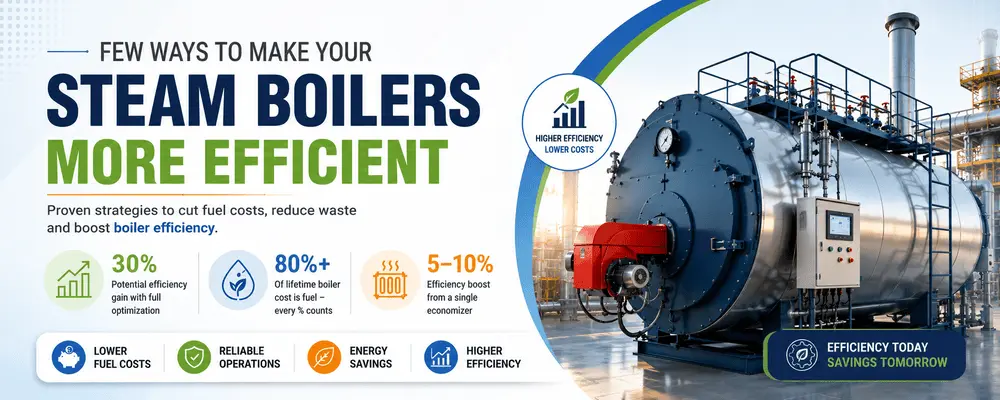
30%
Potential efficiency gain with full optimization
80%+
Of lifetime boiler cost is fuel — every % counts
5–10%
Efficiency boost from a single economizer
6 PROVEN STRATEGIES
01 — Regular Cleaning of Heat Transfer Surfaces
The most fundamental step toward better boiler efficiency is keeping heat transfer surfaces clean and free of deposits. Scale builds up on the water side when dissolved minerals — primarily calcium and magnesium — precipitate out of untreated or poorly treated feedwater. On the fire side, soot accumulates from incomplete combustion. Both act as insulators, forcing the boiler to burn progressively more fuel to achieve the same steam output.
Even a thin scale layer of just one millimeter can reduce heat transfer by up to 10 percent. Scheduling regular tube cleaning, maintaining a rigorous water treatment program, and monitoring flue gas outlet temperatures to detect fouling early are straightforward habits that pay consistent dividends.
→ Schedule annual or semi-annual tube cleaning based on water quality conditions
→ Use a chemical water treatment program to minimize scale-forming minerals in feedwater
→ Monitor flue gas temperature at the stack — a rising trend signals fouling
→ Perform soot blowing regularly in oil-fired or coal-fired boilers to clean the fire side
02 — Optimize Combustion Air to Minimize Stack Losses
Excess combustion air is one of the most significant and most correctable sources of wasted energy in steam systems. When more air enters the furnace than the fuel requires for complete combustion, that excess volume absorbs heat and carries it straight out through the stack — energy that has been paid for but never used productively.
Calibrating burners carefully, installing a continuous oxygen analyzer in the flue gas path, and deploying an oxygen trim control system that automatically adjusts airflow based on real-time load conditions are proven methods for tightening combustion and recovering this hidden loss without compromising safety.
→ Target 10–15% excess air for natural gas; 15–20% for oil; 20–30% for coal
→ Install a permanent flue gas O₂ analyzer and review readings regularly
→ Upgrade to automatic oxygen trim control to maintain optimal air ratio across load changes
→ Check for air in-leakage in the boiler casing, which distorts O₂ readings
“Every 40°F reduction in flue gas temperature corresponds to approximately 1% gain in boiler efficiency — a straightforward number with profound financial implications for any steam system.”
03 — Recover Waste Heat with an Economizer
Hot flue gases leaving the boiler still carry substantial usable energy. In many older installations, this heat is simply vented to the atmosphere — a significant and entirely preventable waste. An economizer is a heat exchanger installed in the flue gas path that captures this residual energy and uses it to preheat incoming feedwater before it enters the boiler drum.
By raising feedwater temperature, you directly reduce the heat input required to generate steam, improving overall boiler efficiency by five to ten percent. A properly sized economizer typically recovers its installation cost within two to three years through fuel savings alone, making it one of the strongest return-on-investment upgrades available.
→ Condensing economizers offer the highest heat recovery for natural gas-fired boilers
→ Ensure flue gas exit temperature stays above the acid dew point to prevent corrosion
→ Consider a combustion air preheater as a complementary or alternative measure
→ Size the economizer correctly for your load range — oversizing can cause flow problems
04 — Eliminate Steam Leaks and Maximize Condensate Return
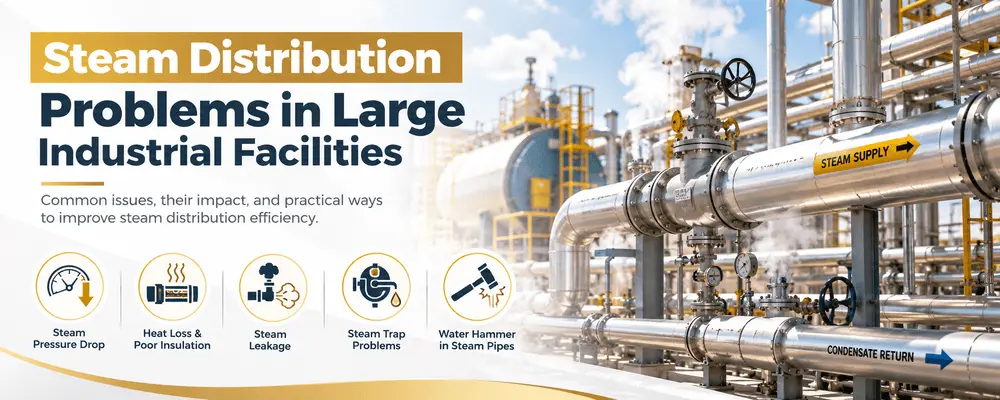
Steam leaks and failed steam traps are among the most persistent hidden losses in any distribution system, and they take a direct toll on boiler efficiency. A single failed-open steam trap can discharge thousands of kilograms of live steam per year. Multiply that across a facility with hundreds of traps, and the losses compound quickly.
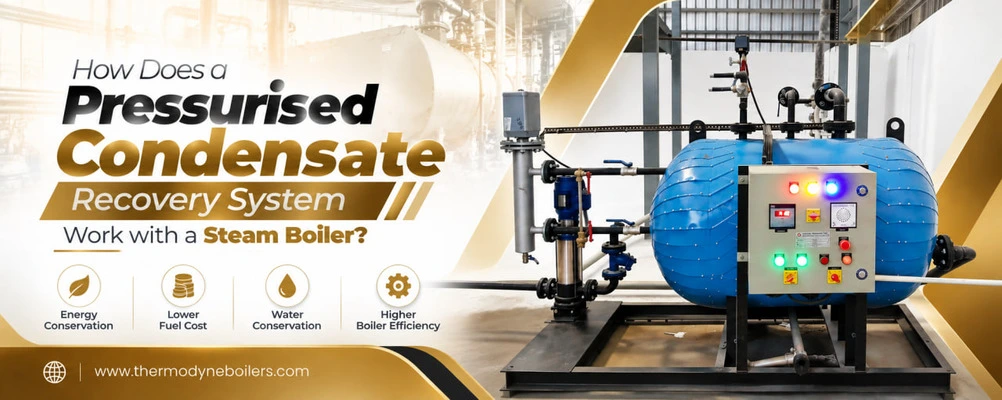
Maximizing condensate return is equally critical — hot condensate carries both thermal energy and pre-treated water back to the boiler, reducing the need to heat cold makeup water and repeat costly chemical treatment. Targeting a condensate return rate above 80 percent is a realistic and highly cost-effective goal for most facilities.
→ Survey all steam traps annually using ultrasonic or infrared testing equipment
→ Replace failed-open traps immediately — a single trap can cost thousands per year
→ Insulate all steam lines, flanges, and valves to cut radiation and convection losses
→ Repair even small pipe leaks promptly — a 3mm orifice at 7 bar wastes ~25 kg/hr of steam
05 — Reduce Operating Pressure to Process Minimum
A widely overlooked opportunity for improving boiler efficiency lies in simply reducing steam pressure to the lowest level your process genuinely requires. Many facilities run boilers at historically set pressures that were once conservative safety buffers but are now unnecessarily high.
Higher pressure corresponds directly to a higher saturation temperature, which demands more heat input, increases standing heat losses through the shell and pipework, and accelerates wear on pressure-containing components. Reducing header pressure — even modestly by 0.5 to 1 bar — can produce meaningful improvements with zero capital investment.
→ Review all process steam consumers and document their actual minimum pressure needs
→ Reduce header pressure in steps and monitor for any operational issues
→ Use pressure-reducing valves close to each consumer rather than running the whole system high
→ Stage multiple smaller boilers at full load rather than one large boiler at partial load
06 — Upgrade Controls and Implement Continuous Monitoring
Even a well-maintained boiler will underperform without accurate, responsive controls. Older on/off systems cause unnecessary cycling, pressure fluctuations, and combustion instability — all of which waste fuel and accelerate component wear. Upgrading to a modern boiler management system with modulating burner control and integrated oxygen trim keeps combustion continuously optimized across the full operating range.
Alongside better controls, investing in permanent performance monitoring — flue gas analyzers, steam flow meters, and energy dashboards — gives operators real-time visibility to catch inefficiencies before they compound. What gets measured gets managed, and continuous data is the foundation of any serious boiler efficiency program.
→ Install an O₂ trim control system for automatic real-time combustion optimization
→ Use a SCADA or BMS to centralize all boiler monitoring in one interface
→ Set automated alerts for key metrics: stack temperature, blowdown rate, excess air level
→ Benchmark current performance monthly and track efficiency trends over time
The Bottom Line
Improving boiler efficiency is best understood as an ongoing discipline rather than a one-time project. The six strategies covered here — surface cleaning, combustion air optimization, economizer heat recovery, steam and condensate loss reduction, pressure management, and modern controls — are most powerful when pursued together as part of a structured energy management approach.
Given that fuel typically accounts for more than 80 percent of a boiler’s total lifetime operating cost, every percentage point of boiler efficiency improvement translates directly into lasting financial savings. Begin with a comprehensive energy audit to establish your current baseline, prioritize the measures with the shortest payback periods, and build a monitoring routine that protects and compounds your gains over time.
Frequently Asked Questions (FAQs)
Boiler efficiency is the percentage of fuel energy that is converted into useful steam energy. A higher boiler efficiency means lower fuel consumption, reduced operating costs, and improved performance of the steam system.
You can improve boiler efficiency by cleaning heat transfer surfaces, optimizing combustion air, installing a boiler economizer, reducing steam leaks, increasing condensate recovery, implementing proper boiler water treatment, and using advanced control systems.
The ideal steam boiler efficiency depends on the boiler type and fuel used. Modern industrial steam boilers can achieve efficiencies above 90%, while older systems may operate between 70% and 85%.
A boiler economizer recovers waste heat from flue gases and uses it to preheat feedwater before it enters the boiler. This reduces fuel consumption and can improve boiler efficiency by 5% to 10%.
Proper boiler water treatment prevents scale formation, corrosion, and sludge buildup inside the boiler. Clean heat transfer surfaces improve steam boiler efficiency and reduce fuel costs.
Boiler heat loss occurs due to excessive flue gas temperatures, poor insulation, steam leaks, excessive blowdown, and improper combustion. Identifying and minimizing these losses is essential for improving boiler efficiency.
Steam leaks waste valuable thermal energy and increase fuel consumption. Even small leaks can significantly reduce boiler efficiency and increase operating costs over time.
Boiler blowdown removes dissolved solids and impurities from boiler water. Properly controlled boiler blowdown helps maintain water quality while minimizing unnecessary heat and energy losses.
A waste heat recovery boiler captures heat from exhaust gases generated by industrial processes and converts it into useful steam. This improves overall plant energy efficiency and reduces fuel consumption.
Even a 1% improvement in boiler efficiency can result in significant annual fuel savings. Depending on boiler size and operating hours, facilities can save thousands of dollars each year through efficiency improvements.
Yes. Operating a boiler at the lowest pressure required by the process can reduce boiler heat loss, improve combustion performance, and enhance overall boiler efficiency.