In industrial steam systems, balancing supply and demand has always been a critical engineering challenge. A steam accumulator is one of the most effective solutions for managing fluctuating steam loads, particularly when connected to a steam boiler that struggles with rapid demand changes. Understanding how a steam accumulator enhances boiler turndown ratio can lead to major gains in efficiency, fuel savings, and operational stability.
Key Insight: A steam accumulator acts as a buffer — absorbing excess steam during low-demand periods and releasing it during peak demand, effectively extending a boiler’s operational range.
What Is a Boiler Turndown Ratio?
The turndown ratio of an industrial boiler refers to its ability to modulate output — specifically, the ratio between its maximum and minimum firing rates. For example, a boiler with a 4:1 turndown ratio can operate as low as 25% of its full capacity. The higher the turndown ratio, the more flexible the steam boiler is in meeting variable load demands without cycling on and off unnecessarily.
When load demand drops below the minimum stable firing rate, a boiler must shut down and restart, causing thermal stress, fuel waste, and increased maintenance. This is where a steam accumulator becomes indispensable.
How a Steam Accumulator Works
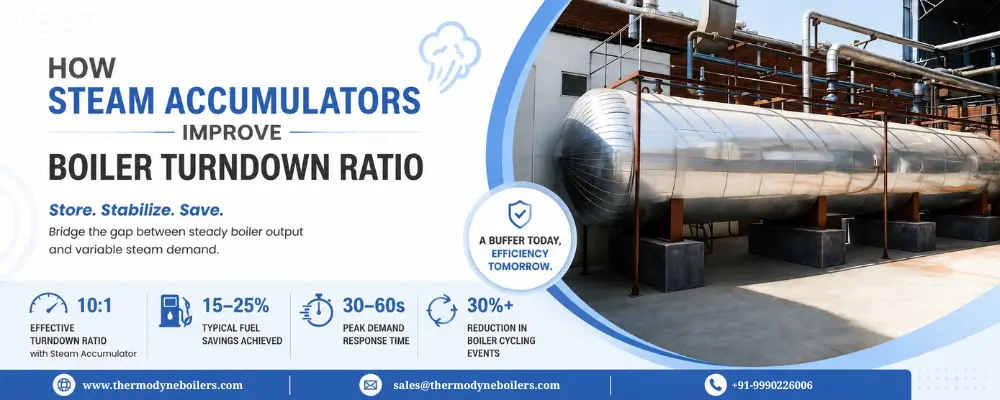
A steam accumulator — essentially a large pressurised steam storage tank — stores thermal energy in the form of hot water under pressure. When the industrial boiler generates more steam than currently needed, the excess is absorbed into the steam storage tank by condensing it into hot water at high pressure. When demand spikes and the boiler cannot respond fast enough, the pressure drop in the system causes this stored hot water to flash back into steam, instantly supplementing supply.
This charge-and-discharge cycle allows the steam boiler to operate at a steadier, more efficient firing rate rather than constantly ramping up and down. The result is a system that effectively behaves as though it has a much higher turndown ratio than the boiler alone could achieve.
10:1
Effective turndown ratio with steam accumulator
15–25%
Typical fuel savings achieved
30–60s
Peak demand response time
30%+
Reduction in boiler cycling events
Key Benefits for Industrial Boiler Performance
Integrating a steam accumulator with an industrial boiler delivers measurable improvements across multiple dimensions:
Improved energy efficiency: A steam boiler operating at a consistent firing rate runs more efficiently than one that cycles on and off. The steam accumulator smooths out load variation, reducing fuel consumption and stack losses significantly.
Extended boiler lifespan: Frequent thermal cycling is the primary cause of premature wear in boiler tubes and refractory linings. A steam storage tank absorbs load fluctuations, dramatically reducing the number of start-stop cycles and protecting the industrial boiler‘s mechanical integrity.
Rapid response to peak demand: Unlike a steam boiler, which takes minutes to increase output, a steam accumulator can deliver high-pressure steam almost instantaneously. This makes it invaluable in processes with sharp, unpredictable demand spikes — such as autoclaves, batch cooking, or press operations.
Smaller boiler footprint: With a steam storage tank handling peak shaving, facilities can install a smaller-capacity steam boiler sized for average rather than peak load. This reduces capital cost, installation space, and ongoing fuel expenditure.
Industries That Benefit Most
The steam accumulator proves especially valuable in industries with highly variable steam consumption patterns. Food and beverage processing, pharmaceuticals, textile manufacturing, and paper mills all rely on batch processes where steam demand swings dramatically within minutes. In these settings, a dedicated steam storage tank paired with a well-sized industrial boiler can eliminate production bottlenecks caused by steam shortfalls.
Breweries, distilleries, and commercial laundries are classic examples — steam demand during a batch cycle can be four to five times higher than the idle baseline. Without a steam accumulator, the steam boiler must be oversized to meet peak demand, which means it runs at inefficient partial loads for the majority of its operating hours.
Design Considerations for Steam Accumulator Integration
Selecting the right steam storage tank requires careful analysis of load profiles, operating pressures, and charge/discharge rates. The vessel must be rated for the maximum boiler operating pressure, and safety valves, level controls, and pressure instrumentation must be correctly specified. Working with experienced engineers ensures the steam accumulator is sized to provide meaningful buffer capacity without over-investing in vessel volume.
Piping layout is equally important — the steam accumulator should be positioned to minimise pressure drops between the industrial boiler, the accumulator, and the process header.
Conclusion
A steam accumulator is not merely a storage vessel — it is a strategic asset that fundamentally transforms how an industrial boiler performs under real-world conditions. By bridging the gap between steady boiler output and variable process demand, the steam storage tank improves turndown ratio, reduces fuel costs, protects equipment, and enables right-sized boiler selection. For any facility relying on a steam boiler to power batch or variable-load processes, investing in a steam accumulator is one of the highest-return decisions available.
Frequently Asked Questions (FAQs)
A steam accumulator is a pressure vessel that stores excess steam energy as hot water under pressure and releases it as steam when demand increases. It acts as a buffer between the steam boiler and the process, helping maintain stable steam pressure during fluctuating load conditions.
A steam accumulator improves the effective boiler turndown ratio by absorbing excess steam during low-demand periods and supplying stored steam during peak demand. This allows the industrial boiler to operate at a more stable firing rate instead of constantly cycling on and off.
The ideal boiler turndown ratio depends on the process requirements. Modern industrial boilers typically offer turndown ratios ranging from 4:1 to 10:1. When combined with a steam accumulator, the effective turndown ratio can be significantly increased, improving efficiency and operational flexibility.
Yes. A steam accumulator helps the steam boiler operate at a steady load, reducing burner cycling, standby losses, and inefficient low-load operation. Many facilities report fuel savings of 15–25% after installing a properly sized steam accumulator.
A steam accumulator can respond almost instantly. When system pressure drops, the stored hot water flashes into steam and supplies the process within seconds, making it ideal for sudden demand spikes.
Industries with fluctuating steam demand benefit the most, including food processing, pharmaceuticals, textiles, paper mills, breweries, distilleries, commercial laundries, chemical plants, laminate manufacturing, and rubber processing facilities.
Yes. Since a steam accumulator handles short-term peak steam loads, the industrial boiler can often be sized based on average demand rather than maximum demand. This reduces capital investment, installation costs, and operating expenses.
The terms are often used interchangeably. A steam accumulator is a specialized steam storage tank designed to store thermal energy in the form of pressurized hot water and release it as steam when required.
Absolutely. By smoothing steam demand fluctuations, a steam accumulator can reduce boiler cycling events by more than 30%, minimizing thermal stress and extending equipment life.
Steam accumulator sizing depends on peak steam demand, average steam consumption, operating pressure, allowable pressure drop, and the duration of peak load events. A detailed steam load analysis is recommended for accurate sizing.
Yes. A steam accumulator helps maintain consistent steam pressure throughout the system by supplying additional steam during demand surges and absorbing excess steam during low-demand periods.