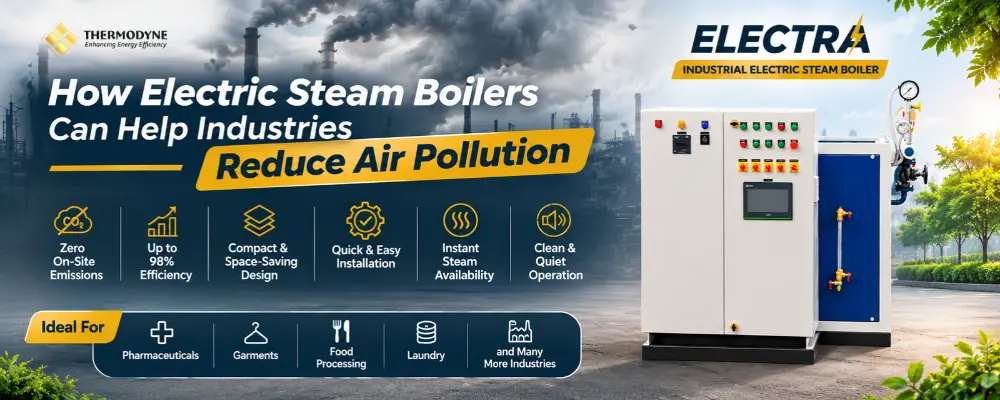
Introduction: The Growing Challenge of Industrial Air Pollution
Steam is a core utility in manufacturing, but combustion-based boilers release flue gases at the plant, and as air-quality norms tighten, many industries want to cut emissions at the source. This article explains how an electric steam boiler works, which pollutants it avoids, and why overall carbon performance depends on the electricity source.
Where Boiler Emissions Come From
In a fuel-fired industrial steam boiler, heat comes from burning fuel and the combustion products, mainly particulate matter, SOx, NOx (formed above roughly 1,300°C), CO and CO2, leave through the flue. These boilers are proven and widely used, and with good combustion and emission control they can meet applicable norms. An electric boiler takes a different route: with no combustion, these pollutants are not formed at the boiler.
What Is an Electric Steam Boiler?
It uses electrical energy instead of fuel to raise steam, and is also called an electrode type boiler . Heat is produced inside the pressure vessel, so there is no burner, furnace or flue. Two heating methods are common:
- Resistance type: sheathed elements immersed in the water, with power controlled by contactors or SCR regulation.
- Electrode type: in an electrode steam boiler, current passes through the boiler water between electrodes, so the water itself is the resistance.
How does an electric steam boiler work? Treated feed water fills the pressure vessel, electrical input heats it to saturation temperature (about 184°C at 10 bar(g)) and supplies the latent heat of vaporisation, and controls modulate power against steam pressure.
How Electric Steam Boilers Help Reduce Industrial Air Pollution
Removing combustion removes every pollutant source listed above at the boiler:
- No combustion by-products: no NOx, SOx, CO or particulate emissions from the boiler.
- No flue gas path: no stack, flue gas treatment or stack-height constraints.
How Electric Steam Boilers Help Reduce Industrial Air Pollution
Zero on-site emissions is not the same as zero lifecycle emissions. The emissions linked to an electric boiler depend on how the electricity is generated, and they occur at the power plant rather than at your site. With solar, wind, hydro or a low-carbon grid mix, overall carbon emissions fall substantially, so pairing the boiler with renewable electricity is the practical route to industrial decarbonization.
Electric Steam Boiler vs. Fuel-Fired Boiler: Choosing the Right Fit
| Parameter | ⚡ Electric Steam Boiler | 🔥 Fuel-Fired Boiler |
|---|---|---|
| On-site emissions | ElectricNone from combustion | Fuel-FiredFlue gas, managed by fuel choice, combustion control and emission control equipment |
| Efficiency | ElectricNear-total conversion; losses are mainly shell radiation and blowdown | Fuel-FiredDepends on fuel and combustion control; includes stack losses |
| Operating cost | ElectricDriven by electricity tariff and demand charges | Fuel-FiredDriven by fuel price and handling |
Not sure which one suits your plant? Talk to Thermodyne’s team →
Key Benefits of Electric Steam Boilers for Industries
Reduced On-Site Emissions
A direct cut in boiler-related NOx, SOx, CO and particulates.
Compact Footprint
No fuel storage or chimney; a pressure vessel plus a control panel.
High Boiler Efficiency
Heat is generated within the vessel with minimal loss.
Thinking of switching to electric? Get a quote →
The ELECTRA Industrial Electric Steam Boiler
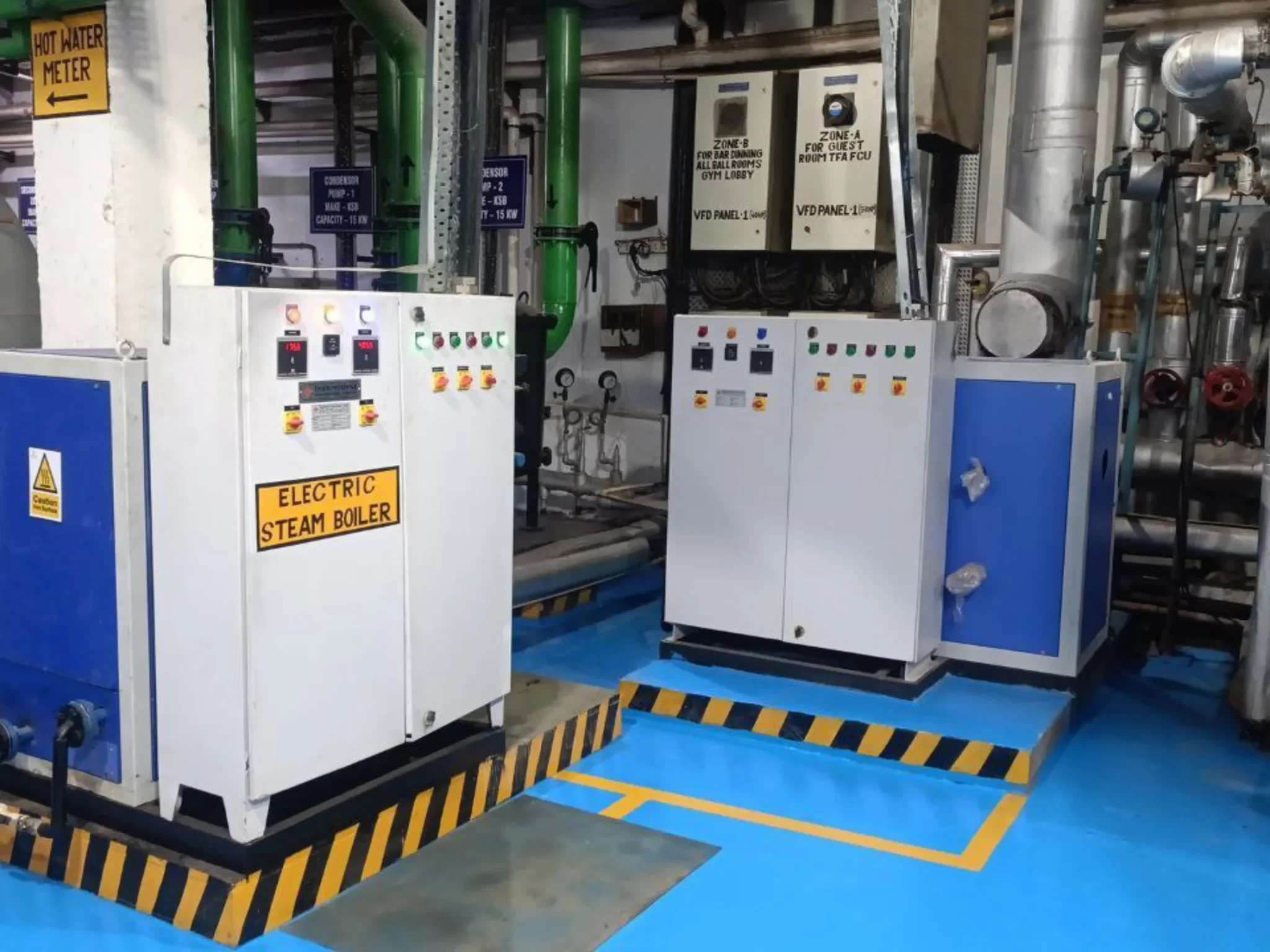
Thermodyne Engineering Systems, an industrial boiler manufacturer, offers the ELECTRA Industrial Electric Steam Boiler for plants moving to combustion-free steam generation. Thermodyne also manufactures solid-fuel, oil-fired and gas-fired boilers, so technology is recommended on application fit.
- Up to 98% efficiency, as per the specified product information
- Zero on-site combustion emissions
- Compact, fully factory-assembled construction
- Quick installation with water and electrical connections
- Clean and quiet operation
- Available in IBR (Indian Boiler Regulations), Non-IBR and SIB models
The Role of Electric Boilers in Sustainable Manufacturing
Replacing a fuel-fired boiler with an electric steam boiler moves energy use from Scope 1 (fuel burned on site) to Scope 2 (purchased electricity), so reported Scope 1 emissions fall while Scope 2 depends on the electricity mix. Where connected load is large or tariffs are high, a hybrid arrangement with an existing boiler may be more practical.
Conclusion – Moving Towards Cleaner Industrial Steam Generation
For plants that want to eliminate boiler emissions at the source, an electric boiler removes combustion from industrial steam generation. Industries should consider cleaner steam generation technologies, and Thermodyne Engineering Systems can help match an ELECTRA configuration to a given steam load.