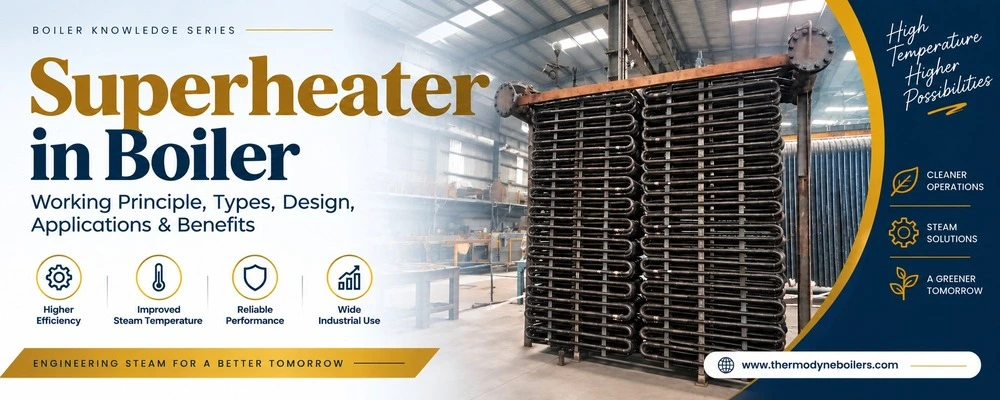
Steam plays a vital role in power generation and industrial operations, where it is used to drive turbines and produce electricity or mechanical power. To improve the efficiency and performance of these steam systems, a superheater plays a crucial role by increasing steam temperature before it enters the turbine or process equipment. A superheater is one of the most important heat-transfer components in an industrial steam boiler, responsible for raising the temperature of steam beyond its saturation point before it leaves the boiler system.
This article explains the working principle, types, design considerations, and practical applications of a boiler superheater, along with the common operational challenges engineers should watch for.
What Is a Superheater and Why Is It Used?
Inside a boiler, water is converted into steam through the addition of heat in the furnace and evaporator sections. At this stage, the steam produced is saturated steam — steam that exists at the same temperature as the boiling water from which it was formed, and which still contains moisture droplets in suspension.
A steam superheater is a heat exchanger installed in the boiler’s flue-gas path that absorbs additional heat from combustion gases and transfers it to this saturated steam, raising its temperature above the saturation point without increasing its pressure. The result is superheated steam — dry, moisture-free steam at a higher temperature than saturated steam at the same pressure.
The purpose of superheating is not simply to add heat for its own sake. Superheated steam:
- Eliminates moisture carryover, reducing erosion of turbine blades, valves, and piping
- Increases the enthalpy (energy content) of steam, improving the thermal efficiency of downstream processes
- Reduces condensation losses in long steam distribution lines
- Provides more stable and controllable steam conditions for process equipment
Planning a New Boiler or Superheater?
Tell us your steam requirements and let our experts recommend the right solution for your plant.
Get Expert ConsultationSuperheater Working Principle
The superheater working principle is based on convective and, in some designs, radiant heat transfer from hot flue gases to steam flowing inside superheater tubes.
Saturated steam collected in the boiler drum (in fire-tube and water-tube drum-type boilers) or generated in the evaporator circuit is routed into the superheater tube bundle. As hot flue gases pass over or around the outer surface of these tubes on their way to the economizer and stack, heat is transferred through the tube wall into the flowing steam. Since the steam absorbs heat without a corresponding phase change, its temperature rises steadily as it travels through the tube circuit, exiting as superheated steam at the desired outlet temperature.
Unlike the evaporator section, where temperature remains constant during boiling, the superheater temperature rise is continuous and depends directly on the heat absorbed per unit mass of steam flow.
Difference Between Saturated Steam and Superheated Steam
| Parameter | Saturated Steam | Superheated Steam |
|---|---|---|
Temperature |
Fixed at boiling point for given pressure |
Higher than saturation temperature |
Moisture content |
May contain water droplets |
Dry, moisture-free |
Energy content |
Lower enthalpy |
Higher enthalpy |
Typical use |
Process heating, sterilization |
Turbines, long-distance steam lines, drying |
Key Components and Tube Arrangement
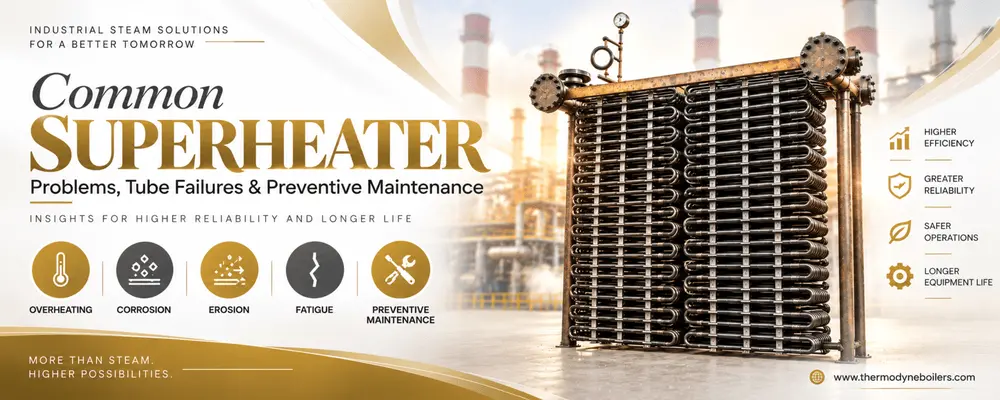
A typical superheater assembly consists of superheater tubes, header manifolds (inlet and outlet), tube supports and spacers, and, in larger installations, temperature-control attemperators.
Superheater tubes are usually arranged as multiple parallel loops connected between an inlet header and an outlet header, allowing steam to be distributed evenly across the tube bank while maximizing surface area exposed to flue gas. Tube spacing, orientation (horizontal or vertical), and pitch are selected based on flue-gas velocity, expected fouling behavior, and allowable pressure drop across the bank.
Types of Superheater
Industrial boilers use different superheater configurations depending on required steam conditions and boiler design.
1. Radiant Superheater
Located directly in the furnace zone where it receives heat primarily by radiation from the flame and hot furnace gases. Radiant superheaters tend to show a decreasing temperature rise as boiler load increases, since radiant heat transfer is less dependent on gas mass flow.
2. Convective Superheater
Positioned in the convective heat-transfer zone, downstream of the furnace, where heat transfer occurs mainly through direct contact between flue gas and tube surfaces. Convective superheaters typically show an increasing temperature rise with load, as higher flue-gas flow improves convective heat transfer.
3. Combination (Radiant-Convective) Superheater
Many modern industrial boiler superheater designs combine both radiant and convective sections in series. This arrangement balances the opposing load-response characteristics of each type, resulting in a more stable superheat temperature across varying boiler loads — an important consideration for plants with fluctuating steam demand.
Superheater Design Considerations
Proper design of a superheater in a steam boiler involves balancing several interrelated factors:
- Steam pressure and temperature requirements of the downstream process or turbine
- Flue-gas temperature and velocity entering the superheater zone
- Heat-transfer area, sized to achieve the target outlet temperature without excessive pressure drop
- Material selection, since superheater tubes must withstand both high steam-side pressure and high metal temperatures — alloy steels are commonly used for higher-temperature sections
- Allowable metal temperature, which sets a practical ceiling on achievable steam temperature and influences tube material grade
- Steam velocity, kept within limits that prevent excessive erosion while maintaining adequate cooling of tube metal
- Thermal expansion, accommodated through tube supports and header design to prevent stress-related failures
- Soot deposition and fouling, which reduce heat transfer over time and require periodic cleaning provisions
Temperature Control
Because superheat temperature can vary with boiler load and fuel firing rate, many systems incorporate attemperation (spray or surface-type desuperheating) between superheater stages to hold outlet steam temperature within a controlled band, protecting both the superheater tubes and downstream equipment from temperature excursions.
Applications of Superheated Steam
Superheated steam is not required for every industrial process. It is most valuable where:
- Steam drives a turbine for mechanical or electrical power generation, where moisture-free steam protects blades from erosion
- Steam travels long distances through distribution piping, where superheat compensates for radiant heat losses and prevents condensation
- Process drying, curing, or high-temperature heating applications require precise, moisture-free thermal energy
Conversely, many direct process-heating applications — such as certain sterilization, cooking, or low-temperature heating processes common in food, dairy, and pharmaceutical operations — are designed around saturated steam, where the latent heat of condensation is the primary energy transfer mechanism. In such cases, a superheater may add unnecessary cost and complexity rather than genuine benefit.
Common Operational Problems and Preventive Maintenance
Superheater tubes operate under some of the most demanding conditions in a boiler, and several issues can affect reliability:
- Tube overheating, often caused by steam flow blockage, uneven flow distribution, or excessive flue-gas temperature, leading to accelerated creep and potential tube failure
- Fouling and soot deposition, which insulate tube surfaces and reduce heat transfer, often requiring soot blowers or scheduled cleaning
- Corrosion, from flue-gas chemistry or steam-side contaminants, gradually thinning tube walls
- Erosion, caused by high-velocity flue gas carrying ash or particulate matter, particularly in solid-fuel-fired boilers
- Thermal stress and cyclic fatigue, resulting from frequent load changes or improper startup/shutdown procedures
Preventive practices include regular inspection of tube wall thickness, monitoring of superheater outlet temperature trends, proper water treatment to limit steam-side deposits, maintaining correct flue-gas velocities, and following manufacturer-recommended startup and load-change procedures to minimize thermal cycling stress.
Conclusion
A well-designed and properly maintained superheater is central to producing dry, high-energy steam that supports efficient turbine operation, reliable long-distance steam distribution, and demanding industrial processes. Understanding superheater working principles, selecting the right type for the application, and addressing design factors such as material selection, tube arrangement, and temperature control all contribute to safer and more efficient boiler operation. Industrial facilities evaluating new boiler systems or upgrading existing ones benefit from working with experienced engineering partners — companies such as Thermodyne Engineering Systems bring the technical expertise needed to design, size, and integrate superheater systems that match a plant’s specific steam pressure, temperature, and process requirements.
Tell us your steam requirements and get the right solution for your plant.
Get a Quote NowFrequently Asked Questions (FAQs)
A superheater in a boiler is a heat-transfer component that raises the temperature of saturated steam above its saturation point. It uses heat from hot flue gases to produce dry, high-temperature superheated steam.
A superheater works by transferring heat from hot combustion gases to steam flowing through superheater tubes. The steam absorbs additional heat without undergoing a phase change, increasing its temperature above the saturation temperature.
Saturated steam is at its saturation temperature for a given pressure and may contain moisture, while superheated steam is heated beyond its saturation temperature and is essentially moisture-free. Superheated steam has higher enthalpy and is particularly useful for turbine applications.
The main types of superheaters are radiant superheaters, convective superheaters, and combination radiant-convective superheaters. The selection depends on boiler design, steam temperature requirements, load conditions, and heat-transfer characteristics.
A superheater is used to increase steam temperature, eliminate moisture, improve steam quality, increase the energy content of steam, and improve the efficiency and reliability of turbines and other high-temperature steam applications.
Superheated steam is commonly used for power generation, steam turbines, long-distance steam distribution, industrial drying, curing, and high-temperature heating processes where dry, high-energy steam is required.
A superheater increases the enthalpy of steam before it reaches the turbine or process equipment. This can improve the performance of steam turbines and reduce condensation-related losses in steam distribution systems.
Superheater tubes are commonly manufactured from materials capable of withstanding high temperatures, pressures, and thermal stresses. Carbon steel may be suitable for lower-temperature sections, while alloy steels are commonly used for higher-temperature superheater applications.
Common superheater problems include tube overheating, soot and ash deposition, corrosion, erosion, thermal stress, and tube failure. Proper steam flow, temperature monitoring, cleaning, water treatment, and regular inspection help improve superheater reliability.
Superheated steam temperature can be controlled using methods such as spray attemperation or desuperheating between superheater stages. These systems help maintain the required outlet steam temperature and protect downstream equipment from excessive temperatures.