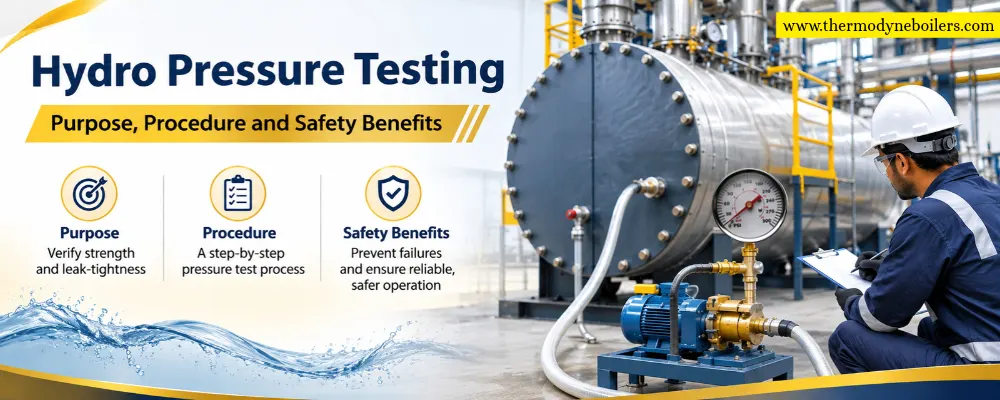
Pressure-retaining components are designed against membrane and bending stresses at a defined design pressure, yet fabrication discontinuities can remain undetected until service. Hydro Pressure Testing loads the completed pressure boundary with a near-incompressible liquid at a code-specified overpressure before commissioning.
What Is Hydro Pressure Testing?
Hydro Pressure Testing, also termed hydrostatic testing, involves filling a boiler, pressure vessel, heat exchanger or piping system with water and raising it to a specified test pressure, defined by the governing code relative to design pressure or maximum allowable working pressure (MAWP).
What Is Hydro Pressure Testing?
Water’s low compressibility means very little elastic energy is stored. During a hydrostatic pressure test, a through-wall flaw therefore causes rapid pressure decay rather than the sudden expansion of a compressed gas. Uniform internal pressure loads shells, heads, nozzle reinforcements, tubesheet ligaments and flanges simultaneously, exposing leakage paths or localised plastic deformation.
Why Hydro Pressure Testing Is Performed
The objectives of Hydro Pressure Testing are to:
- Verify leak-tightness of gasketed joints, expanded or welded tube-to-tubesheet joints and nozzle attachments
- Demonstrate structural adequacy at pressures above normal operation
- Reveal weld discontinuities such as through-wall cracks, lack of fusion and porosity that communicate with the surface
- Expose material defects such as laminations, casting porosity and forming damage
- Requalify equipment after repair, alteration or prolonged shutdown
- Satisfy statutory and design-code requirements
A marginal tube-to-header weld in a repaired economiser may pass visual examination yet weep at test pressure; finding it during the test is far less costly than finding it in service.
The test is a proof of pressure integrity at a single point in time. Hydro Pressure Testing does not predict failure by creep, fatigue, corrosion or erosion, nor does it replace non-destructive examination (NDE). It complements periodic Pressure Vessel Inspection.
Hydro Test Procedure: Step-by-Step
Every Hydro Pressure Testing activity should follow an approved written procedure. Typical stages are:
1. Equipment Preparation
Isolate the pressure boundary, install blanks, and remove or gag safety valves, instruments and expansion joints not rated for test pressure, confining the test to the intended boundary.
2. Visual Inspection and NDE Review
Verify welds, nozzles and supports. Confirm that required radiography, ultrasonic, magnetic particle or penetrant examinations and any post-weld heat treatment are complete and accepted.
3. Water Filling
Keep metal temperature above the minimum permissible value to avoid brittle fracture, and control chloride content for austenitic stainless steel to prevent stress corrosion cracking.
4. Air Venting
Vent from high points until an air-free stream emerges. Entrained air is compressible, stores energy and distorts readings.
5. Gradual Pressurisation
Raise pressure in controlled increments using a suitable test pump, with intermediate holds to check for leaks.
6. Pressure Holding
Hold the required test pressure for the specified duration, normally with the pump isolated, so pressure decay reflects genuine leakage.
7. Inspection
Examine all welds, joints and openings as the procedure requires. Thermal expansion or cooling of trapped water shifts pressure, so interpret readings against temperature.
8. Pressure Release
Depressurise through a controlled valve and open vents to prevent vacuum formation.
9. Final Documentation
Record test pressure, duration, water temperature, gauge calibration, observations and witnesses, then drain and dry the equipment.
Test Pressure, Holding Time and Acceptance Criteria
No single test pressure or holding time applies to all equipment. Test pressure, duration and acceptance criteria are governed by the applicable design code, such as ASME Section I or VIII, EN 12952 or EN 13445, or the Indian Boiler Regulations, together with statutory requirements, manufacturer specifications and the approved inspection procedure. Statutory boiler tests are generally witnessed by an authorised inspector.
Test Pressure, Holding Time and Acceptance Criteria
Stored energy is lower than in pneumatic testing, but jets and component failure remain hazardous.
Before testing
- Use calibrated gauges of suitable range, preferably two for cross-checking
- Fit the test pump with a relief valve set as the procedure specifies
- Isolate test equipment from live systems
- Confirm supports can carry the hydrostatic load
- Issue permits and brief personnel
During testing
- Establish barricaded exclusion zones
- Pressurise in controlled steps with clear communication
- Never tighten fasteners or strike pressurised components
After testing
- Depressurise gradually and verify zero pressure before approach
- Drain, remove blanks and restore valves and instruments
- Report defects and retain records
Safety Benefits of Hydro Pressure Testing
Well-executed Hydro Pressure Testing identifies leaks and weak welds before commissioning, reducing the probability of in-service rupture. Because water limits stored energy, Boiler Safety Testing is also safer for personnel. It supports regulatory compliance and informed restart or repair decisions.
Common Mistakes in Hydro Pressure Testing
- Trapped air in the system
- Uncalibrated or single gauges
- Rapid pressurisation
- Ignoring minimum metal temperature limits
- Leaving safety valves connected
- Applying a generic pressure instead of the code-specified value
- Incomplete documentation
Industrial Applications
Hydro Pressure Testing is applied wherever pressure integrity is critical. In power and process plants, Pressure Testing of Boilers covers economisers, superheaters, headers and steam piping. In chemicals, pharmaceuticals, food processing, oil and gas and textiles, Pressure Vessel Testing covers reactors, autoclaves, receivers and heat exchangers. It is also standard after repairs, making it a core element of Industrial Safety Testing.
Hydrostatic vs Pneumatic Testing
| Parameter | Hydrostatic Test | Pneumatic Test |
|---|---|---|
Test medium |
Water |
Air or gas |
Stored energy |
Low |
High |
Failure mode |
Rapid pressure decay |
Risk of explosive release |
Typical use |
Standard method |
Only where water is unsuitable |
Pneumatic testing requires additional risk controls and code-specific safeguards.
Thermodyne’s Approach
At Thermodyne Engineering Systems, Hydro Pressure Testing of boilers and pressure parts is carried out against the applicable code, approved procedure and customer specification, with results recorded in test documentation.
Conclusion: Why Hydro Pressure Testing Matters
Hydro Pressure Testing verifies leak-tightness, weld quality and structural adequacy under controlled conditions, protecting equipment, production and personnel. Executed with calibrated instrumentation, complete venting and full records, it strengthens reliability and workplace safety.
Talk to our energy expert at Thermodyne Engineering Systems for reliable industrial boiler and thermal engineering solutions.