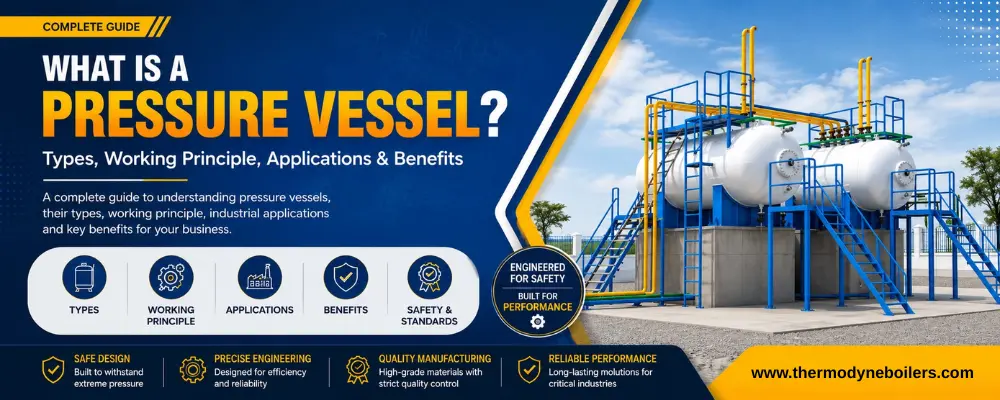
A pressure vessel is a sealed container designed to hold gases or liquids at a pressure that is significantly different from the surrounding atmosphere. From LPG cylinders in your kitchen to massive reactors in a petrochemical plant, pressure vessels quietly power the industrial world around us.
If you work in manufacturing, oil and gas, pharmaceuticals, food processing, or power generation, chances are your plant depends on at least one pressure vessel to function safely and efficiently. These vessels store compressed gases, hold chemical reactions, generate steam, and move fluids through processes that would otherwise be impossible at atmospheric pressure.
But not every pressure vessel is built the same way. Choosing the wrong design, material, or vendor can lead to safety hazards, regulatory non-compliance, and costly downtime. That’s why plant heads, procurement managers, and project engineers need to understand exactly how these vessels work before making a purchasing decision.
In this guide, we’ll walk through everything you need to know about a pressure vessel — its working principle, components, types, materials, applicable design codes, inspection practices, and how to select the right one for your industry. Whether you’re evaluating a CNG storage tank for a fuel station, a chemical storage tank for a process plant, or a custom-built reactor vessel, this article will give you the technical clarity to make an informed decision.
By the end, you’ll understand not just what a pressure vessel is, but how to specify, inspect, and maintain one that keeps your operations safe and compliant for decades.
What is a Pressure Vessel?
Definition
A pressure vessel is a closed, rigid container engineered to hold gases or liquids at a pressure that differs substantially from ambient atmospheric pressure. The pressure inside can range from a few bars to several hundred bars, depending on the application.
Unlike an ordinary tank that simply stores liquid at atmospheric pressure, a pressure vessel is built to contain internal or external pressure without rupturing, deforming, or leaking. This makes its design, material selection, and fabrication process far more rigorous than that of a standard storage container.
Purpose
The core purpose of a pressure vessel is to safely contain a substance under pressure while allowing controlled processes such as storage, chemical reaction, heat exchange, or phase separation to take place inside it. It acts as a barrier between a high-energy internal environment and the outside world.
History
The concept of pressure vessels dates back to the early days of the steam engine, when boiler explosions due to poor design and material fatigue were a serious industrial hazard. These incidents led to the formation of engineering codes and standards, most notably the American Society of Mechanical Engineers (ASME) Boiler and Pressure Vessel Code, which was first published in the early twentieth century. Over time, these standards evolved to cover not just boilers but the wide range of industrial pressure vessels used today.
Industrial Importance
Modern industry simply cannot function without pressure vessels. They are the backbone of chemical processing, gas storage, power generation, and countless manufacturing operations. A well-designed pressure vessel improves process efficiency, reduces the risk of catastrophic failure, and ensures regulatory compliance across industries that are inherently high-risk.
Difference Between a Pressure Vessel and an Ordinary Storage Tank
| Parameter | Pressure Vessel | Ordinary Storage Tank |
|---|---|---|
Operating Pressure |
Above atmospheric (or vacuum) pressure |
Atmospheric pressure |
Design Code |
ASME Section VIII, IS 2825, PESO rules |
IS 803, API 650, or similar atmospheric tank codes |
Wall Thickness |
Higher, calculated for stress under pressure |
Lower, mainly for structural stability |
Testing Requirements |
Hydro test, radiography, PESO approval (where applicable) |
Visual inspection, basic leak test |
Typical Use |
LPG, CNG, compressed air, chemical reactions |
Water storage, fuel storage at atmospheric pressure |
Risk Level |
Higher — requires certified design and periodic inspection |
Lower — simpler compliance requirements |
How Does a Pressure Vessel Work?
Working Principle
A pressure vessel works on a simple physical principle: contain a fluid (gas or liquid) within a sealed shell strong enough to withstand the internal force the fluid exerts on the vessel walls. When gas or liquid is compressed into a fixed volume, it exerts pressure evenly in all directions. The vessel’s shell and heads are designed to resist this force without failing.
Pressure Distribution
Inside a pressure vessel, pressure acts uniformly across the internal surface. This is why cylindrical and spherical shapes are so common — curved surfaces distribute stress more evenly than flat surfaces, which tend to bulge and fail under pressure.
Internal Pressure
Most industrial pressure vessels, such as an LPG storage tank or a CNG storage tank, operate under internal pressure. The vessel wall must resist the outward force generated by the compressed gas or liquid inside it.
External Pressure
Some vessels, particularly those used in vacuum distillation or certain heat exchangers, must resist external pressure, where atmospheric or process pressure pushes inward on the shell. These vessels require special reinforcement, such as stiffening rings, to prevent buckling.
Stress Distribution
Engineers calculate two primary types of stress when designing a pressure vessel:
- Hoop stress (circumferential stress): The stress acting around the circumference of the shell, which is typically twice the longitudinal stress.
- Longitudinal stress (axial stress): The stress acting along the length of the vessel.
Understanding this stress distribution allows engineers to calculate the correct wall thickness so the vessel operates safely within its design pressure and temperature limits.
Safety Mechanisms
Every properly designed pressure vessel includes multiple layers of safety, including:
- Pressure relief valves that release excess pressure automatically
- Rupture discs for sudden overpressure events
- Pressure gauges and instrumentation for continuous monitoring
- Safety factors built into the design calculations, typically well above the maximum allowable working pressure
Simple Explanation
Think of a pressure vessel like a balloon made of steel instead of rubber. Just as a balloon stretches evenly when you blow air into it, a pressure vessel is shaped and built to handle that same outward push — except instead of stretching, its thick steel walls resist the force completely, keeping the contents safely contained.
Main Components of a Pressure Vessel
Shell
The shell is the main cylindrical or spherical body of the vessel that contains the pressurized substance. It is typically fabricated by rolling steel plates and welding them into the required shape.
Heads
Heads are the end closures that seal the shell at both ends. Common head types include hemispherical, elliptical, torispherical, and flat heads, each suited to different pressure and cost requirements.
Nozzles
Nozzles are openings on the shell or head that allow fluid inlet, outlet, instrumentation connections, or access for maintenance. They are reinforced to handle the additional stress concentration around the opening.
Supports
Supports hold the vessel in position and transfer its weight, along with the weight of its contents, to the foundation. Common support types include saddle supports for horizontal vessels and skirt or leg supports for vertical vessels.
Manholes
Manholes are larger openings that allow personnel to enter the vessel for internal inspection, cleaning, or maintenance. They are essential for vessels that require periodic internal examination.
Pressure Relief Valve
This is a critical safety device that automatically releases pressure if it exceeds the vessel’s maximum allowable working pressure, preventing rupture or explosion.
Instrumentation
Pressure gauges, temperature sensors, level indicators, and control systems are mounted on the vessel to monitor operating conditions in real time.
Insulation
Vessels operating at high or low temperatures are insulated externally to maintain process efficiency, protect personnel from burns, and reduce heat loss or gain.
Welds
Welded joints connect the shell, heads, and nozzles. Weld quality is one of the most critical factors in vessel integrity, which is why radiography and other non-destructive testing methods are used to verify weld soundness.
Accessories
Additional accessories may include ladders, platforms, davit arms for manhole covers, lifting lugs, and earthing points, depending on the vessel’s size and application.
Types of Pressure Vessels
Classification by Shape
- Cylindrical Pressure Vessels: The most common type, offering a good balance of manufacturing ease, cost, and structural strength. Widely used for storage tanks and process vessels.
- Spherical Pressure Vessels: Used for very large-volume, high-pressure storage such as LPG spheres, because a sphere distributes stress more evenly than any other shape.
Classification by Orientation
- Horizontal Pressure Vessels: Common for storage applications, particularly where floor space allows for a longer, low-profile installation, such as horizontal LPG bullets.
- Vertical Pressure Vessels: Preferred where floor space is limited or where gravity-driven processes, such as separation or reaction, benefit from a vertical orientation.
Classification by End Closures
- Hemispherical Heads: Strongest head type, ideal for very high-pressure applications, though costlier to manufacture.
- Elliptical Heads: A common industry standard offering good strength-to-cost ratio for moderate to high-pressure vessels.
- Torispherical Heads: Economical and widely used for low to moderate pressure applications.
- Flat Heads: Used only for low-pressure vessels due to higher stress concentration at the edges.
Classification by Construction
- Single Wall Vessels: Standard construction with a single shell layer, suitable for most industrial applications.
- Double Wall Vessels: Used for cryogenic storage or applications requiring an insulation gap between two shells, such as liquid nitrogen or LNG storage.
Pressure Vessel Types Comparison Table
| Type | Best Suited For | Pressure Range | Relative Cost |
|---|---|---|---|
Cylindrical |
General storage, process vessels |
Low to high |
Moderate |
Spherical |
Large-volume LPG/gas storage |
High |
High |
Horizontal |
LPG bullets, fuel storage |
Low to moderate |
Moderate |
Vertical |
Reactors, columns, limited floor space |
Low to high |
Moderate to High |
Double Wall |
Cryogenic gases |
Low to moderate |
High |
Pressure Vessel Design Standards
ASME Section VIII
The ASME Boiler and Pressure Vessel Code, Section VIII, is the globally recognized standard for the design, fabrication, and inspection of pressure vessels. It sets out detailed rules for material selection, design calculations, welding procedures, and testing requirements.
PESO
In India, the Petroleum and Explosives Safety Organisation (PESO) regulates the design, manufacture, installation, and periodic inspection of pressure vessels used for storing hazardous gases such as LPG and CNG. PESO approval is mandatory for such vessels before they can be commissioned.
IS Codes
Indian Standards such as IS 2825 provide the national code of practice for unfired pressure vessels, covering design, materials, fabrication, and testing requirements specific to Indian manufacturing conditions.
API Standards
American Petroleum Institute (API) standards apply to pressure vessels used in the oil and gas sector, covering design and inspection practices for equipment used in exploration, refining, and processing.
ISO Standards
International Organization for Standardization (ISO) standards provide globally harmonized guidelines for pressure equipment, supporting manufacturers who export vessels to international markets.
PED
The Pressure Equipment Directive (PED) is the European Union’s regulatory framework governing the design, manufacture, and conformity assessment of pressure equipment sold within the EU market.
Importance of Compliance
Compliance with recognized design codes is not just a legal requirement — it ensures that a pressure vessel has been engineered with proven safety margins, verified material properties, and traceable quality control at every stage of fabrication.
Inspection Requirements
Design codes mandate specific inspection stages, including material verification, weld inspection, hydrostatic testing, and final documentation review before a vessel can be certified for use.
Certification
A certified pressure vessel comes with complete documentation, including design calculations, material test certificates, welding procedure records, and test reports, which are essential for regulatory approval and insurance purposes.
Design Codes Comparison Table
| Standard | Region/Scope | Applicable To |
|---|---|---|
ASME Section VIII |
Global |
General pressure vessels |
PESO |
India |
LPG, CNG, and hazardous gas vessels |
IS 2825 |
India |
Unfired pressure vessels |
API |
Global (Oil & Gas) |
Refinery and upstream equipment |
ISO |
Global |
International trade and harmonization |
PED |
European Union |
Pressure equipment sold in the EU |
Advantages of Pressure Vessels
Enabling Industrial Processes at Scale Pressure vessels allow chemical reactions, gas compression, and fluid storage to take place efficiently at volumes that would be impossible under atmospheric conditions alone.
Improves Storage Efficiency By storing gases like LPG and CNG in liquid or compressed form, pressure vessels dramatically reduce the storage footprint compared to storing the same energy content at atmospheric pressure.
Enhances Process Safety When designed and maintained according to recognized codes, pressure vessels include multiple built-in safety mechanisms that significantly reduce the risk of leaks, ruptures, or accidents.
Supports Long-Term Reliability A well-fabricated pressure vessel, built from the right material and maintained through regular inspection, can operate reliably for decades with proper care.
Enables Regulatory Compliance Using a certified pressure vessel helps industries meet safety regulations, pass audits, and maintain insurance coverage without complications.
Reduces Operational Costs Efficient pressure vessels reduce energy losses, minimize product wastage, and lower the frequency of unplanned shutdowns, translating into long-term operational savings.
Inspection, Testing & Maintenance
ASME Section VIII
A hydrostatic test involves filling the vessel with water and pressurizing it 1.5 times its design pressure.
Radiography
Radiographic testing uses X-rays or gamma rays to examine weld joints for internal defects such as porosity, cracks, or incomplete fusion.
Ultrasonic Testing
Ultrasonic testing measures wall thickness and detects internal flaws using high-frequency sound waves, commonly used for periodic in-service inspection.
Magnetic Particle Testing
This method detects surface and near-surface defects in ferromagnetic materials by applying magnetic fields and fine iron particles that reveal cracks or discontinuities.
Visual Inspection
Routine visual inspection checks for external corrosion, physical damage, leaks, or signs of deterioration that may require further investigation.
Leak Testing
Leak testing confirms that all joints, nozzles, and fittings are properly sealed and free from any gas or liquid leakage under operating conditions.
Periodic Inspection
Regulatory bodies such as PESO mandate periodic inspection intervals for pressure vessels handling hazardous substances, ensuring ongoing safety throughout the vessel’s operational life.
Preventive Maintenance
A structured preventive maintenance program, including scheduled inspections, corrosion monitoring, and timely repairs, significantly extends the service life of a pressure vessel while reducing the risk of unplanned failures.
Inspection, Testing & Maintenance
| Method | Purpose | Typical Frequency |
|---|---|---|
Hydro Test |
Verify structural strength before commissioning |
Before commissioning / periodic re-test |
Radiography |
Detect internal weld defects |
During fabrication |
Ultrasonic Testing |
Measure wall thickness, detect flaws |
Periodic in-service |
Magnetic Particle Testing |
Detect surface cracks |
During fabrication and periodic |
Visual Inspection |
Identify external damage or corrosion |
Routine/scheduled |
Leak Testing |
Confirm joint and fitting integrity |
Before commissioning and periodic |
Common Pressure Vessel Failures
Corrosion
Prolonged exposure to corrosive substances or moisture can thin the vessel wall over time, weakening its ability to withstand design pressure. Regular thickness monitoring and correct material selection help prevent this.
Fatigue
Repeated pressure cycling can cause fatigue cracks to develop, particularly at welds and nozzle junctions. Proper design margins and periodic inspection help catch fatigue damage before it becomes critical.
Overpressure
Operating a vessel beyond its maximum allowable working pressure, often due to faulty relief valves or process upsets, can lead to catastrophic failure. Properly sized and maintained relief devices are essential safeguards.
Poor Welding
Substandard welding practices can introduce defects such as porosity, cracks, or incomplete fusion, compromising the vessel’s structural integrity. This is why radiographic testing during fabrication is critical.
Improper Design
A vessel designed without accounting for actual operating conditions, including pressure, temperature, and cyclic loading, is prone to premature failure regardless of material quality.
Lack of Inspection
Skipping mandatory periodic inspections allows developing defects to go undetected until they cause a serious failure, making regular inspection one of the most important preventive measures.
Mechanical Damage
External impacts, improper handling during transport, or accidental damage during maintenance can weaken a vessel’s structure, making post-incident inspection essential before returning it to service.
Prevention Summary
Preventing pressure vessel failure comes down to three consistent practices: selecting the right material and design code from the start, following a disciplined inspection and maintenance schedule, and ensuring operating conditions never exceed the vessel’s certified limits.
Why Choose Thermodyne Engineering Systems?
Thermodyne Engineering Systems designs and manufactures industrial pressure vessels built to recognized design codes, including PESO approved pressure vessels for hazardous gas applications. Every vessel is custom-engineered around the customer’s specific process conditions rather than offered as a generic product.
Quality assurance runs through every stage — material verification, welding control, radiography, and hydrostatic testing before dispatch — backed by an experienced engineering team and reliable after-sales support for installation and maintenance queries.
Conclusion
A pressure vessel is a precisely engineered piece of equipment that keeps entire industries running safely. From LPG and CNG storage tanks to complex process reactors, the right vessel directly impacts your plant’s safety, compliance, and performance.
Never compromise on certification and quality — a vessel built to ASME, PESO, or IS code standards, backed by rigorous testing and documentation, protects your equipment and your people. If you’re evaluating a pressure vessel manufacturer, verify their design compliance, material traceability, and testing process first.
Thermodyne Engineering Systems builds pressure vessels around your exact requirements, backed by strict quality control at every stage. Reach out to our engineering team to discuss your next pressure vessel requirement.
FAQs related to Pressure Vessel
A pressure vessel is a specially designed container that safely stores gases or liquids at pressures higher or lower than atmospheric pressure. It is widely used in industries such as oil & gas, chemical processing, pharmaceuticals, food processing, and power generation.
A pressure vessel works by containing pressurized fluids inside a strong, sealed shell. Its cylindrical or spherical design distributes internal pressure evenly, while safety devices such as pressure relief valves prevent overpressure and ensure safe operation.
The main types of pressure vessels include cylindrical, spherical, horizontal, vertical, single-wall, and double-wall vessels. They can also be classified based on head type, orientation, operating pressure, and industrial application.
Pressure vessels are commonly manufactured using carbon steel, stainless steel, alloy steel, duplex stainless steel, and nickel alloys. The material selection depends on operating pressure, temperature, corrosion resistance, and the type of fluid being handled.
Pressure vessels are used in various industries, including oil & gas, petrochemicals, fertilizers, pharmaceuticals, food & beverage, dairy, power plants, chemical processing, water treatment, and compressed gas storage facilities.
A pressure vessel is designed to operate under internal or external pressure and follows strict design codes such as ASME Section VIII or IS 2825. A storage tank generally stores liquids at atmospheric pressure and has less stringent design requirements.
The most widely recognized standards include ASME Section VIII, IS 2825, PESO regulations, API standards, ISO standards, and the Pressure Equipment Directive (PED) for European markets.
Pressure vessels should undergo regular inspections based on applicable regulations and operating conditions. Typical inspections include hydrostatic testing, ultrasonic thickness testing, radiographic examination, leak testing, and periodic visual inspections to ensure long-term safety.
A pressure vessel is typically equipped with pressure relief valves, rupture discs, pressure gauges, temperature sensors, level indicators, and control instrumentation to prevent overpressure and maintain safe operation.
Choose a manufacturer that provides ASME or PESO-compliant pressure vessels, uses certified materials, performs rigorous quality inspections, offers complete documentation, and provides engineering support for installation, testing, and after-sales service.