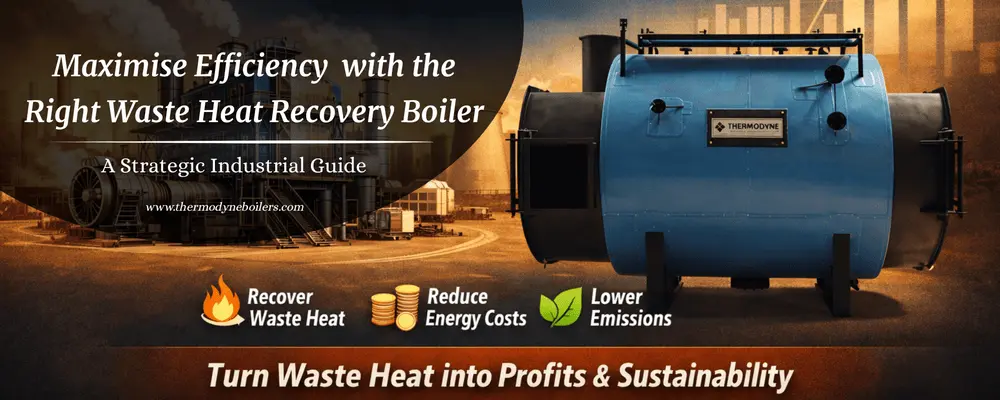
Industrial sectors across the globe are under immense pressure to optimize energy consumption. One of the most effective ways to achieve this is by integrating a waste heat recovery boiler into the production line. By capturing thermal energy from exhaust gases, a WHRB allows plants to generate steam or power without burning additional fuel.
However, selecting the right waste heat boiler is a complex process. It’s not just about the size; it’s about matching the boiler’s design with your plant’s specific thermal profile.
What is a WHRB Boiler and Why Does Selection Matter?
A WHRB boiler (Waste Heat Recovery Boiler) acts as a heat exchanger, recovering heat from hot gas streams produced in furnaces, kilns, or turbines. Since the “fuel” (waste gas) is essentially free, the efficiency of your waste heat recovery boiler directly impacts your ROI and carbon footprint.
Selecting the wrong unit can lead to frequent maintenance shutdowns, corrosion, or even damage to your primary equipment due to backpressure.
Key Selection Criteria for a Waste Heat Recovery Boiler
1. Analysis of the Exhaust Gas Stream
The characteristics of your heat source are the most critical factors when choosing a waste heat boiler.
- Temperature: High-grade heat (>500°C) is ideal for high-pressure steam, while low-grade heat is better for process water heating.
- Gas Composition: If the gas contains sulfur or chlorine, the WHRB must be designed with corrosion-resistant materials to withstand the acid dew point.
- Dust Load: For “dirty” gases found in cement or steel plants, the WHRB boiler must feature wide tube spacing and cleaning mechanisms like soot blowers.
2. Water-Tube vs. Fire-Tube Design
The debate between water-tube and fire-tube configurations depends on your pressure needs:
- Water-Tube WHRB: Best for high-pressure applications and rapid steam generation. The water flows inside the tubes, making it easier to handle high thermal stress.
- Fire-Tube Waste Heat Boiler: Usually more compact and cost-effective for lower pressure requirements and cleaner gas streams.
3. Pressure Drop Management
Every waste heat recovery boiler creates a pressure drop ($\Delta P$) in the gas flow. If the pressure drop is too high, it can choke the upstream process, such as a gas turbine or engine. A well-engineered WHRB ensures maximum heat transfer with minimal resistance to the gas flow.
Technical Specifications Table for WHRB Selection
| Criteria | Importance | Impact on WHRB Boiler |
|---|---|---|
Gas Flow Rate |
High |
Determines the physical size and footprint. |
Fouling Factor |
Critical |
Influences the tube arrangement (Inline vs. Staggered). |
Steam Pressure |
High |
Dictates whether a water-tube or fire-tube design is used. |
Space Constraints |
Moderate |
Vertical vs. horizontal installation options. |
4. Maintenance and Cleaning Systems
In many industries, the exhaust gas is “sticky” or abrasive. When selecting a waste heat recovery boiler, ensure it includes:
- Access Doors: For manual inspection.
- Mechanical Rapping or Soot Blowers: To prevent ash buildup on the tubes.
- Erosion Protection: Especially at the gas inlet where velocities are highest.
5. Economic Viability and ROI
While the technical specs are vital, the financial aspect of a waste heat boiler project cannot be ignored. You should evaluate:
- Payback Period: Usually, a well-selected WHRB pays for itself within 12 to 24 months through fuel savings.
- Operational Costs: Consider the power required for pumps and cleaning systems.
Conclusion: Investing in the Future
A waste heat recovery boiler is more than just a piece of hardware; it is a strategic investment in industrial sustainability. By carefully evaluating gas quality, pressure drops, and metallurgical requirements, you can ensure your WHRB boiler provides reliable service for decades.
Choosing the right waste heat boiler today means lower energy bills and a smaller carbon footprint tomorrow.
Turn your waste heat into measurable savings with Wastetherm—our high-performance Waste Heat Recovery Boiler designed for optimized heat recovery, superior durability, and sustainable industrial operations.
(FAQs) – Waste Heat Recovery Boiler Selection
Waste Heat Recovery Boilers are widely used in cement plants, steel mills, chemical processing units, refineries, power plants, glass manufacturing, pulp & paper, and gas turbine-based industries, where high-temperature exhaust gases are continuously available.
Typically, exhaust gas temperatures above 250°C are suitable for waste heat recovery. High-grade heat sources (>500°C) are ideal for high-pressure steam generation, while lower temperatures are better suited for hot water or low-pressure steam applications.
A WHRB captures otherwise wasted thermal energy and converts it into useful steam or power without additional fuel consumption, improving overall plant efficiency, reducing operating costs, and lowering carbon emissions.
Unlike conventional boilers that burn fuel, a waste heat recovery boiler uses exhaust gases as its heat source. This makes WHRBs more energy-efficient and environmentally friendly, with significantly lower fuel and operating costs.
Water-tube WHRBs are preferred for high-pressure and high-capacity steam generation.
Fire-tube WHRBs are suitable for lower pressure applications with cleaner exhaust gases and limited space.
The choice depends on steam pressure, gas temperature, and process requirements.
For dusty or sticky exhaust gases, WHRBs are designed with wide tube spacing, soot blowers, rapping systems, and erosion-resistant materials to minimize fouling and ensure long-term reliability.
Depending on operating hours, fuel savings, and process conditions, a WHRB usually achieves a payback period between 12 to 24 months, making it a highly cost-effective investment.
When exhaust gases contain sulfur, chlorine, or moisture, WHRBs use corrosion-resistant alloys and special metallurgical selections to withstand acid dew point corrosion and extend boiler life.
Yes. Waste heat recovery boilers can be designed in vertical or horizontal configurations and customized to fit tight plant layouts without compromising performance or safety.