In today’s energy-conscious industrial environment, every unit of fuel counts. Whether you operate a plywood unit, food processing plant, or chemical manufacturing facility, excessive fuel consumption in your thermic fluid heater can significantly impact your production cost and profitability.
Understanding why your thermic fluid heater is consuming more fuel and how to optimize its performance is the key to maintaining operational efficiency, minimizing downtime, and ensuring long-term survival of the company.
Understanding the Role of a Thermic Fluid Heater
A Thermic Fluid Heater (TFH) is an indirect heating system that uses a specialized heat transfer fluid — commonly called thermic fluid or thermal oil — to supply heat to process equipment without direct flame contact.
Unlike steam boilers, thermic fluid heaters operate at high temperatures (up to 300°C) at atmospheric pressure, offering better safety and control. However, like any thermal system, improper operation or maintenance can lead to performance drops — especially higher fuel consumption.
Top Causes of High Fuel Consumption in Thermic Fluid Heaters
Let’s break down the most common reasons behind excessive fuel usage and explore effective solutions for each.
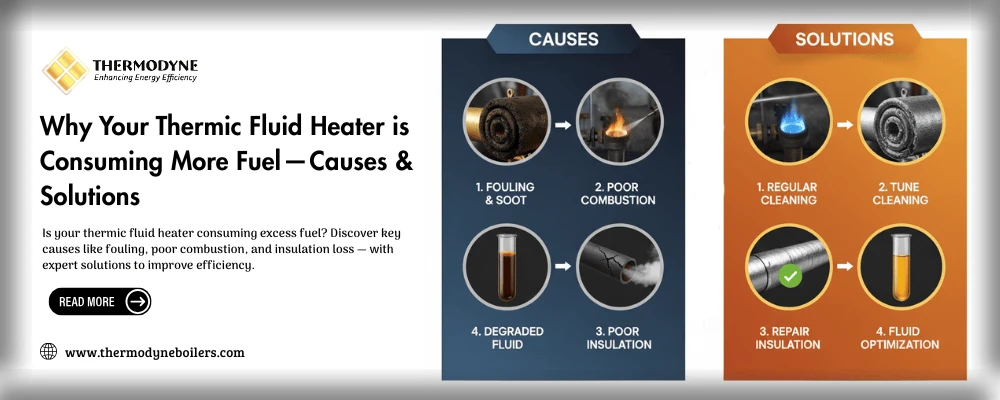
1- Fouling and Scaling on Heat Transfer Surfaces
Problem:
Over time, carbon deposits, soot, and oxidation residues accumulate on the heater coils. This layer acts as an insulator, restricting heat transfer between the combustion gases and thermic fluid.
Impact:
When heat transfer efficiency drops, the system compensates by burning more fuel to achieve the same outlet temperature — leading to fuel wastage and overheating.
Solutions:
- Perform regular coil cleaning to remove soot and carbon deposits.
- Use high-quality thermic fluid with good oxidation stability.
- Maintain proper air-to-fuel ratio to ensure clean combustion.
- Install soot blowers or manual cleaning ports for periodic maintenance.
2- Poor Combustion Efficiency
Problem:
An improperly tuned burner — with incorrect air-to-fuel ratio, clogged nozzles, or low fuel pressure — can cause incomplete combustion.
Impact:
Unburned fuel escapes as smoke or unutilized hydrocarbons, wasting energy and causing higher emissions.
Solutions:
- Check and tune burner settings regularly for complete combustion.
- Monitor flue gas oxygen (O₂) levels and adjust air dampers accordingly.
- Clean fuel filters and nozzles to maintain uniform atomization.
- Ensure the fuel supply pressure remains stable within design limits.
3- Deterioration or Oxidation of Thermic Fluid
Problem:
Thermic fluids degrade over time due to thermal cracking, oxidation, or contamination. As viscosity and acidity increase, the fluid’s heat transfer capability reduces drastically.
Impact:
Poor fluid quality results in uneven heating, delayed temperature rise, and the need for more fuel to maintain process temperature.
Solutions:
- Conduct periodic thermic fluid testing (for TAN, viscosity, flash point).
- Replace or filter thermic fluid if test results exceed recommended limits.
- Avoid exposing expansion tanks to atmospheric air.
- Maintain proper circulation to prevent local overheating.
4- Heat Loss through Poor Insulation
Problem:
Uninsulated or damaged pipelines, valves, and expansion tanks lead to unnecessary heat dissipation.
Impact:
The system must reheat the returning fluid frequently, increasing fuel consumption and reducing system efficiency.
Solutions:
- Inspect insulation regularly and repair damaged areas immediately.
- Use high-temperature-resistant insulation materials for pipelines and tanks.
- Cover flanges and valves using removable insulation jackets for easy maintenance.
5- Improper Fluid Circulation and Flow Rate
Problem:
A malfunctioning or undersized circulation pump results in low flow rates, causing uneven heating and hot spots in coils.
Impact:
Poor circulation leads to overheating of local fluid areas, reduced heat transfer efficiency, and increased energy demand.
Solutions:
- Maintain recommended pump flow rate and head pressure.
- Monitor pump performance parameters (current, discharge pressure, temperature).
- Ensure no air entrapment in the circuit — bleed the system regularly.
- Replace worn-out pumps or impellers promptly.
6- Excess Air in the Combustion Process
Problem:
While adequate air is essential for combustion, too much excess air cools the furnace and carries away usable heat with the flue gases.
Impact:
This results in higher stack temperatures and significant energy loss.
Solutions:
- Use a combustion analyzer to optimize excess air levels.
- Install O₂ and CO₂ monitoring sensors in the flue gas line.
- Tune burners periodically for ideal air-fuel ratio efficiency.
7- Excess Air in the Combustion Process
Problem:
When flue gases exit the system at high temperatures (at about 300°C), it indicates wasted heat energy that could be recovered.
Impact:
Fuel consumption increases since available energy from flue gases is not reused.
Solutions:
- Install a waste heat recovery unit (WHRU) or air preheater to utilize flue gas heat.
- Check flue gas draft and velocity to ensure proper flow through the system.
- Maintain clean heat transfer surfaces in economizers.
Additional Factors That Influence Fuel Efficiency
- Incorrect system sizing: An oversized TFH runs at partial load, reducing efficiency.
- Frequent start/stop operation: Leads to repeated preheating cycles and wasted energy.
- Improper temperature control: Overheating wastes fuel and stresses the system.
- Lack of regular servicing: Neglected maintenance gradually decreases thermal efficiency.
Best Practices to Improve Thermic Fluid Heater Efficiency
- Schedule Annual Efficiency Audits — measure flue gas temperature, O₂ levels, and stack losses.
- Maintain Optimum Operating Temperature — avoid unnecessary overheating beyond process requirements.
- Use Premium-Grade Thermic Fluid — with high thermal stability and oxidation resistance.
- Implement Preventive Maintenance Programs — regular coil inspection, burner tuning, and leak checks.
- Integrate Automation and Monitoring Systems — PLC-based control panels can optimize firing rate and temperature automatically.
Towards Sustainable Energy Efficiency
Combining thermic fluid systems with waste heat recovery can help industries achieve both energy savings and sustainability goals.
Thermodyne’s Fluidtherm Thermic Fluid Heater is engineered with a focus on high combustion efficiency, minimal heat loss, and advanced safety interlocks — ensuring clean, continuous, and economical operation across industries.
Conclusion
High fuel consumption in a thermic fluid heater is not an unavoidable cost — it’s a signal of inefficiency that can be diagnosed and corrected.
By addressing factors like coil fouling, poor combustion, degraded fluid quality, and inadequate insulation, you can achieve up to 15% fuel savings, reduce maintenance downtime, and extend equipment life.
A well-maintained and properly operated Thermic Fluid Heating System is not just an energy-saving device — it’s a long-term investment in productivity, safety, and sustainable growth.