A Thermic Fluid Heater for Textile Industry operation is a closed-loop thermal system that circulates heated thermal oil instead of steam to supply process heat. Textile mills use it for dyeing, printing, drying, stentering, heat setting, calendaring, laminating, coating, and finishing because it delivers stable, uniform temperatures at low pressure, reducing fuel consumption and maintenance compared to conventional steam boilers.
Textile manufacturing depends on consistent, high-temperature heat for dyeing plants, finishing plants, and continuous production lines. A Thermal Fluid Heater setup meets this need by transferring thermal energy through a sealed circuit, avoiding the pressure risks and scaling problems associated with steam-based systems.
What Does the Textile Industry Actually Need?
Heat is required at almost every stage of the textile manufacturing process — dyeing, printing, drying, stenter machines, heat setting, calendaring, laminating, coating, and finishing. Every one of these machines needs continuous, stable temperature, generally between 180°C and 250°C. This is exactly the point where steam and thermic fluid start to behave very differently, and where their real-world performance diverges.
Looking for an Efficient Thermic Fluid Heating Solution?
Discover Fluidtherm for reliable, uniform and precise high-temperature process heating across multiple industries.
Steam Boilers and High-Temperature Textile Processes
Steam boilers are proven, widely trusted equipment across countless industrial applications, and they remain the right choice for many processes. However, when a textile process needs sustained heat around 220°C, the physics of steam brings certain engineering requirements along with it. According to standard steam tables, saturated steam at 220°C corresponds to roughly 23 bar pressure. Operating at this pressure typically calls for:
- Heavy pressure vessels
- IBR (Indian Boiler Regulation) approval
- High-pressure piping and valves
- Additional safety precautions
- Steam traps and a condensate recovery system
- Blowdown losses
These are standard, well-understood requirements of high-pressure steam systems — not defects, simply the nature of generating high temperature through steam. As the required pressure rises, so does the scope of piping, safety compliance, and day-to-day upkeep, which is one reason textile mills increasingly evaluate a boiler alternative suited to their specific temperature-at-low-pressure needs.
What a Thermic Fluid Heater Does Differently
A well-designed Thermal Fluid Heater heats thermal oil to 250°C–350°C without raising system pressure the way steam does. Typical operating pressure stays in the 0–3 bar range, sometimes close to atmospheric. This is the single biggest advantage of thermic fluid technology, and engineers describe it in one phrase: high temperature at low pressure.
A Simple Comparison
Suppose a textile plant needs 240°C of process heat.
| Parameter | Steam Boiler | Thermic Fluid Heater |
|---|---|---|
Pressure required |
~33 bar |
1–2 bar |
Piping |
Heavy-duty, high-pressure rated |
Standard insulated piping |
Safety requirement |
High |
Comparatively lower |
Temperature achieved |
240°C |
240°C |
The temperature is identical — the pressure is not. That difference alone reshapes the entire cost, safety, and maintenance profile of the plant.
Why Textile Machines Respond Well to Thermal Oil
Textile machines ultimately need controlled surface temperature at the fabric. Both steam and thermal oil can deliver heat effectively — the difference lies in how each medium behaves once it reaches the process equipment.
Take a stenter machine as an example. Inside, dozens of heating coils carry circulating thermal oil. A typical profile might look like this:
- Thermal oil: 220°C
- Machine wall: 215°C
- Fabric surface: 210°C
Because thermal oil doesn’t change phase the way steam does, this temperature profile tends to stay steady across long production runs, which helps maintain consistent fabric quality shift after shift.
Better Dye Quality Through Precise Control
In textile processing, even 1°C can matter. If a dye bath drifts from 180°C to 186°C, the color shade can shift noticeably — a costly problem in commercial dyeing.
A Textile Dyeing Heating System built around thermal oil, paired with a PID controller, can typically hold temperature within ±1°C, since thermal oil temperature can be regulated directly without the pressure-temperature relationship that governs steam. This makes it a strong fit for dye baths where tight tolerance matters most.
Dry Heat for Moisture-Sensitive Processes
Thermal oil transfers heat without changing phase, so it never condenses the way steam does. For drying-sensitive operations, this can make heat delivery more predictable, since there’s no condensate to manage at the point of use.
Uniform Heat Across Every Machine
Because thermal oil is continuously circulated by a pump, every heating coil in the line receives essentially the same temperature. That means every point on the fabric receives comparable heating, which supports:
- Better finish quality
- Better GSM (fabric weight) control
- More consistent fabric quality
- Improved overall energy efficiency
A thermic fluid circuit is designed with fewer natural loss points than a steam distribution network — there’s no blowdown, flash steam, or condensate to manage — so overall system efficiency in day-to-day operation tends to be strong, especially for high-temperature process heating. This is why it functions as a genuinely Energy Efficient Heating System for continuous textile operations.
Component Simplicity and Maintenance
A steam system includes a well-established set of components — steam traps, pressure reducing valves, a deaerator, feed water pump, water treatment plant, blowdown system, and a softener — each requiring its own upkeep schedule.
A thermic fluid heater uses a comparatively smaller set: burner, coil, expansion tank, circulation pump, and thermal oil. Fewer components can translate into a simpler routine maintenance schedule.
Water Treatment: A Key Difference
Steam boilers rely on well-established water management practices — an RO plant, softener, chemical dosing, TDS control, and routine boiler water testing — to keep the system running reliably, and these are standard, manageable parts of steam boiler operation. A Thermal Fluid Heater for Textile Industry setup, by contrast, uses thermal oil rather than water as the heat-transfer medium, so this particular water-treatment workflow isn’t required for the heating circuit itself.
One Heater, Multiple Machines
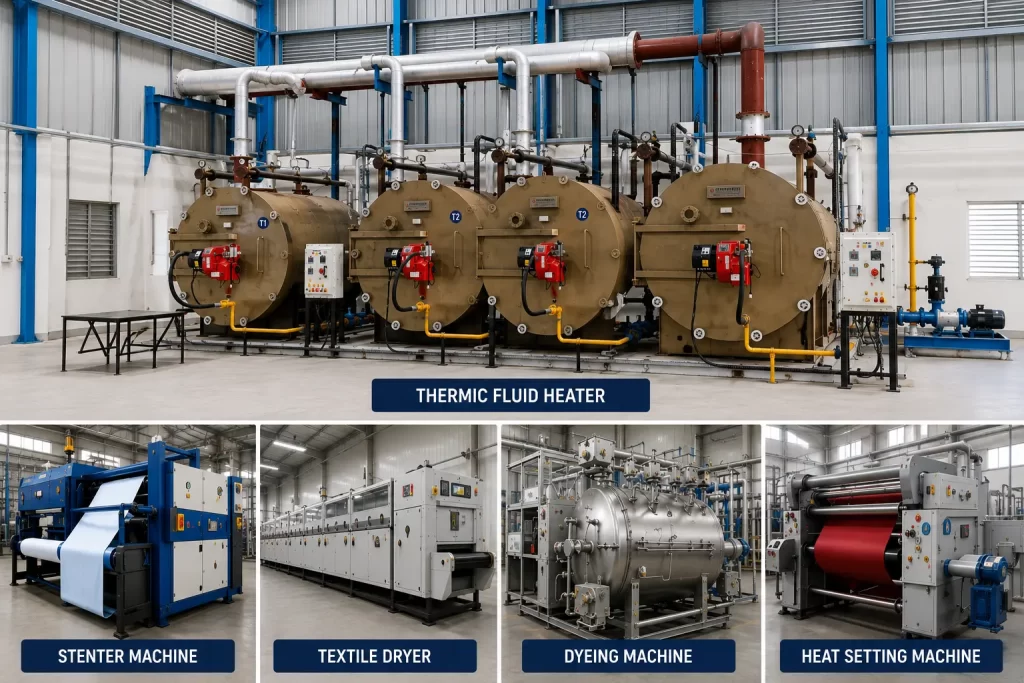
A single Thermic Fluid Heater for Textile Industry installation can simultaneously supply heat to a stenter, dryer, printing machine, calendar, and heat-setting machine — with each machine’s temperature independently controlled. For textile plants running several process lines side by side, this is a highly practical setup that simplifies the utility layout of the plant.
Fuel Flexibility
Modern Industrial Thermic Fluid Heater systems can run on a wide range of fuels, including natural gas, diesel, furnace oil (FO), light diesel oil (LDO), biomass, rice husk, agro-waste, and even solid fuels like coal in select designs. This lets textile manufacturers choose fuel based on local availability and cost rather than being locked into one option.
Safety: An Engineering Perspective
Steam boilers are safe, reliable equipment when properly designed, IBR-approved, and maintained — high-pressure steam systems operate across industries every day with strong safety records. A thermic fluid heater takes a different engineering approach: it operates at low pressure, which changes the nature of the safety considerations involved. Because thermal oil runs at high temperature, proper safety interlocks, an expansion tank, flow switches, and temperature protection remain essential to prevent oil leaks or overheating.
Why Your Thermic Fluid Heater is Consuming More Fuel — Causes & Solutions
Find out what is driving your heater’s fuel consumption and how to improve efficiency.
A Practical Example
Consider a textile mill running eight stenter machines, each needing a constant 220°C.
A steam-based approach would involve:
- 20–25+ bar pressure requirement
- Steam traps and a condensate network
- IBR-compliant high-pressure infrastructure
A Thermic Fluid Heater for Textile Industry approach would involve:
- 220°C thermal oil
- 1–3 bar pressure
- Continuous circulation
- Uniform heating across all eight machines
For this specific combination of high, sustained temperature and low pressure, many mills find the thermic fluid route more straightforward to design, install, and run.
Thermic Fluid Heater and Steam Boiler: A Side-by-Side View
Both technologies are established, reliable ways to generate industrial process heat, and the right choice depends on the application. For textile processes that need sustained high temperature at manageable pressure, the two systems compare as follows:
| Feature | Thermic Fluid System | Steam Boiler |
|---|---|---|
Operating Pressure |
Low pressure (0–3 bar typical) |
Higher pressure for high temperatures |
Heat Transfer |
Indirect, via thermal oil circulation |
Direct steam contact |
Water Treatment |
Not required for the heating circuit |
Standard RO/softening/dosing setup |
Startup Time |
Faster |
Slightly longer |
Best Suited For |
Textile dyeing, finishing, and similar temperature-sensitive processes |
General and high-volume steam demand |
This side-by-side view is why many textile mills evaluate a thermic fluid system as a practical boiler alternative for temperature-sensitive Industrial Process Heating needs — while steam boilers remain the preferred choice for many other industrial steam applications.
Choosing the Right Industrial Heating System
Selecting an Industrial Heating System for a textile facility depends on production capacity, the type of textile finishing process involved, and the required temperature range. Mills should evaluate heat exchanger design, thermal oil quality, and automation controls for temperature control before installation. A properly sized Textile Industry Heating System also reduces long-term maintenance costs and supports uninterrupted production.
Before finalizing a Thermic Fluid Heater for Textile Industry purchase, it also helps to consult the equipment manufacturer about coil design, insulation grade, and after-sales service support, since these factors influence performance more than headline specifications alone.
Engineer's Conclusion
Steam boilers remain excellent, proven equipment for a wide range of industrial applications. For textile processes specifically — where sustained high temperature, tight tolerance, and continuous operation matter most — a Thermic Fluid Heater for Textile Industry installation offers a well-matched fit because it:
- Delivers 250–350°C process heat at low pressure
- Provides highly uniform, precise temperature control for fabric processing
- Delivers heat without the phase-change behavior of steam
- Uses a comparatively simple set of components suited to continuous textile operations
- Supplies multiple process machines efficiently from a single heater
This combination — high temperature, low pressure, stable heat transfer, and precise process control — is why thermic fluid heating has become a strong choice specifically for textile manufacturing, even as steam boilers continue to serve many other industrial heating needs well.
FAQs related to Thermic Fluid Heater for Textile Industry
A Thermic Fluid Heater is a closed-loop heating system that circulates thermal oil to provide stable, high-temperature process heat. It is widely used in textile applications such as dyeing, drying, printing, stentering, heat setting, calendaring, coating, and finishing.
Thermic Fluid Heaters can deliver high temperatures at comparatively low operating pressure. This makes them suitable for textile processes that require continuous, uniform, and precise heat for long production cycles.
Depending on the system design and thermal fluid used, Thermic Fluid Heaters can typically provide process temperatures in the range of 250°C to 350°C, making them suitable for demanding textile heating applications.
Thermic Fluid Heaters can be used for dyeing, printing, drying, stentering, heat setting, calendaring, laminating, coating, and textile finishing. A single heater can also supply heat to multiple machines simultaneously.
It depends on the application. Steam boilers remain highly effective for processes requiring steam, while Thermic Fluid Heaters are particularly suitable when textile processes require sustained high temperatures at low pressure and precise temperature control.
Key advantages include high-temperature operation at low pressure, uniform heat transfer, precise temperature control, no condensate management in the heating circuit, reduced dependence on water treatment, and suitability for multiple textile machines.
No. Since a Thermic Fluid Heater uses thermal oil rather than water as the heat-transfer medium, the heating circuit does not require the conventional RO, softener, chemical dosing, and boiler-water treatment associated with steam boilers.
Yes. A properly designed system can supply thermal energy to multiple machines such as stenters, dryers, printing machines, calendars, and heat-setting machines, with individual temperature control at different process points.
Depending on the heater design, fuel options can include natural gas, diesel, furnace oil, LDO, biomass, rice husk, agro-waste, and selected solid fuels such as coal. This provides textile manufacturers with greater fuel flexibility.
Yes, when properly designed, installed, operated, and maintained. Although the system operates at low pressure, thermal oil operates at high temperatures, so safety features such as temperature protection, flow switches, safety interlocks, and an expansion tank are important.
Thermal oil provides stable and uniform heat transfer, which helps maintain consistent process temperatures. This is particularly valuable in applications such as dyeing and finishing, where small temperature variations can affect fabric quality and colour consistency.
Selection should consider the required operating temperature, total heat load, number of machines, fuel availability, process requirements, thermal oil characteristics, automation requirements, coil design, insulation, and after-sales service support. Proper sizing is essential for reliable and energy-efficient operation.