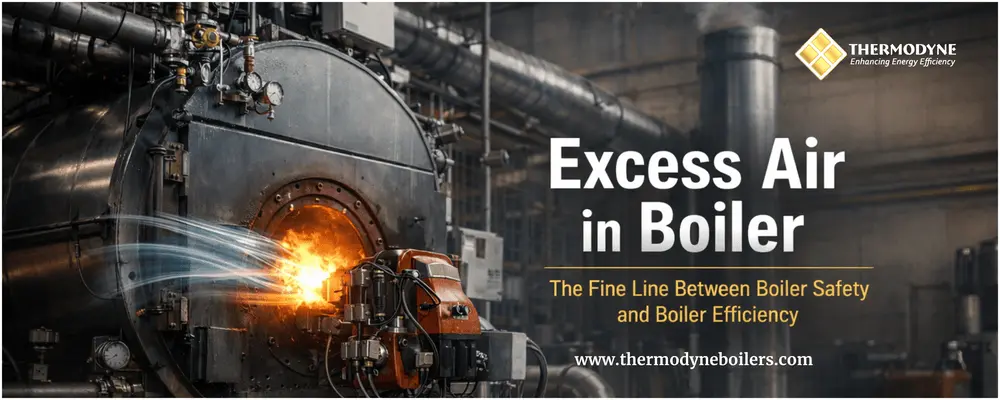
In every industrial boiler system, combustion is the most critical factor governing performance, reliability, and operating cost. Whether a facility operates a gas/oil/ coal or biomass based boiler the interaction between fuel and air inside the furnace determines how efficiently energy is converted into usable heat. Among all combustion parameters, excess air in boiler operation plays a decisive role.
While excess air is essential to ensure boiler safety and stable combustion, uncontrolled excess air leads to increased boiler heat loss, reduced boiler efficiency, and higher fuel consumption. The real challenge for every boiler user and operator is to maintain the optimum excess air level—balancing safety with performance.
Understanding Excess Air in Boiler Combustion
In theory, complete combustion occurs when fuel reacts with exactly the amount of oxygen required for full oxidation. However, in practical combustion in boiler systems, perfect fuel–air mixing is never achieved due to variations in fuel quality, burner design, operating load, and draft conditions.
To compensate for these variations, industrial boilers are supplied with additional air beyond the theoretical requirement. This additional air is known as excess air in boiler combustion. Proper excess air ensures complete fuel burning, minimizes unburnt carbon, and reduces soot formation on heat transfer surfaces.
Without adequate excess air, steam boiler systems—especially coal fired boilers, wood fired boiler, briquette boiler, and biomass-fired boilers—face unstable flames and incomplete combustion.
Role of Excess Air in Boiler Safety
Maintaining boiler safety is the primary reason excess air is introduced into the furnace. Insufficient air supply results in incomplete combustion, excessive carbon monoxide formation, flame instability, and increased explosion risk.
In solid-fuel systems such as coal fired boiler, wood boiler, and biomass boiler, fuel moisture and size variation make excess air even more critical. Similarly, gas fired boiler and oil fired boiler systems require precise air control to ensure stable flames during load fluctuations.
Adequate excess air ensures:
- Complete oxidation of fuel
- Stable and safe combustion
- Reduced CO formation
- Reliable operation of industrial steam boiler systems
For this reason, most boiler companies design systems with a safety margin for excess air—though this margin must be carefully controlled.
How Excess Air Impacts Boiler Efficiency
While excess air supports safety, excessive excess air directly reduces boiler efficiency. Every extra unit of air entering the furnace absorbs heat and exits through the chimney as hot flue gas, contributing to boiler heat loss.
High excess air causes:
- Increased stack temperature losses
- Reduced flame temperature
- Higher fuel consumption
- Increased fan power consumption
Even a small increase in excess air in boiler operation can reduce overall efficiency by 1–2%. In continuously operating steam boiler systems, this loss translates into significant recurring fuel costs.
Typical Excess Air Levels for Different Boiler Types
Different fuels demand different excess air levels due to combustion behavior:
- Gas Gas fired boiler: 5–15%
- Oil fired boiler: 10–20%
- Coal fired boiler: 20–40%
- Biomass boiler / Wood fired boiler / Briquette boiler: 30–60%
Measuring Excess Air in Boiler Systems
Traditional visual methods such as flame color or smoke observation are no longer sufficient for modern industrial boiler operations. Accurate control of excess air in boiler systems requires flue gas analysis.
Key measurements include:
- Oxygen (O₂) concentration
- Carbon monoxide (CO) levels
- Stack temperature
Typical optimal oxygen levels in flue gas:
- Gas fired boiler: 2–3% O₂
- Oil fired boiler: 3–5% O₂
- Coal boiler and biomass-fired boilers: 6–10% O₂
These ranges ensure safe combustion in boiler systems while minimizing heat loss.
Optimizing Excess Air in Industrial Boilers
Efficient excess air control depends on proper burner design, regular maintenance, and advanced combustion control systems. Worn burners or misaligned air registers force operators to increase excess air unnecessarily.
Modern boiler companies integrate:
- Automatic fuel–air ratio control
- VFD-controlled FD and ID fans
- Oxygen trim systems
These technologies allow industrial boiler systems to operate safely at the lowest possible excess air level while maintaining stable steam output.
Conclusion: Why Excess Air in Boiler Matters
Excess air in boiler operation may seem like a small parameter, but its impact on efficiency, fuel cost, emissions is enormous. In an era of rising energy costs and stricter environmental norms, optimizing excess air is essential for every boiler, whether gas, oil, coal, biomass, or electric.
By controlling excess air effectively, industries achieve higher boiler efficiency, improved reliability, and long-term operational savings. In the boiler room, efficiency is engineered—and excess air control is one of the most powerful tools to achieve it.