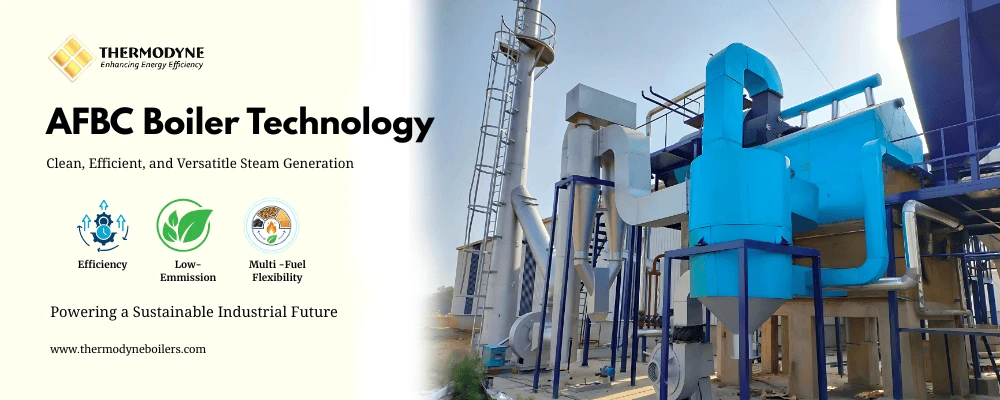
In modern industrial power and process heating systems, energy efficiency and emission control have become critical goals. Among all combustion technologies, the AFBC boiler — short for Atmospheric Fluidized Bed Combustion boiler — has emerged as a leading innovation in efficient steam generation.
This technology not only ensures superior combustion and fuel flexibility but also helps industries reduce operational costs and comply with environmental standards. In this blog, we will explore the mechanism, working, and advantages of the AFBC boiler, along with its industrial significance.
What is an AFBC Boiler?
An AFBC boiler is a type of fluidized bed boiler (FBC boiler) where combustion occurs at atmospheric pressure. In this system, solid fuel particles — such as coal, lignite, or biomass — are suspended in an upward flow of air. This creates a fluid-like bed of fuel and sand, allowing complete and uniform combustion.
The concept of a fluidized bed ensures:
- Uniform temperature distribution within the bed
- Enhanced heat transfer
- Complete combustion of fuel
Compared to a conventional industrial steam boiler, the AFBC boiler operates at lower combustion temperatures, typically between 800°C and 900°C, thereby minimizing nitrogen oxide (NOx) formation and reducing ash-related issues.
This makes it an ideal steam boiler for industries such as food processing, rice mills, textiles, and chemicals where continuous, efficient, and clean steam supply is essential.
Understanding FBC Boiler Technology
The FBC boiler (Fluidized Bed Combustion boiler) represents a family of technologies, including:
- AFBC (Atmospheric Fluidized Bed Combustion): Combustion takes place at atmospheric pressure with fuel particles suspended in an air-fluidized bed for efficient and uniform burning.
- CFBC (Circulating Fluidized Bed Combustion): Hot bed materials and gases circulate between the furnace and cyclone separator, ensuring complete fuel combustion and higher efficiency.
- PFBC (Pressurized Fluidized Bed Combustion): Combustion occurs under high pressure, allowing the flue gases to drive a gas turbine for combined-cycle power generation with improved efficiency.
Mechanism of AFBC Boiler
The mechanism of an AFBC boiler is built upon the fundamental principle of fluidization. When air is passed upward through a bed of solid particles at a velocity higher than the minimum fluidization velocity, the particles are suspended, forming a fluidized bed.
Step-by-Step Mechanism:
- Formation of Fluidized Bed : A bed of inert material (like silica sand) is placed on a perforated distributor plate. Air is forced upward through this plate to suspend the particles, forming a turbulent, fluid-like bed.
- Fuel Injection : Crushed fuel (coal, lignite, or rice husk) is fed into the furnace bed using screw feeders or pneumatic feeding systems.
- Mixing and Combustion : In the fluidized state, fuel particles mix uniformly with air and bed material, ensuring even temperature (800–900°C) and complete combustion.
- Heat Generation and Transfer : The heat produced during combustion is absorbed by water tubes surrounding the bed, converting water into high-pressure steam.
- Flue Gas Treatment : Flue gases carrying ash particles are passed through a cyclone separator or multicyclone, which recirculates unburnt particles for complete combustion.
- Ash Removal : The heavier ash particles settle at the bottom and are discharged through an ash extraction system. Fly ash is collected from the economizer, air preheater, and ESP (Electrostatic Precipitator).
Key Features of AFBC Boiler Mechanism
| Features | Description |
|---|---|
Combustion Type |
Atmospheric Fluidized Bed Combustion |
Fuel Type |
Coal, lignite, rice husk, bagasse, wood chips, and agro waste |
Bed Material |
Sand or inert ash |
Temperature Range |
800°C – 900°C |
Air Supply |
Primary and Secondary air through distributor nozzles |
Emission Control |
Low NOx and SOx with limestone addition |
Working of AFBC Boiler
The working of an AFBC boiler involves a continuous process of controlled combustion, heat transfer, and flue gas cleaning — designed to achieve high efficiency with minimal emissions.
1- Fuel and Air Feeding
- Fuel is crushed to the desired particle size (below 6 mm).
- Primary air from the FD fan passes through the air distributor plate to fluidize the bed.
- Secondary air is supplied above the bed to complete combustion and control flame temperature.
2- Fluidization Process
The air velocity is maintained between 1.2 to 3.5 m/s, ensuring suspension of fuel and sand particles in a uniform fluidized state. This results in:
- Better air-fuel contact
- Even temperature distribution
- High heat transfer rates
- Reduced clinker formation
3- Combustion Reaction
Combustion occurs under atmospheric conditions according to the basic reaction:
C+O2→CO2+Heat
The released heat is transferred to water in the surrounding boiler tubes, converting it into saturated or superheated steam, depending on the design.
4- Heat Recovery and Steam Generation
Generated heat passes through water-wall tubes, superheater, and economizer to ensure maximum energy recovery before gases exit through the chimney.
Typical AFBC boiler efficiency ranges from 85% to 90%, which is significantly higher than conventional industrial steam boilers.
5- Flue Gas Cleaning
The flue gas passes through:
- Cyclone separator for ash separation
- Economizer for feedwater preheating
- Air preheater for combustion air warming
- ESP (Electrostatic Precipitator) for particulate removal
This ensures clean emissions and adherence to pollution norms.
6- Ash Handling and Disposal
- Bed ash: Removed mechanically from the furnace bottom.
- Fly ash: Captured using bag filters or ESPs.
Collected ash can be reused in cement, brick, and construction applications, promoting circular waste utilization.
Technical Advantages of AFBC Boiler Technology
- High Combustion Efficiency : Efficient turbulence and mixing ensure complete combustion, even for low-grade fuels with high ash content.
- Lower Emissions : The combustion temperature below 900°C reduces NOx formation. Adding limestone to the bed captures SOx, ensuring eco-friendly operation.
- Compact Design with High Heat Transfer : The intense mixing results in fast and uniform heat transfer, allowing compact boiler design and lower space requirements.
- Easy Operation and Maintenance : AFBC boilers feature modular components for easy start-up, faster load response, and simplified maintenance.
- Reduced Slagging and Fouling : Controlled bed temperature prevents ash fusion and tube damage, enhancing the life of the steam boiler.
Applications of AFBC Boiler in Industries
AFBC boilers are versatile and widely used in various industries due to their adaptability and reliability:
- Rice Mills: Utilize rice husk waste for low-cost steam generation.
- Plywood and Furniture Industry: Burns wood waste efficiently for drying and pressing operations.
- Chemical and Textile Plants: Provides continuous and stable process steam.
- Food Processing and Dairy: Ensures reliable and hygienic steam for processing and sterilization.
- Pharmaceutical and Paper Industry: Supplies consistent steam for precision operations and drying.
Thermodyne Boilers’ AFBC Solutions – COMBITHERM Series
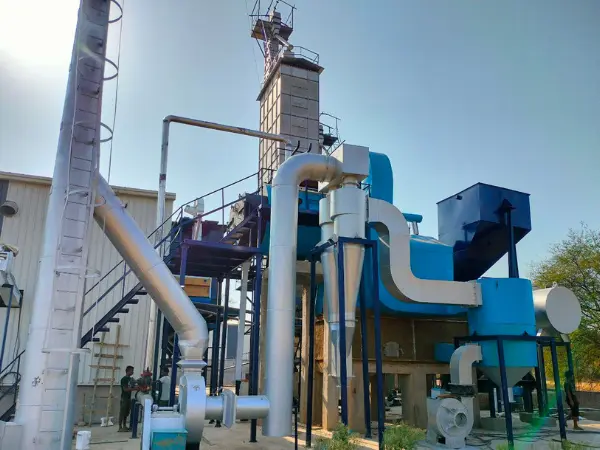
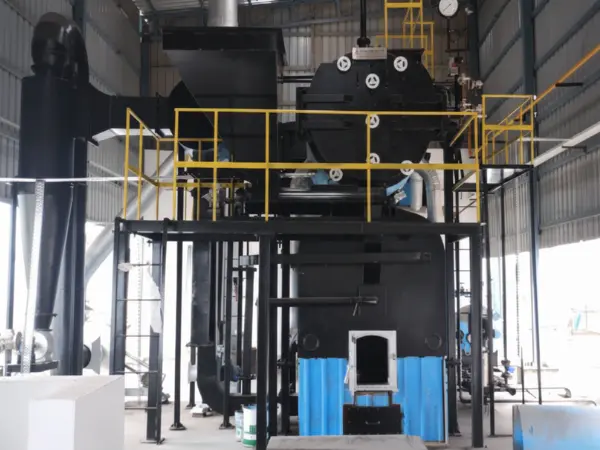
Thermodyne Engineering Systems, one of India’s most trusted industrial steam boiler manufacturers, offers advanced AFBC technology through its COMBITHERM and COMBITHERM ULTRA series.
Salient Features of Thermodyne’s AFBC Boilers:
- IBR-certified design ensuring safety and reliability
- Optimized combustion chamber for higher efficiency
- Multi-fuel operation with smooth load variation
- Superior insulation to minimize heat losses
- Easy installation and maintenance
- Proven operational success across diverse industries
With more than two decades of engineering excellence, Thermodyne’s AFBC boilers have powered numerous industries with energy-efficient, environment-friendly, and cost-saving steam generation solutions.
Environmental and Economic Impact
By adopting AFBC technology, industries can achieve:
- 15–25% reduction in fuel consumption
- Lower carbon and particulate emissions
- Utilization of industrial and agricultural waste fuels
- Long-term operational savings and sustainability
The AFBC boiler thus represents a key step toward cleaner industrial energy and responsible manufacturing.
Conclusion
The AFBC boiler is a remarkable innovation in the field of industrial combustion and steam generation. Combining energy efficiency, multi-fuel flexibility, and eco-friendly operation, it stands out as a dependable solution for modern manufacturing facilities.
By integrating Atmospheric Fluidized Bed Combustion (AFBC) technology with robust engineering, Thermodyne Boilers continues to deliver high-performance industrial steam boilers that help industries save energy, cut fuel costs, and reduce emissions — contributing to a sustainable industrial future.
FAQs on AFBC Boiler and Fluidized Bed Combustion Technology
An AFBC boiler is an Atmospheric Fluidized Bed Combustion boiler designed to burn solid fuels in a fluidized state at atmospheric pressure. It offers efficient combustion, uniform heat transfer, and the ability to use low-grade fuels such as coal, lignite, rice husk, and biomass. Its lower operating temperature (800–900°C) also reduces NOx and SOx emissions.
The afbc boiler full form is Atmospheric Fluidized Bed Combustion boiler. It operates at atmospheric pressure and uses a fluidized bed of sand and fuel to ensure efficient and uniform combustion in industrial steam generation applications.
A fluidized bed boiler is a combustion system where solid fuel particles are suspended in an upward flow of air, creating a fluid-like bed. This process enhances heat transfer, ensures complete fuel burning, reduces emissions, and allows the use of low-grade fuels such as biomass, lignite, and coal.
A cfbc boiler is a Circulating Fluidized Bed Combustion boiler, where bed material and fuel particles circulate continuously at high velocity. This enhances mixing, improves carbon burnout, lowers emissions, and allows efficient use of high-ash and low-calorific value fuels.
Key benefits include:
High combustion efficiency
Reduced NOx and SOx emissions
Ability to burn low-grade fuels
Lower operating temperature
Minimal clinker formation
Compact design and easy maintenance
Stable steam output for continuous industrial operations
AFBC boilers operate at lower combustion temperatures, which reduces:
NOx emissions due to suppressed thermal formation
SOx emissions when limestone is added
Additionally, ESPs and bag filters ensure low particulate discharge.
Most modern AFBC boilers achieve 85%–90% efficiency, depending on fuel quality, bed temperature control, and heat recovery system design.
AFBC boilers generate two types of ash:
Bed Ash: Discharged from the furnace bottom.
Fly Ash: Captured using multicyclones, bag filters, or ESPs.
The ash can be reused in construction materials, promoting environmental sustainability.