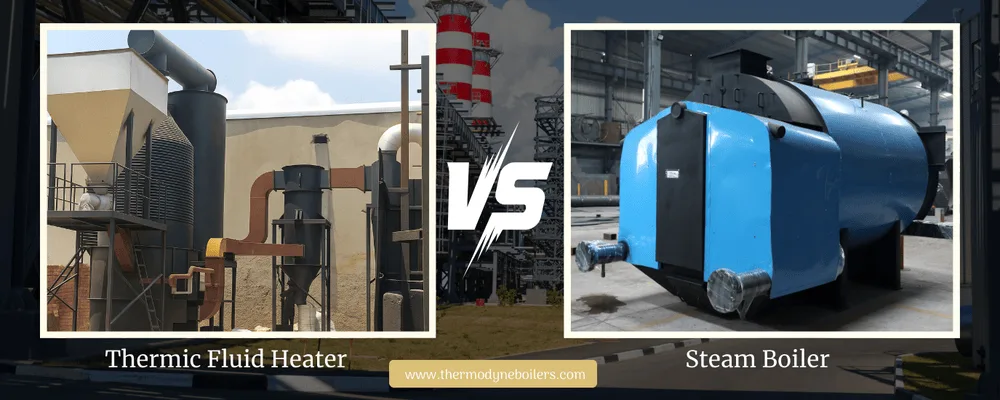
In today’s competitive industrial landscape, reliable and efficient heating systems are the foundation of productivity. From chemicals to textiles, plywood, food processing, and pharmaceuticals—industries rely on advanced heating technologies to ensure quality, consistency, and cost savings. Among the most widely used systems are the Thermic Fluid Heater and the Industrial Steam Boiler.
Both solutions Thermic Fluid Heater & Steam Boiler serve the purpose of heat generation, but they differ in design, operation, safety, and application. This article explores the differences between them and helps industries decide which system best suits their needs.
What is a Thermic Fluid Heater?
A Thermic Fluid Heater (TFH), also known as a thermal oil heater, is an industrial heating system that uses heat transfer oil instead of water or steam. The thermic fluid is heated inside the heater and then circulated to the process equipment where heat is required.
Unlike boilers, a TFH operates without high pressure, offering industries a safe, reliable, and energy-efficient way to achieve high temperatures up to 300°C.
Common Applications of Thermic Fluid Heaters:
- Plywood and laminate industries for press heating
- Textile stenter machines and dryers
- Food processing units for frying, baking, and packaging
- Chemical and pharmaceutical reactors and dryers
What is an Industrial Steam Boiler?
An Industrial Steam Boiler is a traditional heating system that converts water into steam using fuel such as coal, oil, gas, or electricity. The generated steam is then distributed for direct or indirect heating processes.
Typical Applications of Industrial Steam Boilers:
- Rice mills for parboiling and drying
- Food processing plants for cooking and sterilization
- Textile plants for dyeing and finishing
- Hospitals and pharma units for sterilized operations
- Power generation through steam turbines
| Parameter | Thermic Fluid Heater | Industrial Steam Boiler |
|---|---|---|
Heating Medium |
Thermic oil (synthetic or mineral) |
Water / Steam |
Operating Temperature |
Up to 300°C depending on thermal oil |
Up to 250°C (higher temp requires high pressure) |
Operating Pressure |
Atmospheric / Low Pressure |
10 – 100 bar (depending on application) |
Efficiency Range |
80 ± 2% (with heat recovery options) |
Gas & Oil Fired Boiler Up to 90% & Solid Fuel Fired Boiler Up to 85% , Electric Fired Boiler 98% |
Fuel Options |
Solid (coal, biomass, briquettes), liquid (oil), gas |
Solid, liquid, gas, electricity |
Startup Time |
2-3 hours depending on capacity and temperature required |
Moderate to long (30–60 minutes) |
Heat Transfer Method |
Indirect via circulation of thermic oil |
Direct via steam generation |
Applications |
Continuous process heating, dryers, textile stenters, plywood presses, chemical reactors |
Sterilization, parboiling (rice mills), food processing, pharma, power generation |
Maintenance Needs |
Low (no scaling/corrosion, no blowdown) |
High (needs blowdown, water treatment, descaling) |
Safety |
Very safe (no high-pressure risks) |
Requires strict monitoring (risk of high-pressure accidents) |
Service Life of Medium |
Thermic oil lasts 3–5 years (depends on quality & maintenance) |
Boiler water requires continuous treatment |
Which Heating System Should You Choose?
The choice between a Thermic Fluid Heater and an Industrial Steam Boiler depends on your industry’s requirements:
- Opt for a Thermic Fluid Heater if you need continuous heating, higher temperatures, lower maintenance, and safety without pressure risks—best for plywood, textile, chemical, and food processing industries.
- Opt for an Industrial Steam Boiler if your process demands steam for sterilization, power generation, or direct heating—ideal for rice mills, pharma, hospitals, and large food processing plants.
Conclusion
Both the Thermic Fluid Heater and the Industrial Steam Boiler are indispensable in industrial heating, but their applications differ. A Thermic Fluid Heater offers unmatched safety, efficiency, and high-temperature performance for continuous processes, while an Industrial Steam Boiler remains the preferred choice where steam itself is required.
By evaluating the unique advantages of each system, industries can select the right heating solution, optimize energy consumption, and improve long-term operational efficiency.