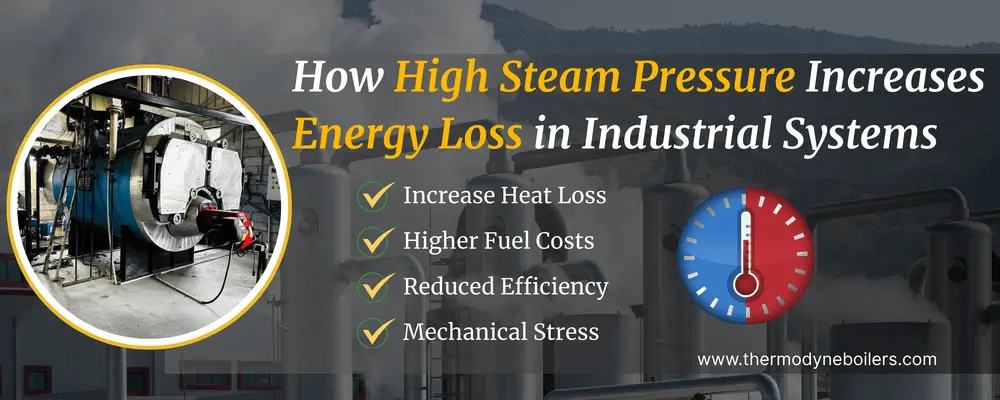
In industrial operations, improving boiler efficiency is always a priority. Most discussions focus on fuel type, burner design, or installing a waste heat recovery system. However, one critical and often overlooked factor affecting boiler efficiency is high steam pressure.
While elevated pressure may appear to enhance output, in many industrial steam boiler applications it actually increases boiler heat loss, reduces steam system efficiency, and drives higher fuel consumption.
For industrial operations that depend on continuous and reliable steam generation, understanding how high steam pressure influences boiler efficiency is critical for achieving sustainable performance and long-term cost optimization. Excess pressure not only increases energy losses but also affects overall system stability, fuel consumption, and operational reliability. Strategic pressure management therefore becomes essential for improving efficiency and maintaining competitive operational standards.
Understanding Boiler Efficiency in an Industrial Steam Boiler
Boiler efficiency represents the percentage of fuel energy converted into usable steam energy inside an industrial steam boiler.
An optimized system minimizes losses through:
- Flue gases
- Radiation
- Blowdown
- Condensate discharge
- Steam leakage
Operating pressure plays a major role in determining overall steam system efficiency and directly influences boiler heat loss.
Why people often choose a much higher pressure boiler than their process requirement
Many industries select a higher pressure industrial steam boiler as a precaution for future expansion, load fluctuations, or to create an operational safety margin. There is also a common misconception that higher pressure automatically improves performance and productivity.However, when actual process demand is lower, operating at unnecessary high steam pressure increases boiler heat loss, stack losses, blowdown losses, and throttling losses. Instead of improving boiler efficiency, it often reduces steam system efficiency and increases fuel consumption.
Accurate pressure selection, aligned with real process requirements, is essential to maintain optimal boiler efficiency and sustainable operating costs.
How High Steam Pressure Affects Boiler Efficiency
Steam pressure and temperature are directly proportional. When high steam pressure is maintained, saturation temperature rises significantly. This creates several performance challenges inside an industrial steam boiler system.
1- Increased Radiation and Convection Losses
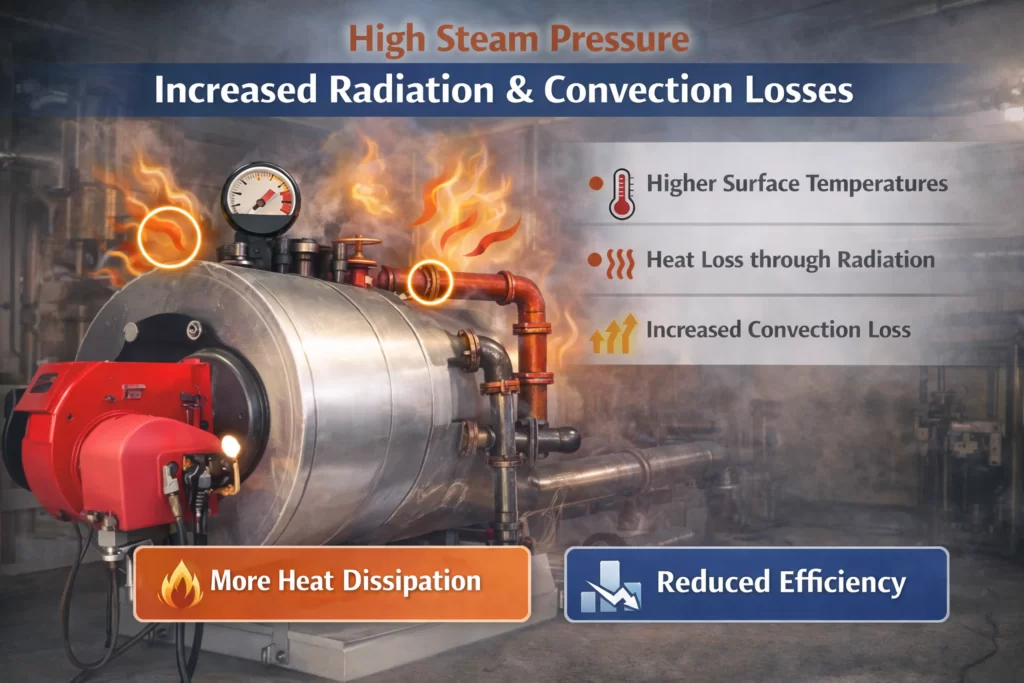
When operating at high steam pressure, surface temperatures of the boiler and piping increase.
This leads to higher heat dissipation from:
- Boiler shell
- Steam headers
- Distribution pipelines
- Valves and fittings
As the temperature difference between steam and ambient air increases, boiler heat loss through radiation and convection rises. Over extended steam networks, this gradually reduces overall boiler efficiency and negatively impacts steam system efficiency.
2- Higher Stack Temperature and Flue Gas Loss
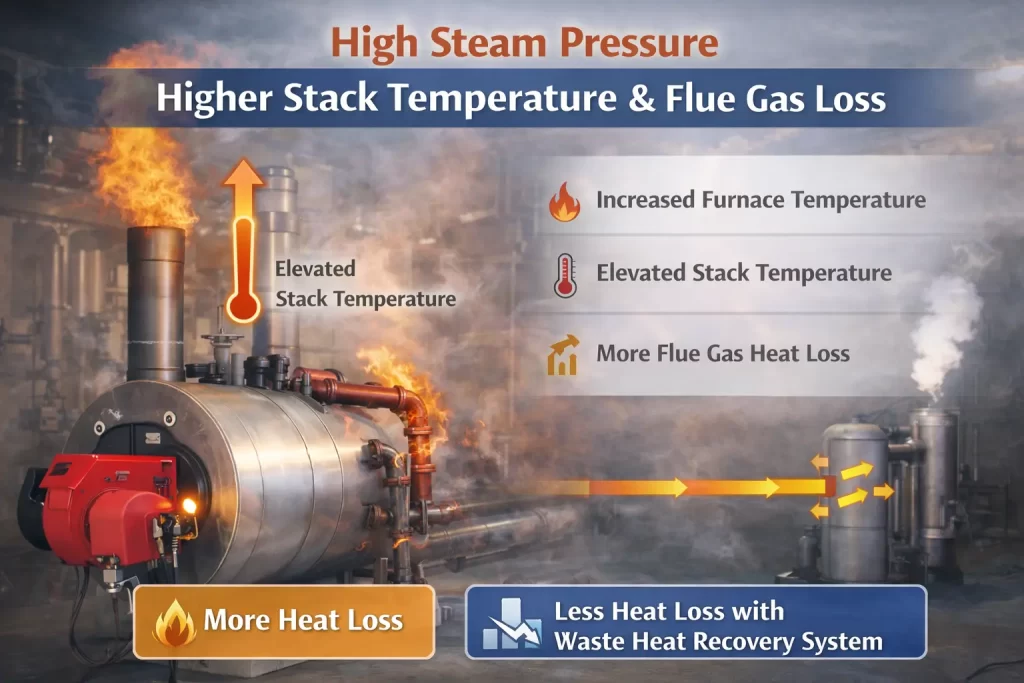
Generating high steam pressure requires greater combustion intensity. This typically results in:
- Higher furnace temperature
- Elevated stack temperature
- Increased flue gas heat loss
When stack temperature increases, fuel energy escapes through the chimney, lowering boiler efficiency.
Installing a properly designed waste heat recovery system significantly improves boiler efficiency by capturing residual flue gas heat and converting it into usable energy.
A waste heat recovery system not only reduces stack losses but also enhances overall steam system efficiency in high-load industrial operations.
3- Reduction in Useful Latent Heat
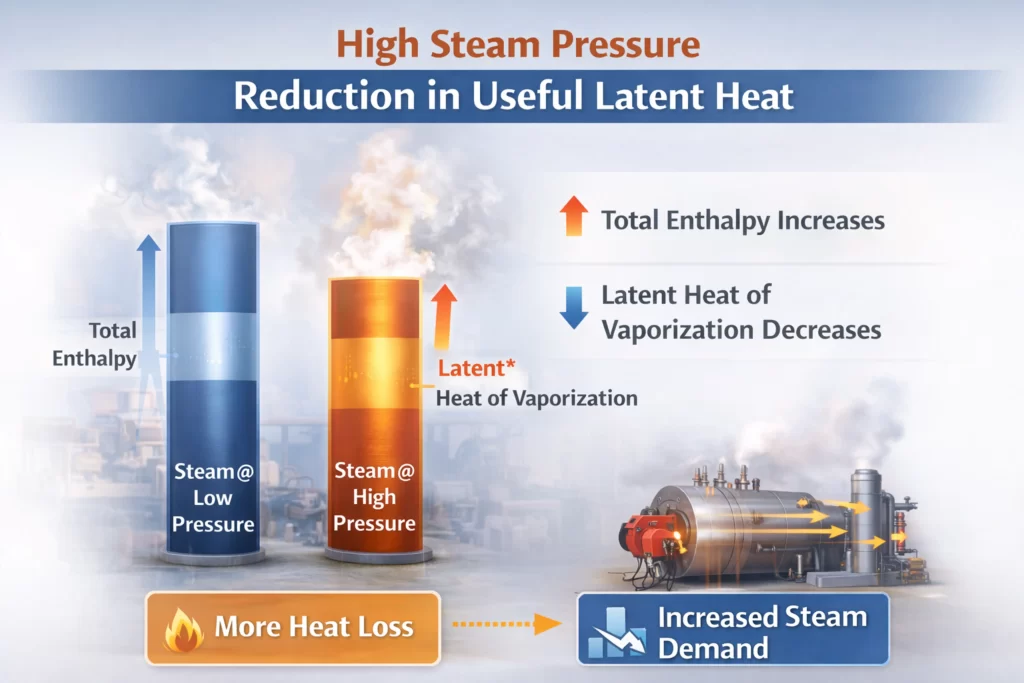
As pressure rises, steam properties change:
- Total enthalpy increases
- Latent heat of vaporization decreases
This means that at high steam pressure, each kilogram of steam carries slightly less usable heat for process heating.
Industries that rely on steam for drying, cooking, sterilization, or heating experience reduced thermal utilization, which ultimately lowers boiler efficiency and increases steam demand from the industrial steam boiler.
High Steam Pressure and Blowdown Losses
Boiler blowdown is essential to maintain water quality. However, it represents direct energy loss.
At high steam pressure:
- Boiler water temperature is higher
- Blowdown water contains more stored energy
- Thermal loss per cycle increases
In continuous process industries, these repeated losses significantly reduce boiler efficiency and weaken steam system efficiency.
Throttling Losses and Their Impact on Boiler Efficiency
Many facilities generate steam at high steam pressure but use it at lower pressure levels.
Pressure reducing valves (PRVs) are used to drop the pressure, but this causes:
- Flash steam formation
- Dissipation of pressure energy
- No recovery of useful work
This pressure mismatch increases boiler heat loss and decreases overall boiler efficiency in the system.
Distribution Losses in an Industrial Steam Boiler Network
In large industrial facilities, steam travels long distances before reaching process equipment.
When operating at high steam pressure, distribution losses increase due to:
- Higher pipe surface temperature
- Increased insulation stress
- Greater condensation
Even properly insulated pipelines lose more heat at elevated temperatures, reducing both steam system efficiency and overall boiler efficiency.
Modern coil-type systems like Revosteam help optimize pressure control and minimize standby losses, supporting improved boiler efficiency in compact installations.
High-capacity water tube systems such as Powertherm are engineered for genuine high-pressure applications, but optimal pressure selection remains essential to maintain strong boiler efficiency.
Mechanical Stress and Its Effect on Boiler Efficiency
Operating at unnecessary high steam pressure increases:
- Mechanical stress on boiler components
- Valve and gasket wear
- Steam trap failures
- Safety valve lifting frequency
Frequent leakage and maintenance issues contribute to additional boiler heat loss, ultimately lowering boiler efficiency.
When Is High Steam Pressure Justified?
Certain applications genuinely require high steam pressure, including:
- Power generation turbines
- Back-pressure turbine systems
- High-temperature chemical reactions
However, for most process heating applications, optimizing pressure to match demand results in better steam system efficiency and improved boiler efficiency.
Practical Strategies to Improve Boiler Efficiency
To reduce boiler heat loss caused by excessive high steam pressure, industries should:
1- Align Operating Pressure with Process Demand
Maintaining appropriate pressure directly improves boiler efficiency.
2- Install a Waste Heat Recovery System
A properly designed waste heat recovery system enhances both steam system efficiency and boiler efficiency.
3- Optimize Blowdown Control
Reducing high-enthalpy water discharge supports better boiler efficiency.
4- Improve Insulation Standards
Minimizing radiation loss reduces boiler heat loss and improves overall performance.
5- Conduct Steam Energy Audits
Regular audits identify pressure mismatches affecting boiler efficiency.
Financial Impact on Boiler Efficiency
Even a 2–3% reduction in boiler efficiency due to prolonged high steam pressure can result in:
- Significant annual fuel cost increase
- Higher carbon emissions
- Increased maintenance expenditure
- Reduced operational profitability
For energy-intensive industries, optimizing pressure conditions is one of the most effective methods to improve boiler efficiency and strengthen steam system efficiency.
Conclusion: The Right Pressure Protects Boiler Efficiency
Higher pressure does not automatically mean higher performance. In many industrial steam boiler systems, excessive high steam pressure increases boiler heat loss, reduces steam system efficiency, and lowers overall boiler efficiency. True boiler efficiency is achieved not by operating at maximum pressure, but by operating at the correct pressure. Sustainable industrial growth depends on intelligent pressure management, integration of a waste heat recovery system, and continuous optimization of the industrial steam boiler system.Efficient steam generation is not about excess pressure. It is about protecting and maximizing boiler efficiency through precision engineering and strategic energy management.